

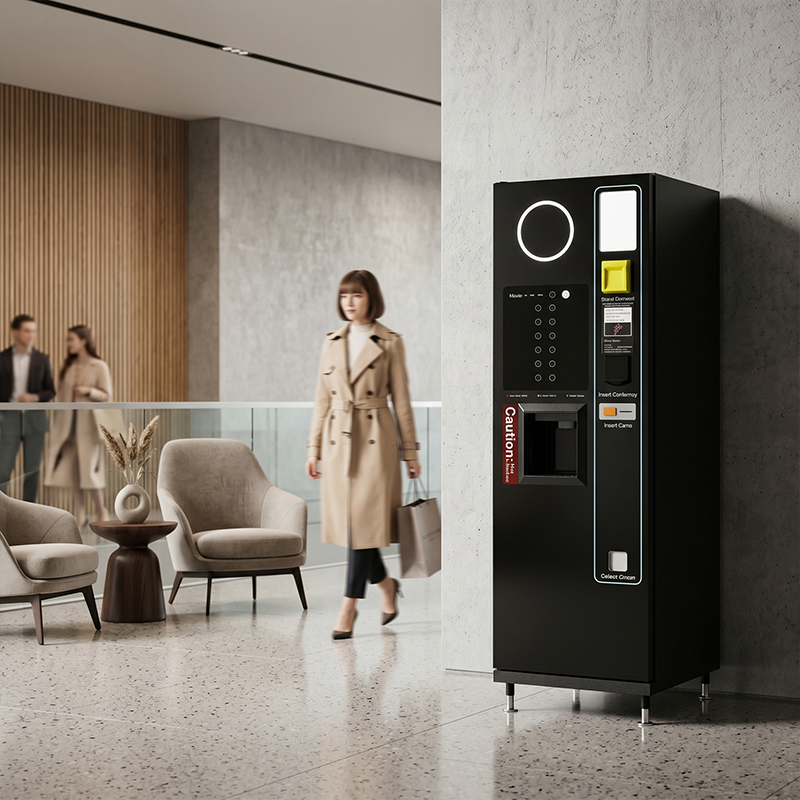
 A coffee vending machine exporter supports international OEM programs by combining equipment manufacturing with customization, software integration, documentation, logistics, installation guidance, and after-sales coordination. The strongest partner can adapt an OEM coffee vending machine to local languages, payment systems, menus, electrical conditions, cleaning routines, and operating models while maintaining consistent production and remote service processes.
- International OEM delivery requires more than a customized machine enclosure.
- Menu, payment, language, connectivity, and compliance requirements should be defined before production.
- IoT monitoring helps overseas operators manage inventory, faults, cleaning, and service events remotely.
- A staged validation process reduces integration risk before commercial deployment.
- Hardware, software, spare parts, documentation, and training should be planned as one program.
For an international OEM coffee vending machine program, the exporter must connect product engineering, local market adaptation, software, logistics, and support. PCI DSS provides a recognized framework for protecting payment card data, while NIST Cybersecurity Framework 2.0 organizes cybersecurity risk management around Govern, Identify, Protect, Detect, Respond, and Recover. These references show why an export project should be planned as a connected operating system rather than a simple machine purchase.
What Does a Coffee Vending Machine Exporter Actually Deliver?
The main value of a coffee vending machine exporter is coordinated execution across the complete equipment lifecycle. An OEM buyer may need a machine that looks like its own brand, prepares a defined beverage menu, accepts local payments, reports operating data, and can be maintained by a regional service team. Each requirement affects more than one component.
A serious OEM program normally covers the following delivery layers:
- Mechanical platform: cabinet design, brewing system, grinders or soluble ingredient modules, refrigeration where required, dispensing area, and service access.
- Software layer: user interface, recipes, pricing, product availability, alerts, permissions, and remote configuration.
- Market adaptation: language, currency display, payment method, electrical configuration, labeling, packaging, and local operating procedures.
- Commercial operations: installation, replenishment, cleaning, spare parts, technician training, warranty handling, and performance reporting.
The exporter should therefore be evaluated as a program partner, not only as a factory. A machine may pass a factory inspection and still fail commercially if the payment gateway, network connection, ingredient supply, or maintenance process is not ready in the target country.
How Is an OEM Coffee Vending Machine Adapted for Different Markets?
Market adaptation begins with a documented configuration brief that separates universal requirements from country-specific requirements. This prevents late changes from affecting electrical design, software architecture, procurement, and testing.
| OEM workstream | Typical decisions | Planning sequence | Primary owner |
|---|---|---|---|
| Brand and interface | Logo placement, colors, screen language, tone of voice, and customer instructions | 1 | Brand and product teams |
| Beverage program | Recipes, cup sizes, ingredients, allergen notices, and cleaning frequency | 2 | Operations and coffee teams |
| Payment and pricing | Cashless payment, QR payment, card acceptance, currency, tax display, and refunds | 3 | Commercial and technology teams |
| Connectivity | SIM or Wi-Fi strategy, cloud access, device identity, alerts, and data permissions | 4 | IT and service teams |
| Deployment | Site preparation, delivery route, installation, training, replenishment, and escalation | 5 | Local operating partner |
The sequence above is a practical project framework rather than a universal regulatory checklist. The earlier choices influence later engineering decisions. For example, a larger beverage menu can change ingredient storage, cleaning procedures, user-interface design, and replenishment planning.
Payment integration deserves separate technical review. The exporter should clarify whether the machine connects directly to a payment provider, communicates through a payment terminal, or uses a local integrator. The parties should also define transaction status, timeout behavior, refunds, offline operation, reconciliation, and responsibility for payment data. PCI Security Standards Council resources on PCI DSS provide the relevant industry reference for payment card data security.
Why IoT and Remote Management Matter in International OEM Programs
Remote visibility is especially valuable when machines operate across borders because service teams cannot inspect every location frequently. A connected system can turn an equipment problem into a managed work order before the operator receives a customer complaint.
Useful remote-management functions include machine online status, error codes, ingredient levels, sales records, temperature or refrigeration alerts where relevant, cleaning reminders, recipe updates, price changes, and technician notes. The exact feature set should reflect the business model and local data requirements rather than being added only for marketing purposes.
Cybersecurity should be designed into the deployment model. NIST describes the Cybersecurity Framework 2.0 as a resource for organizations of different sizes and sectors; its official overview is available from NIST. For an OEM vending program, practical controls may include unique device identities, role-based access, protected communication, software update procedures, audit records, backup processes, and a clear incident escalation path.
| Remote function | Operational question answered | Recommended review cadence | Business effect |
|---|---|---|---|
| Fault alerts | Which machine needs attention and why? | Continuous monitoring | Faster triage and fewer avoidable visits |
| Inventory visibility | Which ingredients or cups require replenishment? | Daily operational review | Better route planning |
| Sales reporting | Which locations and products are performing? | Weekly commercial review | More informed assortment decisions |
| Configuration control | Which recipe, price, or interface version is active? | At every approved change | Improved deployment consistency |
| Service history | What was repaired, replaced, or cleaned? | After every service event | Stronger warranty and maintenance records |
The cadence in this table is an operating recommendation, not a claim about universal machine performance. Each operator should adjust it according to foot traffic, product perishability, service coverage, and contractual obligations.
 How Should Buyers Validate a Vending Machine Manufacturer?
A manufacturer should be assessed through evidence that connects engineering capability with repeatable delivery. Product photographs and a factory profile are useful, but they do not prove that an exporter can support a multi-country OEM rollout.
- Review the platform: confirm the beverage technology, ingredient format, dispensing method, service access, cleaning design, and site requirements.
- Review customization boundaries: identify which changes are standard configuration, which require engineering, and which are not supported.
- Review software ownership: clarify cloud access, application programming interface availability, data export, user permissions, hosting responsibilities, and update control.
- Review supply continuity: ask about critical parts, consumables, packaging, replacement lead times, and regional service inventory.
- Review documentation: request installation instructions, cleaning procedures, troubleshooting guides, electrical information, and spare-parts identification.
- Review pilot readiness: define acceptance criteria before approving a commercial batch.
The best questions are measurable and scenario-based. Instead of asking whether the machine is easy to maintain, ask who performs daily cleaning, which components require scheduled attention, how faults are reported, and what evidence closes a service ticket.
What Should an International OEM Pilot Include?
A pilot should test the complete customer and operator journey, not merely whether coffee is dispensed. The machine should be evaluated in a representative location with the intended network, payment method, ingredients, cups, branding, and service process.
Acceptance testing should cover startup, menu navigation, recipe consistency, payment outcomes, refund handling, connectivity loss, replenishment, cleaning, error recovery, remote alerts, and local-language instructions. The pilot should also record open issues, responsible owners, due dates, and approval status.
Ingredient and consumable compatibility is often underestimated. Coffee beans, soluble ingredients, milk products, cups, lids, stirrers, water quality, and cleaning chemicals may vary by market. A technically correct machine can still produce an unreliable service if local consumables do not match the operating design.
For product identification and supply-chain data, buyers can review the standards and identification resources published by GS1. These resources are relevant when an OEM program needs consistent product, packaging, location, or asset information across multiple partners.
Which International Deployment Risks Need Early Control?
The most common export risks arise at the interfaces between organizations. Engineering may approve a machine before the payment provider confirms its integration. The buyer may approve branding before the local-language content is reviewed. Logistics may deliver equipment before the site has power, network access, drainage, or trained personnel.
| Risk area | Early warning sign | Control action | Decision stage |
|---|---|---|---|
| Payment | Terminal selected without transaction testing | Run approved payment scenarios and reconciliation checks | Before pilot approval |
| Service | No named local technician or escalation owner | Create a service responsibility matrix and training plan | Before shipment |
| Consumables | Recipes depend on untested local supplies | Validate ingredients, cups, water, and cleaning materials | Before production release |
| Connectivity | Cloud access is assumed rather than tested | Confirm network, device identity, permissions, and fallback behavior | During site validation |
| Documentation | Instructions are translated after production | Approve operator and service documentation with the configuration | Before final inspection |
Clear responsibility is as important as technical capability. The contract should distinguish factory warranty, software support, payment-provider support, local installation, consumable supply, and customer-site obligations. This reduces disputes when a machine issue is caused by infrastructure or operating practice rather than a manufacturing defect.
How Does a Complete OEM Solution Improve Commercial Operations?
A complete solution links automated beverage preparation with the practical work required to keep a location productive. In an office, the priority may be convenience and consistent service during working hours. In an airport or hotel, the priorities may include multilingual interaction, rapid replenishment, and high visibility. In a factory, uptime, simple operation, and service access may matter most.
The same supplier may also support adjacent unattended-retail needs, such as instant beverage equipment, countertop vending formats, combination vending machines, ice-making systems, or service-oriented terminals. The commercial logic is to build a managed unattended or lightly attended environment rather than place an isolated machine in a site.
Yile Shangyun presents its offering around equipment, software, and operational support. Buyers evaluating this type of partner can review the company site for the current product and solution scope, then request exact product-page, integration, and service documentation for the intended market.
Questions to Ask Before Signing an OEM Agreement
- Which machine platform is the baseline for the target beverage menu?
- Which branding, language, payment, and software changes are included?
- Who owns the cloud account, operational data, and configuration history?
- What local infrastructure is required at each site?
- Which parts and consumables must be stocked in the destination market?
- Who performs installation, cleaning, replenishment, and first-line troubleshooting?
- What acceptance criteria must be passed before a commercial batch is released?
FAQ
What is an OEM coffee vending machine?
An OEM coffee vending machine is equipment produced for another company to sell or operate under its own brand. The program may include customized appearance, recipes, user-interface language, payment integration, connectivity, documentation, and service processes.
What is the difference between OEM and ODM vending equipment?
OEM usually starts with an existing manufacturer platform and applies agreed customer specifications. ODM generally involves a broader product-development role in which the supplier contributes more of the design and engineering definition. Actual responsibilities should be stated in the contract.
Can a coffee vending machine exporter support local payment methods?
It can support them when the selected hardware, software, payment provider, network, and settlement process are compatible. Buyers should test authorization, declined transactions, refunds, offline conditions, receipts, and reconciliation before commercial deployment.
How are overseas machines monitored?
Connected machines can report status, faults, inventory signals, sales information, and configuration data to a remote platform. The available functions depend on the machine controller, network, cloud architecture, user permissions, and local data requirements.
What should be included in an international service plan?
The plan should define installation, operator training, cleaning, replenishment, preventive maintenance, spare parts, remote diagnosis, escalation, warranty boundaries, response expectations, and the party responsible for each activity.
How can buyers reduce the risk of a failed pilot?
Use the intended site conditions, payment method, network, ingredients, cups, branding, and operating team during the pilot. Define acceptance criteria before testing and record every unresolved issue with an owner and approval status.
Is one machine configuration suitable for every country?
No. Electrical conditions, payment practices, languages, connectivity, consumables, labeling, service coverage, and local requirements can differ. A reusable platform is valuable, but each market still needs a documented configuration review.
About the Supplier
Yile Shangyun develops commercial self-service equipment and integrated unattended-retail solutions across coffee, beverages, ice, vending, and intelligent service applications. Its capabilities combine machine manufacturing, OEM and ODM customization, remote management, and operational support for locations such as offices, airports, schools, factories, hotels, campuses, and communities. Buyers can begin with the product and solution overview and submit an inquiry for market-specific configuration, documentation, and deployment planning.

Post time: Sep-14-2026