

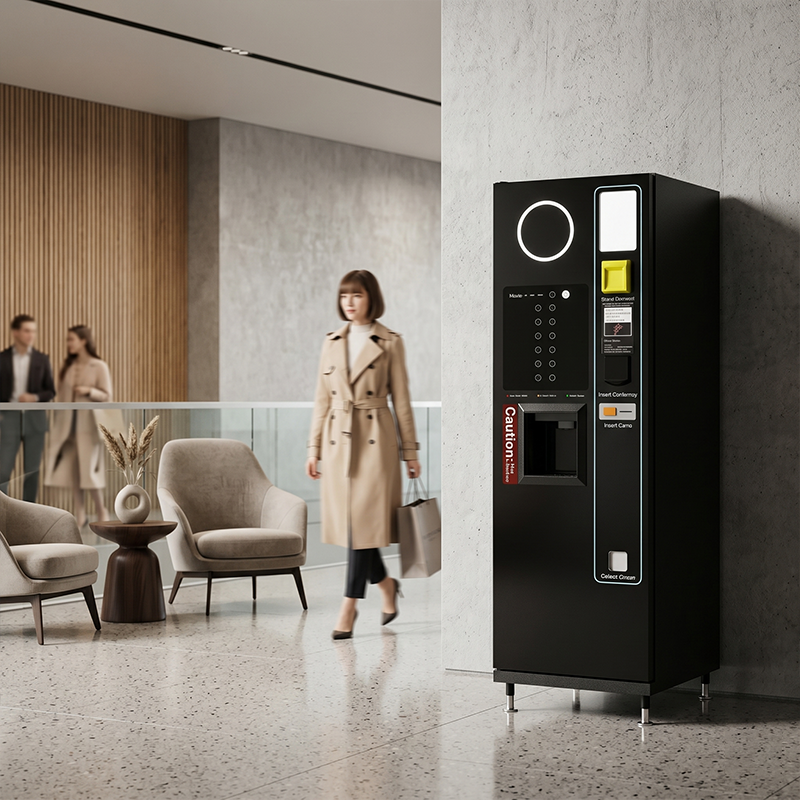
- Cashless payment reduces friction for customers who do not carry coins or banknotes.
- Remote monitoring helps operators track sales, stock, faults, and refill needs without visiting every machine.
- Automated preparation can improve consistency across offices, campuses, hotels, factories, and public venues.
- The best machine depends on traffic volume, menu complexity, payment preferences, utilities, and maintenance capability.
- A complete solution should include hardware, software, payment integration, and an operating plan.
Smart coffee vending machines combine automated beverage preparation with digital commerce and remote management. The payment layer must be treated as part of the operating system, not an afterthought: the PCI Security Standards Council describes PCI DSS as a framework containing 12 requirements for protecting payment data. This article explains how cashless vending creates business value, where it works best, and how to select a reliable coffee vending solution.
Why Choose a Smart Coffee Vending Machine?
The primary benefit of a smart coffee vending machine is the combination of unattended service and measurable operations. Traditional self-service coffee points may require staff to collect payments, check supplies, clean equipment, and investigate faults manually. A connected machine can centralize many of these tasks through software while still requiring planned cleaning, replenishment, and technical support.
Cashless payment is especially useful in locations where customers expect speed and convenience. A machine can support selected combinations of contactless cards, mobile wallets, QR payments, or local payment methods, depending on the market and payment provider. The correct choice is not simply the largest number of payment methods; it is the combination that customers already use and that the operator can reconcile reliably.
Lower dependence on on-site labor
Automation can reduce the number of routine transactions handled by staff, but it does not eliminate operational work. Operators still need to refill ingredients, empty waste containers, clean food-contact parts, inspect payment devices, and respond to exceptions. The practical advantage is that these tasks can be scheduled according to actual demand instead of being performed at the same frequency at every location.
Longer service availability
A coffee vending machine can serve customers beyond the opening hours of a staffed cafe when the site provides secure access, power, ingredients, and a suitable maintenance routine. This is valuable in office buildings with early commuters, factories with shift workers, hotels with late arrivals, and transport environments with variable demand.
How Cashless Vending Machines Improve Customer Experience
Cashless vending machines shorten the distance between product choice and payment. Customers can select a beverage, review the price, authorize payment, and receive the product without searching for coins or waiting for a cashier.
| Customer factor | Cash-based operation | Cashless operation | Evaluation priority |
|---|---|---|---|
| Payment behavior | Requires coins or notes | Supports digital authorization | 5/5 |
| Transaction record | Often reconciled manually | Usually available through payment software | 5/5 |
| Queue interaction | May require change handling | Designed for rapid selection and approval | 4/5 |
| Refund handling | Can require physical cash control | Depends on gateway and operator workflow | 4/5 |
| Local adaptation | Limited by cash acceptance | Depends on regional payment integration | 5/5 |
The priority scores in this table are an editorial evaluation framework, not an industry statistic. They help buyers compare payment requirements before requesting a quotation. A payment terminal should also support clear transaction status, failed-payment handling, receipts where required, and a process for disputed or interrupted sales.
Operational Benefits of a Connected Coffee Vending Machine
Remote visibility is the main difference between a connected coffee vending machine and a stand-alone dispenser. A cloud dashboard can give operators access to sales activity, stock alerts, machine status, and selected performance indicators from a central location.
Inventory and replenishment planning
Ingredient monitoring can help operators plan refills around actual consumption. Coffee beans, instant coffee, milk powder, cups, lids, sugar, stirrers, and cleaning supplies do not all move at the same rate. A better replenishment plan reduces unnecessary visits while lowering the risk of an empty ingredient causing a lost sale.
Fault detection and service coordination
Remote alerts can identify conditions such as payment communication errors, low consumables, temperature warnings, blocked dispensing paths, or cleaning reminders. The alert does not replace diagnosis by a trained technician, but it can improve the information available before a site visit.
Menu and pricing control
Digital management can make it easier to adjust menu visibility, prices, language, and promotional messages by location. An office, hotel, airport, and factory may need different menus even when they use similar equipment. Any pricing or menu change should be tested against local regulations, tax rules, payment configuration, and customer expectations.
Smart Coffee Vending Machine Selection Guide
The best machine is determined by the operating environment rather than by feature count alone. Buyers should define the service model first, then select equipment that matches the site, menu, and maintenance resources.
- Estimate demand by daypart, shift pattern, season, and access hours.
- Define the beverage menu, including bean-to-cup, instant, milk-based, hot water, sugar, and flavor options.
- Confirm available power, water, drainage, ventilation, floor space, network coverage, and physical security.
- Choose payment methods that match local customer behavior and settlement requirements.
- Map cleaning, replenishment, waste removal, troubleshooting, and escalation responsibilities.
- Request evidence of software support, spare-parts availability, training, warranty terms, and integration capability.
| Site profile | Recommended emphasis | Typical operational risk | Priority score |
|---|---|---|---|
| Office building | Quiet operation, premium menu, contactless payment | Peak demand before work and at breaks | 4/5 |
| Factory | Fast service, durable design, shift-based replenishment | Demand changes by shift | 5/5 |
| School or campus | Clear pricing, local payment options, easy cleaning | Short high-volume periods | 5/5 |
| Hotel | Multilingual interface, premium presentation, long availability | Variable demand and guest expectations | 4/5 |
| Airport or transport site | Rapid transactions, strong connectivity, robust security | Traffic peaks and limited service windows | 5/5 |
The scores are planning priorities rather than measured market data. They should be adjusted after a site survey and a review of transaction history.
Payment Security, Connectivity, and Data Governance
Cashless payment creates convenience but also introduces responsibilities for payment security, device management, connectivity, and data handling. Operators should ask whether card data is tokenized or handled by a compliant payment provider, how software updates are managed, and what happens when the network is unavailable.
The NIST Cybersecurity Framework provides a useful structure for discussing cybersecurity through the functions Govern, Identify, Protect, Detect, Respond, and Recover. A vending deployment does not need to copy the framework mechanically, but the principles help buyers ask practical questions about access control, incident response, vendor responsibilities, and recovery procedures.
Payment continuity should be tested before launch. A machine may need to handle declined transactions, interrupted connectivity, duplicate authorization concerns, refund requests, and a customer who receives no product after payment. These cases should be documented in the operating agreement between the equipment supplier, payment provider, and site owner.
Maintenance and Total Cost of Ownership
The purchase price is only one part of the cost of operating a coffee vending machine. A realistic evaluation includes ingredients, cups and packaging, payment processing, connectivity, electricity, water treatment where applicable, cleaning labor, spare parts, transport, software fees, and downtime.
Cleaning access is a buying criterion, not merely a service detail. Food-contact components should be easy to remove, inspect, and sanitize according to the machine manufacturer instructions and applicable local food-safety rules. Operators should also confirm waste capacity, drainage arrangements, descaling procedures, milk-system requirements, and the availability of trained service personnel.
Bean-to-cup systems can offer a more visible preparation experience and a broader fresh-brew proposition, while instant systems can prioritize simplified operation and rapid preparation. Neither format is universally better. The correct choice depends on expected demand, menu expectations, ingredient logistics, cleaning capability, and the value customers place on preparation style.
Where Cashless Coffee Vending Works Best
Office buildings benefit when employees need convenient beverages without leaving the premises. A connected machine can support a small refreshment area while giving facilities managers visibility into usage and refill requirements.
Factories and logistics sites benefit from service availability across shifts. In these environments, fast selection, durable components, easy cleaning, and dependable payment acceptance may be more important than an extensive specialty menu.
Hotels, campuses, airports, and community spaces require stronger attention to language, accessibility, presentation, and local payment habits. A configurable interface and remote menu management can help operators adapt the same equipment concept to different audiences.
For broader unattended retail, operators can connect coffee with snacks, cold drinks, ice, or other frequently purchased products. This creates a more complete service point, but it also increases the need for accurate inventory control and a clear replenishment route. Buyers evaluating a wider unattended retail program can review commercial coffee vending equipment, automated ice vending equipment, and snack vending solutions as separate parts of the operating plan.
Questions to Ask Before Buying
- Which payment methods are supported in the target country, and who owns the payment relationship?
- Can the machine continue safely during temporary network disruption?
- What dashboard information is available for sales, stock, faults, cleaning, and machine status?
- How are software updates, cybersecurity responsibilities, refunds, and customer complaints handled?
- What utilities, floor clearance, water treatment, drainage, and network conditions are required?
- Which parts are user-serviceable, and which tasks require an authorized technician?
- Can the supplier customize language, menu, payment hardware, enclosure design, and branding?
FAQ
What is a smart coffee vending machine?
It is an automated coffee dispenser that combines beverage preparation with digital controls, payment technology, and often remote monitoring. Features vary by model, so buyers should confirm the exact menu, connectivity, payment options, and dashboard functions.
Why is cashless payment important for coffee vending?
Cashless payment helps customers pay with commonly used digital methods and gives operators a more structured transaction record. Its value depends on local adoption, payment fees, connectivity, and reliable refund handling.
Can a cashless vending machine accept mobile wallets?
Many systems can support mobile wallets when the payment terminal, gateway, acquirer, and local payment network are compatible. The supplier should confirm supported methods for the intended country before purchase.
Does remote monitoring remove the need for maintenance?
No. Remote monitoring can improve visibility and scheduling, but operators still need to clean food-contact areas, refill ingredients, remove waste, inspect components, and arrange technical service.
Is bean-to-cup better than instant coffee vending?
Neither format is always better. Bean-to-cup may suit sites where fresh grinding and preparation visibility matter, while instant systems may suit buyers prioritizing simple operation, fast service, and easier ingredient handling.
What should be checked before installation?
Check power, floor space, access, water and drainage requirements, network coverage, ventilation, security, waste handling, delivery access, and the planned cleaning and replenishment route.
Can the machine be customized for overseas markets?
Customization may include language, menu, payment hardware, appearance, software functions, and electrical configuration. The buyer should also confirm local payment, food-safety, accessibility, and product-labeling requirements.
About the Supplier
Yile Shangyun develops commercial self-service equipment and integrated unattended retail solutions covering coffee, beverages, ice, vending, and AI service terminals. Its delivery model combines hardware, software, remote operations, and OEM or ODM customization for international customers. Buyers can review the contact and inquiry options to discuss site requirements, payment integration, menu configuration, and service planning.

Post time: Oct-09-2026