

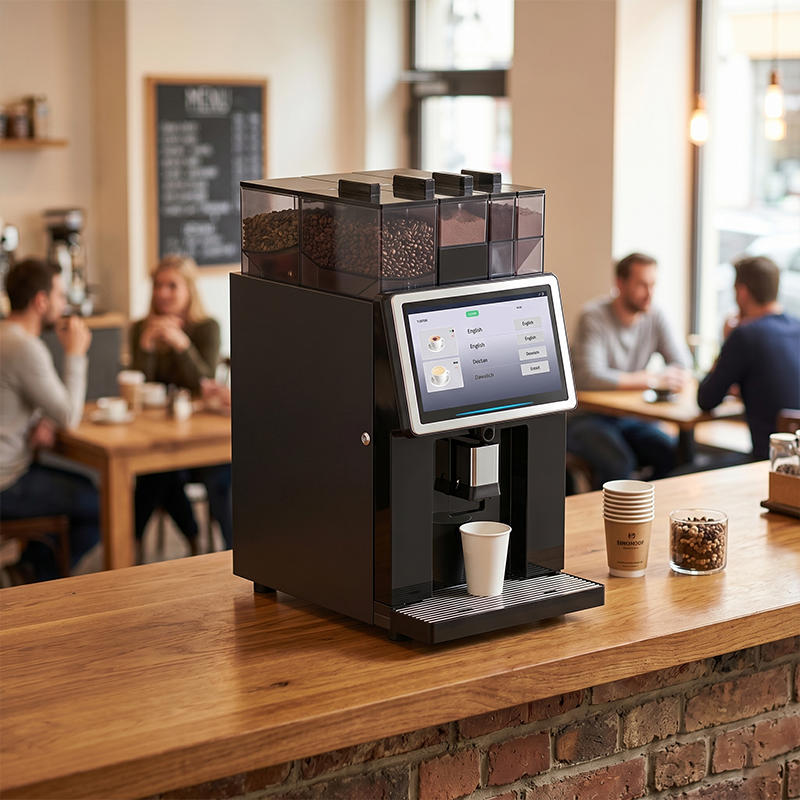
Buying a commercial bean-to-cup machine from existing stock can solve a practical problem: getting a café, office, or foodservice location serving coffee without waiting months for custom equipment. But fast delivery alone does not guarantee good value. The real question is whether ready-to-ship models offer the right balance of drink quality, reliability, workflow fit, and total cost for your business. This article explains where these machines make the most sense, what trade-offs to expect compared with custom-ordered options, and which buying factors matter most if you need quick deployment without compromising day-to-day performance.
Why Are Ready-to-Ship Commercial Bean-to-Cup Coffee Machines Gaining Att
The commercial coffee industry is experiencing a significant shift in equipment procurement strategies. Historically dominated by custom-built configurations, the market is now pivoting toward ready-to-ship commercial equipment to address immediate operational demands. This transition is largely driven by macroeconomic factors, including supply chain volatility that previously pushed custom equipment lead times to 12 to 16 weeks.
Today, securing a commercial bean-to-cup coffee machine directly from existing inventory reduces procurement delays to a mere three to five business days, fundamentally altering how businesses plan their beverage programs and manage capital expenditures.
How do faster deployment timelines affect purchasing priorities
Faster deployment timelines directly impact the financial viability of new commercial projects. For quick-service restaurants, corporate cafeterias, and convenience stores, every week of delayed opening translates to lost beverage revenue.
By utilizing off-the-shelf inventory, project managers can align equipment delivery precisely with site completion schedules, bypassing the unpredictable manufacturing delays associated with made-to-order units.
Why do immediate availability, labor pressure, and menu consiste
ncy matter
Beyond procurement speed, the hospitality and food service sectors face an ongoing labor crisis, with annual staff turnover rates frequently exceeding 70 percent.
The immediate availability of fully automated bean-to-cup systems provides an instant solution to labor shortages. These machines guarantee menu consistency by automating grinding, tamping, and extraction. This ensures an operation can reliably serve 50 to 150 cups daily at an identical quality standard, regardless of the operator’s barista training.
What Should Buyers Compare When Evaluating Ready-to-Ship Commercial Bean
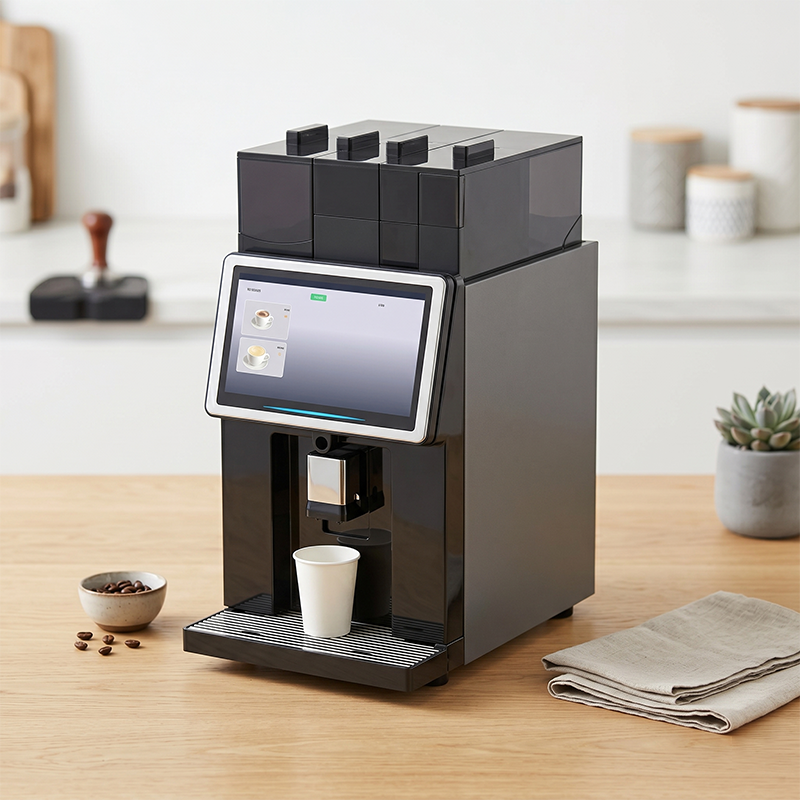
Evaluating pre-configured coffee equipment requires a rigorous comparison of hardware capabilities against operational requirements. Because these machines are pre-built, buyers must ensure the standardized specifications align with their anticipated peak-hour demand and overall volume expectations.
Which technical specifications matter most
The most critical technical specifications revolve around throughput capacity and thermal stability. Buyers must assess the daily output volume rating, which typically ranges from 50 cups for entry-level models to over 250 cups for high-volume commercial units.
Boiler configuration is equally crucial; a dual 1.5-liter thermoblock or boiler system is often necessary to handle simultaneous espresso extraction and milk frothing without temperature drops.
| Specification | Low-Volume RTS Machine | High-Volume RTS Machine |
|---|---|---|
| Daily Output | 50 – 100 cups | 150 – 300+ cups |
| Boiler System | Single 2L Boiler | Dual 1.5L / Independent |
| Bean Hopper Capacity | 500g | 1.0kg – 1.2kg |
| Display Interface | 7-inch Touchscreen | 10-inch Touchscreen |
Which cost and quality trade-offs should be assessed
Off-the-shelf equipment inherently involves balancing upfront cost savings against a lack of customization. Ready-to-ship models typically offer a 15 to 20 percent reduction in baseline MSRP compared to bespoke units because manufacturers achieve economies of scale through standardized production.
The trade-off is the inability to specify custom RAL chassis colors, unique telemetry integrations, or specialized hopper configurations prior to delivery.
How does performance compare with made-to-order alternatives
When assessing field performance, standardized models often demonstrate exceptional reliability. Because these units are mass-produced on established assembly lines, their core components are rigorously field-tested.
The mean time between failures (MTBF) for a premium ready-to-ship machine frequently matches or exceeds the 15,000-cycle benchmark expected of custom alternatives. Understanding the manufacturer’s production standards provides further assurance that standardized performance does not equate to compromised build quality.
Are Ready-to-Ship Commercial Bean-to-Cup Coffee Machines Operationally W
Determining the true value of off-the-shelf automated coffee systems extends beyond the initial purchase price. Facility managers and procurement officers must evaluate the long-term operational footprint, maintenance costs, and lifecycle logistics to confirm whether these machines represent a sound investment.
How should total cost of ownership be calculated
Calculating the total cost of ownership (TCO) requires modeling the initial capital expenditure alongside preventative maintenance, consumable parts, and energy consumption over a standard five-year lifecycle.
While ready-to-ship machines lower initial CapEx by $1,000 to $2,500 relative to custom builds, buyers must budget approximately $400 to $600 annually for standard maintenance kits. These kits include replacement O-rings, water filters, and grinder burrs, which typically require replacement every 10,000 cycles.
What operational constraints should buyers expect
Deploying pre-configured equipment introduces specific operational constraints. The physical dimensions and utility requirements are fixed, meaning the installation environment must adapt to the machine rather than the reverse.
For example, a standard ready-to-ship unit features a fixed 1-kilogram bean hopper and a standardized drip tray clearance (usually 140mm to 160mm). This may restrict the use of extra-large or uniquely shaped travel mugs unless an aftermarket riser or extension is sourced.
When does rapid availability outweigh the drawbacks
The strategic advantage of rapid availability heavily outweighs these minor constraints in dynamic commercial environments. When an existing machine suffers a catastrophic failure, the ability to deploy a replacement unit within 48 to 72 hours prevents significant revenue leakage.
For a location selling 100 cups a day at $3.00 per cup, avoiding a three-week wait for a custom machine preserves over $6,000 in gross revenue, instantly validating the decision to utilize readily available inventory.
What Sourcing, Compliance, and Logistics Checks Reduce Buying Risk
Mitigating the risks associated with procuring commercial coffee equipment requires thorough vetting of the supplier, the hardware’s regulatory compliance, and installation logistics. Even when equipment is ready for immediate dispatch, skipping due diligence can lead to costly operational bottlenecks.
Which supplier due diligence steps matter most
Effective supplier due diligence focuses on after-sales support infrastructure rather than just upfront availability. Buyers must verify the warranty terms—typically targeting a minimum of a one-year parts warranty—and confirm that replacement components are stocked domestically for 24-hour dispatch.
Establishing a direct line to the vendor’s technical support team ensures that any software anomalies or mechanical faults can be triaged rapidly, minimizing machine downtime.
What compliance and site-readiness issues should be reviewed
Before a machine is dispatched, facility managers must verify that the installation site meets all fixed regulatory and utility requirements. Commercial environments mandate specific health and safety certifications, such as NSF/ANSI 4 for sanitation or UL/CE for electrical safety.
Furthermore, site utilities must precisely match the machine’s fixed specifications to avoid installation failure.
| Site Readiness Check | Standard Requirement | Potential Site Modification |
|---|---|---|
| Electrical Supply | Dedicated 110V/15A or 220V/20A circuit | Upgrading breaker panel |
| Water Supply | 3/8-inch line, minimum 2 bar pressure | Installing booster pump |
| Water Filtration | Inline scale inhibitor / RO system | Adding under-counter filter |
| Drainage | Gravity drain within 1.5 meters | Drilling counter routing holes |
What procurement process should buyers follow
The procurement process for inventory-ready machines should be highly structured despite the accelerated timeline. Buyers should request a comprehensive specification sheet, confirm exact inventory levels prior to issuing a purchase order, and clarify freight terms (such as FOB or DDP).
Finally, buyers must secure a certified third-party technician for the installation, as proper calibration of the grinder and water volumetrics is critical even for pre-assembled units.
Are Ready-to-Ship Commercial Bean-to-Cup Coffee Machines Worth Buying
The decision to invest in pre-configured, automated coffee equipment ultimately depends on aligning the machine’s standardized capabilities with the specific demands of the host business. When matched with the correct operational profile, these machines deliver exceptional utility and return on investment.
Which buyer profiles are the best fit
The most suitable buyer profiles for these machines include corporate offices with 50 to 200 employees, convenience stores, hotel breakfast bars, and quick-service restaurants.
In these environments, the primary objectives are speed of service, minimal staff intervention, and absolute consistency. Establishments that do not require specialized specialty coffee theatrics but demand a reliable output of 100 to 250 cups per day will find off-the-shelf bean-to-cup systems to be an ideal operational fit.
What criteria should guide the final decision
The final purchasing decision should be guided by a strict evaluation of volume requirements, budget ceilings, and deployment urgency. If a business requires immediate deployment to capture seasonal foot traffic or replace failing equipment, the standardized bean-to-cup machine provides an unmatched solution.
By balancing the $1,000 to $2,500 savings in initial CapEx against the fixed hardware specifications, procurement managers can confidently deploy these systems to stabilize their beverage programs and maximize profitability.
Further reading:
Key Takeaways
- The most important conclusions and rationale for Ready-to-Ship Commercial Bean-to-Cup Coffee Machines
- Specs, compliance, and risk checks worth validating before you commit
- Practical next steps and caveats readers can apply immediately
Frequently Asked Questions
How fast can a ready-to-ship bean-to-cup machine be delivered?
In-stock units typically ship in about 3 to 5 business days, much faster than custom machines that can take 12 to 16 weeks.
How many cups per day should my machine handle?
Match capacity to demand: 50 to 100 cups suits small sites, while 150 to 300+ cups is better for busy cafeterias, c-stores, and offices.
Are ready-to-ship machines cheaper than custom-built models?
Usually yes. Standardized ready-to-ship models often cost 15 to 20% less upfront, though you give up options like custom colors or special integrations.
What specs matter most when comparing in-stock bean-to-cup machines?
Focus on daily output, boiler setup, bean hopper size, and touchscreen interface. For steady espresso and milk drinks, a dual boiler or dual thermoblock setup is ideal.
Where can I compare ready-to-ship commercial coffee machines from YL Vending?
You can review current in-stock models and specifications on YL Vending’s product pages at ylvending.com/products/.

Kely
Post time: Jun-16-2026