

Introduction
Finding the right coffee vending machine for a small business in 2026 means looking beyond drink variety and comparing how each unit affects labor time, daily output, maintenance needs, and limited floor space. The best option depends on whether you’re serving employees, customers, or both, and on how many cups you need to deliver without slowing operations. This guide breaks down the key features, capacity ranges, and cost factors that matter most for small offices, shops, and waiting areas, so you can identify a machine that fits your workflow, budget, and service expectations before moving into specific recommendations.
Why Choosing the Right Small Business Coffee Machine Matters
Deploying a commercial beverage system requires a strategic approach that balances capital expenditure with operational efficiency. For modern enterprises, the transition from decentralized manual brewing to automated dispensing represents a critical optimization of facility management. Selecting the optimal small business coffee machine involves analyzing complex operational metrics rather than merely evaluating beverage aesthetics.
Labor costs, beverage expectations, and space constraints
Labor expenditures and operational efficiency are heavily influenced by workplace beverage solutions. Manual coffee preparation typically consumes 10 to 15 minutes per employee per instance. When aggregated across a 30-person staff, this translates to dozens of lost labor hours weekly. Automated systems reduce dispensing times to under 45 seconds, reclaiming significant productivity.
Furthermore, modern commercial hardware addresses stringent space constraints. High-capacity countertop units now operate within footprints as compact as 0.3 to 0.5 square meters, eliminating the need for expansive breakroom infrastructure while meeting the escalating quality expectations of a workforce accustomed to specialty café standards.
Use cases for small business coffee machines
Deployments vary significantly across different commercial environments. In corporate office settings, the primary objective is sustaining employee productivity through continuous availability, often requiring machines rated for 50 to 150 cups daily. These environments prioritize diverse menus, including espressos, cappuccinos, and flat whites.
Conversely, customer-facing environments such as auto dealerships, boutique medical clinics, and hospitality lobbies utilize beverage provisioning as a client retention tool. In these scenarios, the hardware must balance premium extraction quality with intuitive, zero-training user interfaces, ensuring that a transient user base can successfully operate the unit without staff intervention.
What Defines the Best Coffee Vending Machine for Small Business
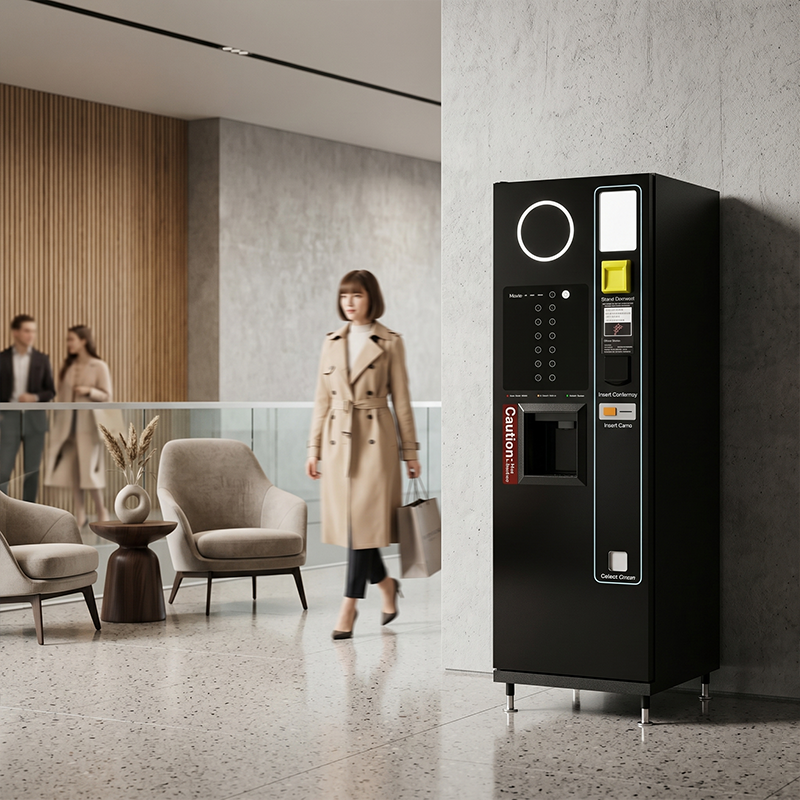 Technical specifications dictate the operational viability of any commercial beverage hardware. Procurement officers must evaluate internal extraction mechanics, ingredient storage capacities, and the digital infrastructure that governs payment and telemetry.
Machine types, drink systems, and payment options
Modern commercial systems utilize sophisticated extraction hardware, generally categorized into whole-bean (bean-to-cup) and soluble platforms. Bean-to-cup units feature integrated conical burr grinders and brew groups capable of generating the 9 to 15 bar pressure required for authentic espresso extraction. Soluble systems, utilizing freeze-dried ingredients, prioritize speed and mechanical simplicity.
Payment infrastructure has also evolved. Contemporary units integrate cashless telemetry modules supporting NFC, RFID smart cards for employee allowances, and dynamic QR code payments, ensuring secure and frictionless transaction processing in hybrid or public-facing deployment zones.
Cup capacity, ingredient canisters, and cleaning needs
Component sizing directly impacts maintenance frequency and labor overhead. High-volume environments require hardware equipped with at least 1-kilogram bean hoppers and dual 1.5-liter soluble canisters for auxiliary ingredients like powdered milk or cocoa. This sizing ensures the machine can output approximately 80 to 100 beverages before triggering an empty-state alert.
Cleaning protocols represent a critical evaluation metric. Premium units now feature automated, programmable flush cycles that purge the brew group and milk lines with water heated to 90°C (194°F) after a specified period of inactivity, drastically reducing manual daily sanitation requirements and mitigating bacterial growth risks.
Comparison criteria for benchmarking machines
Evaluating hardware requires a standardized matrix to benchmark performance variables against organizational requirements.
| Specification | Bean-to-Cup Architecture | High-Speed Soluble Architecture |
|---|---|---|
| Average Dispense Time | 40 – 55 seconds | 12 – 18 seconds |
| Moving Mechanical Parts | High (Grinder, Brew Group) | Low (Augers, Whippers) |
| Ingredient Capacity | 1kg beans, 2L liquid milk | 2kg soluble powder variants |
| Ideal Daily Volume | 50 – 150 cups | 150 – 300+ cups |
| Preventive Maintenance | Monthly calibration | Quarterly inspection |
How to Compare Cost, Compliance, and Operating Risk
Procurement extends beyond initial capital outlay, requiring a comprehensive analysis of the Total Cost of Ownership (TCO), regulatory compliance, and the mitigation of operational risks through structured vendor support.
Real cost drivers for small business coffee machines
Total Cost of Ownership encompasses hardware acquisition, consumable logistics, and maintenance overhead. Initial capital expenditures for commercial-grade tabletop units typically range from $1,800 to $4,500, depending on boiler capacity and telemetry features.
Operating expenses (OpEx) are driven by the cost per cup. A standard 8-ounce bean-to-cup beverage utilizing mid-tier commercial beans and powdered milk averages $0.28 to $0.42 per cup. Factoring in annual water filter replacements and chemical cleaning supplies adds an estimated $150 to $250 to the yearly maintenance budget.
Food safety, electrical, water filtration, and accessibility requirements
Regulatory adherence is non-negotiable for commercial deployments. Hardware must carry appropriate certifications, such as NSF/ANSI 25 for food equipment sanitation and UL/CE marks for electrical safety. Units must operate safely on standard 110V/120V (15-20 Amp) circuits in North America, or 220V/240V internationally.
Furthermore, accessibility compliance is critical. In the United States, ADA regulations mandate that interactive touchscreens and physical selection buttons must be positioned between 15 and 48 inches from the finished floor to ensure wheelchair accessibility. Plumbed units also necessitate inline carbon or reverse osmosis water filtration systems to prevent scale buildup and comply with local municipal health codes.
Warranty terms, parts availability, and vendor SLAs
Service Level Agreements (SLAs) mitigate operational downtime, which can disrupt workplace routines. Standard commercial warranties typically cover parts for 12 months, but enterprise deployments should secure extended SLAs that guarantee a technician response time of 24 to 48 hours.
Parts availability is equally crucial. Utilizing hardware from established manufacturers ensures that high-wear components—such as O-rings, burr sets, and solenoid valves—remain accessible throughout the machine’s projected 5 to 7-year lifecycle, preventing premature obsolescence.
How to Procure and Deploy the Right Machine
Execution of the deployment phase dictates long-term hardware reliability. Proper procurement involves aligning machine specifications with site infrastructure and establishing a seamless installation protocol.
Step-by-step evaluation process
A rigorous site audit precedes physical installation. Facility managers must verify the availability of a dedicated electrical circuit to prevent breaker trips during the machine’s dual-heating phases. For plumbed units, a 3/8-inch or 1/2-inch cold water supply line equipped with a dedicated shut-off valve must be located within 1.5 meters of the installation footprint.
Organizations should engage directly with vendor engineering teams via formal consultation channels to validate site blueprints, discuss filtration integration, and schedule post-installation staff training sessions.
Matching machine specifications to daily demand
Aligning hardware throughput with user volume prevents both operational bottlenecks and asset underutilization. Selecting a unit with inadequate boiler capacity results in thermal recovery delays, extending dispense times during peak morning hours.
| Employee Headcount | Estimated Daily Cups | Recommended Boiler Capacity | Recommended Waste Bin Capacity |
|---|---|---|---|
| 10 – 25 Staff | 20 – 45 cups | Single Thermoblock | 30 pucks |
| 26 – 50 Staff | 50 – 90 cups | Dual Thermoblock | 50 – 70 pucks |
| 51 – 100 Staff | 100 – 180 cups | Dual Stainless Boilers | Direct chute to under-counter bin |
How to Make the Final Buying Decision
The final procurement phase synthesizes technical specifications, financial modeling, and organizational objectives to select the most appropriate hardware asset.
Buyer profiles and scenario-based recommendations
Different operational environments necessitate distinct hardware profiles. A premium corporate law firm prioritizing client experience should deploy a dual-grinder, fresh-milk system capable of producing latte-art-quality beverages, accepting the higher $4,000+ CapEx and daily cleaning requirements.
Conversely, a high-turnover logistics warehouse requires a ruggedized, high-capacity soluble or hybrid system. In this scenario, rapid 15-second dispense times, 2-kilogram ingredient hoppers, and minimal daily maintenance take precedence over specialty drink variety.
Final decision criteria for small businesses
Finalizing the acquisition requires weighting specific performance metrics against long-term operational goals. Decision-makers must evaluate the total TCO over a 60-month lifecycle, the strictness of local health department compliance, and the vendor’s documented SLA adherence.
Reviewing a manufacturer’s corporate infrastructure and vendor history provides assurance of sustained technical support. Ultimately, the best commercial system is one that seamlessly integrates into the facility’s existing workflow, demands minimal staff intervention, and reliably scales alongside the business’s daily operational demands.
Further reading:
Key Takeaways
- The most important conclusions and rationale for small business coffee machine
- Specs, compliance, and risk checks worth validating before you commit
- Practical next steps and caveats readers can apply immediately
Frequently Asked Questions
What size coffee vending machine suits a small business best?
Match daily demand to capacity. For most offices, choose a bean-to-cup unit rated for 50–150 cups per day with about a 1 kg bean hopper to reduce refills.
Should a small business choose bean-to-cup or soluble coffee machines?
Choose bean-to-cup for better espresso-style quality in offices or client areas. Choose soluble for faster service, simpler maintenance, and higher-volume sites needing 150+ drinks daily.
What payment options should a small business coffee machine support?
For staff use, RFID or employee card systems work well. For public or lobby placement, add NFC and QR payments for quick, cashless transactions.
How much space does a small business coffee machine need?
Many modern countertop units fit within roughly 0.3–0.5 square meters. Check footprint, water access, waste capacity, and clearance for refilling and cleaning before buying.
How can YL Vending help small businesses choose the right coffee machine?
YL Vending offers commercial beverage systems, product guidance, and support on machine selection, capacity, and payment features based on your workplace traffic and drink menu needs.

Kely
Post time: Jun-01-2026