

 Introduction
For buyers comparing a factory price coffee machine with distributor-supplied options, the real difference is not just purchase cost but long-term operating value. This article explains how direct-from-factory pricing works for commercial coffee vending machines, where the main savings come from, and which business cases benefit most from buying at the source. It also helps readers evaluate order volume, customization, warranty expectations, and total deployment cost so they can judge whether factory procurement makes sense for a single site, a growing vending network, or a large facilities operation.
Why Buy a Commercial Coffee Vending Machine Direct from the
Sourcing commercial coffee equipment represents a significant capital expenditure for operators, distributors, and large-scale facility managers. Securing a factory price coffee machine directly from the manufacturer circumvents traditional distribution markups, fundamentally altering the return on investment timeline for vending fleets.
Factory pricing and cost advantages
Purchasing directly from the manufacturing source typically yields cost reductions of 30% to 50% compared to domestic wholesale channels. Traditional supply chains layer margins for regional distributors, warehousing, and local sales agents. By eliminating these intermediaries, buyers access the true ex-works (EXW) baseline cost. Furthermore, manufacturers often provide tiered pricing structures based on Minimum Order Quantities (MOQs). While a single evaluation unit might carry a standard factory rate, scaling an order to 10 or 20 units unlocks significant bulk discounts, allowing operators to deploy larger fleets with the same initial capital outlay.
Best commercial use cases for direct sourcing
Direct factory sourcing is highly advantageous for specific commercial applications. Independent vending operators, corporate campus managers, and hospitality chains stand to gain the most from this procurement model. For example, a hospital network deploying 50 machines across multiple campuses requires uniform hardware, centralized telemetry, and bulk spare parts. Engaging directly with the factory ensures tailored solutions that meet exact venue specifications, whereas relying on off-the-shelf local stock often results in a fragmented, difficult-to-maintain equipment portfolio.
What to Compare When Evaluating Factory-Price Coffee Machines
Evaluating a commercial coffee vending machine requires looking beyond the exterior casing to understand the internal mechanics. The technical architecture dictates not only the quality of the dispensed beverage but also the maximum daily throughput the unit can sustain during peak hours.
Technical specifications that affect drink quality and capacity
The core of any espresso-based vending machine lies in its brewing mechanism and thermal stability. High-volume commercial environments demand dual-boiler systems with capacities ranging from 1.5 to 3.0 liters, ensuring simultaneous brewing and steaming without temperature drops. The extraction pressure must consistently hit the industry standard of 9 bar to produce authentic espresso crema. Additionally, bean hoppers holding 1.2 to 2.0 kilograms of whole beans are necessary to prevent frequent restocking during high-traffic periods. Exploring specific products from manufacturers reveals how these specifications align with varying capacity requirements.
Payment systems, telemetry, customization, and branding
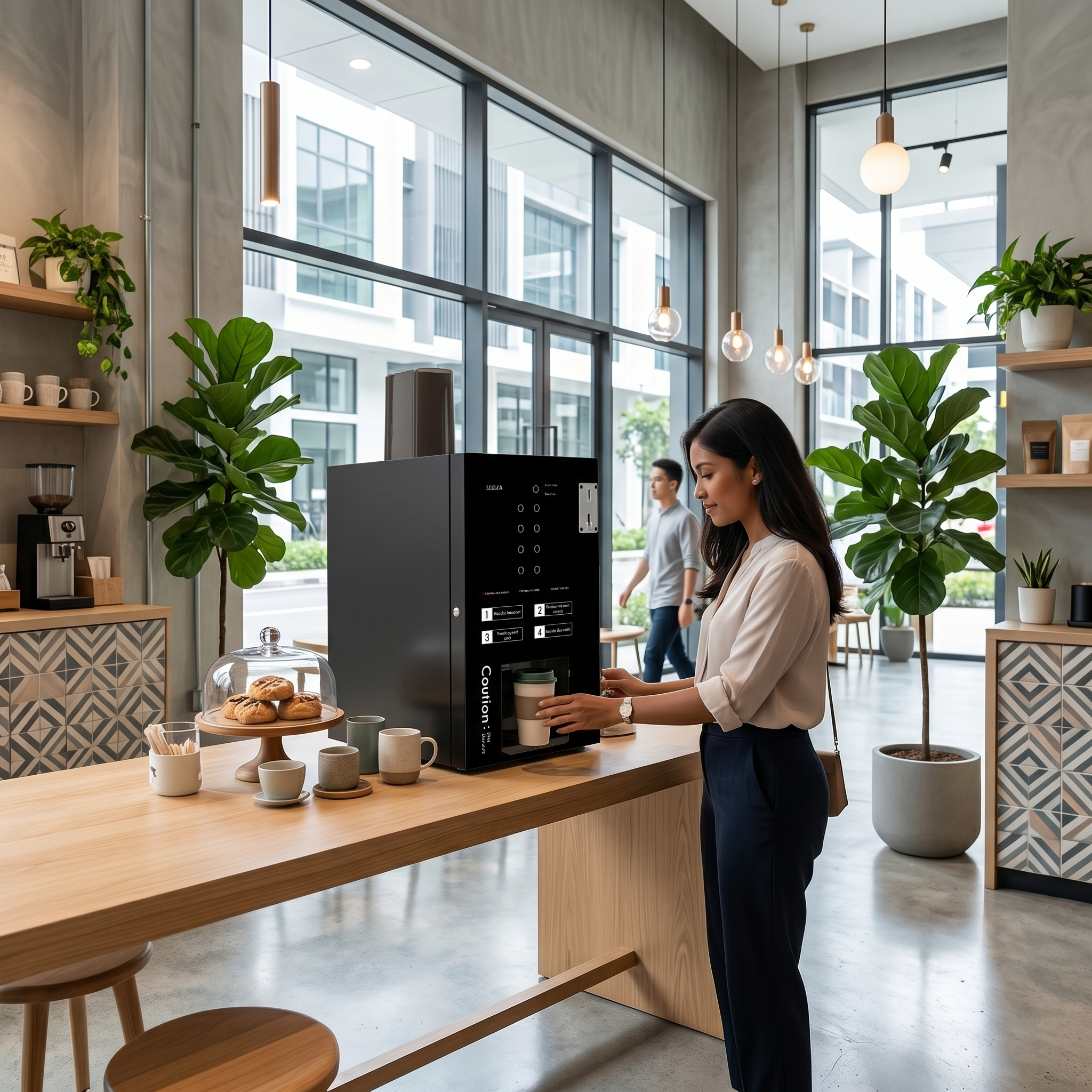 Modern vending operations rely heavily on digital interfaces and connectivity. Factory-direct machines can be customized with 15-inch to 21-inch high-definition touchscreens, which serve a dual purpose: facilitating user selection and displaying digital advertising. Integrated telemetry via 4G or Wi-Fi allows operators to monitor inventory levels, track real-time sales data, and diagnose technical faults remotely. Payment systems must also be versatile, supporting closed-loop RFID cards for corporate environments alongside open-loop credit card readers and mobile payment gateways.
Comparison criteria for fresh milk and bean-to-cup models
Selecting between fresh milk systems and soluble/powdered milk alternatives involves weighing beverage quality against maintenance complexity. Bean-to-cup machines with fresh milk modules offer premium café-style beverages but require daily automated cleaning cycles and strict temperature controls (typically maintained below 4°C). Conversely, machines utilizing granulated milk powder reduce operational overhead and eliminate spoilage risks, making them suitable for remote or unstaffed locations.
| Feature | Fresh Milk Bean-to-Cup | Powdered/Soluble Bean-to-Cup |
|---|---|---|
| Beverage Quality | Premium / Authentic | Standard / Convenience |
| Maintenance Time | 15-20 mins daily | 5 mins daily |
| Estimated Cost/Cup | $0.25 – $0.40 | $0.10 – $0.15 |
| Ideal Environment | Executive offices, lounges | Public transit, factory floors |
How to Verify Quality, Compliance, and Factory Reliability
When importing heavy electrical equipment that processes consumable goods, stringent compliance with international safety and health standards is non-negotiable. Vetting the manufacturing facility is a critical step in mitigating risks associated with direct overseas procurement.
Required certifications and food-safe electrical standards
Commercial coffee machines must possess specific certifications to clear customs and operate legally in most jurisdictions. Electrical components require CE (Europe) or UL/ETL (North America) certifications to ensure fire and shock safety. Furthermore, because these machines handle hot water and consumable ingredients, all internal tubing, boilers, and dispensing nozzles must meet food-safe standards, such as NSF International guidelines or FDA compliance for food contact materials. RoHS compliance is also mandatory in many regions to certify the absence of hazardous heavy metals in the electronic circuitry.
Factory audits, quality control, and production capability
A reliable factory price coffee machine supplier operates with transparent quality control protocols. Buyers should look for manufacturers holding ISO 9001 certification, which dictates rigorous quality management systems. Before committing to a large order, operators should request documentation of the factory’s testing procedures. Leading manufacturers subject their brewing units to endurance testing, often exceeding 50,000 to 100,000 continuous cycles to simulate years of commercial use. A reputable factory will also boast a defect rate of less than 1% and provide comprehensive video documentation of the pre-shipment inspection for the specific batch being purchased.
What Shapes the Final Landed Cost
The initial factory quote is only one component of the total capital required to deploy a coffee vending machine. Accurately calculating the landed cost—the total price of a product once it has arrived at the buyer’s door—is essential for accurate financial modeling and return on investment projections.
Price drivers beyond the ex-works quote
The ex-works (EXW) price represents the bare cost of the machine sitting on the factory floor. Beyond this, buyers must account for inland transportation to the port of origin, export customs clearance, and terminal handling charges. Additionally, currency exchange fluctuations and bank transfer fees (often ranging from $30 to $50 per wire) can impact the final procurement budget. Custom branding, localized software language packs, and modified payment terminal brackets will also add incremental costs to the baseline factory quote.
Shipping terms, import duties, installation, and maintenance
Shipping terms dictate who bears the risk and cost during transit. Free on Board (FOB) is common, where the factory covers costs to load the goods onto the vessel. Ocean freight for a standard 20-foot container (which holds approximately 40 to 50 freestanding vending machines) fluctuates based on global shipping lanes. Upon arrival, import duties typically range from 3% to 6% for commercial coffee equipment, depending on the destination country’s harmonized tariff schedule. Finally, local logistics, professional installation (costing $150 to $300 per unit), and ongoing preventative maintenance must be factored into the operational budget.
Procurement steps for negotiation and cost control
Effective procurement involves strategic negotiation and careful logistics planning. Consolidating shipments to maximize container space drastically reduces the per-unit freight cost. Buyers should also negotiate a comprehensive spare parts package (often 2% to 5% of the total order value) to be shipped alongside the machines, minimizing future international shipping costs for critical components like solenoid valves, O-rings, and grinder blades.
| Cost Component | Typical Percentage of Landed Cost | Description |
|---|---|---|
| Factory Price (EXW) | 65% – 75% | Base machine and selected configurations |
| Ocean Freight & Insurance | 10% – 15% | Container shipping and transit coverage |
| Import Duties & Taxes | 5% – 10% | Customs tariffs and local import levies |
| Inland Freight & Setup | 5% – 10% | Delivery to venue and technical installation |
How to Choose the Right Machine for Your Business
Finalizing the ideal machine specification requires a precise alignment between the hardware’s capabilities and the target venue’s operational realities. Over-specifying results in wasted capital, while under-specifying leads to equipment breakdowns and lost revenue during peak operating hours.
Matching machine configuration to traffic and venue needs
Venue traffic is the primary metric for configuration. A low-traffic environment, such as a small office of 30 employees, is well-served by a tabletop unit designed for 50 to 75 cups per day. In contrast, a university library or a busy factory breakroom requires a freestanding, high-capacity machine capable of dispensing 200 to 300 cups daily. These high-volume solutions necessitate dual grinders, high-capacity waste bins that hold up to 100 spent coffee pucks, and direct plumbing to a municipal water line to eliminate the need for manual tank refills.
Final decision criteria for commercial buyers
Commercial buyers must base their final decision on Total Cost of Ownership (TCO) rather than just the initial purchase price. Key criteria include the availability of local technical support, the ease of routine cleaning, and the machine’s energy efficiency rating. A unit that enters a deep sleep mode during off-peak hours can reduce electricity consumption by up to 30%, significantly impacting long-term operational costs. By carefully evaluating capacity requirements, maintenance overhead, and factory support structures, operators can deploy a highly profitable and reliable automated coffee service.
Further reading:
Key Takeaways
- The most important conclusions and rationale for factory price coffee machine
- Specs, compliance, and risk checks worth validating before you commit
- Practical next steps and caveats readers can apply immediately
Frequently Asked Questions
How much can I save by buying a factory price coffee machine direct from YL Vending?
Direct factory sourcing typically saves 30%–50% versus distributor pricing, especially on larger orders like 10 or 20 units.
What should I compare when choosing a commercial coffee vending machine?
Check boiler capacity, stable 9-bar extraction, bean hopper size, daily output, payment options, and remote telemetry support.
Is a fresh milk coffee vending machine better than a powdered milk model?
Fresh milk gives premium drinks but needs daily cleaning and cold-chain control. Powdered milk is easier to manage in remote or unstaffed sites.
Can YL Vending customize coffee machines for my business needs?
Yes. Factory-direct orders can include touchscreen size, branding, payment modules, telemetry, and configurations matched to your venue.
What certifications should I verify before importing a commercial coffee machine?
Confirm the machine meets your market’s electrical and food-safety requirements, and ask the factory for current compliance documents before shipping.

Kely
Post time: Jun-06-2026