

 Introduction
For buyers evaluating CE certified vending China suppliers, the key question is not just price, but how certification, manufacturing depth, and customization capacity affect long-term performance. A factory with valid CE compliance can simplify market entry, reduce regulatory risk, and shorten deployment timelines, especially for Europe-bound projects. At the same time, China’s mature component ecosystem gives operators access to smart features such as telemetry, cashless payment integration, refrigeration, and touchscreen interfaces at competitive costs. This article explains why CE-certified sourcing from China is gaining momentum, what advantages qualified factories offer, and which factors matter most when comparing partners for reliability, speed, and total cost of ownership.
Why Is a CE-Certified Vending Supply Strategy in China Gaining
Sourcing automated retail equipment internationally requires balancing upfront capital expenditure with long-term operational reliability. For operators expanding their fleets, partnering with a China smart vending machine factory that holds valid CE certification has become an increasingly dominant supply strategy. China currently manufactures a significant majority of the world’s commercial vending hardware, leveraging extensive industrial clusters to deliver advanced telemetry, touch-screen interfaces, and refrigeration systems at highly competitive price points.
CE certification serves as a non-negotiable baseline for entering the European Economic Area (EEA) and is widely recognized globally as a benchmark for electrical safety. By securing equipment that already meets these stringent regulatory standards, international buyers can bypass costly local testing procedures, accelerating their time-to-market while protecting their brand reputation and limiting liability.
How do labor costs, component ecosystems, and customization affect sourcing
The migration of vending machine production to China is deeply tied to the concentration of specialized component ecosystems. Factories located in manufacturing hubs have immediate access to commercial-grade compressors, IoT sensors, and high-durability touchscreens, which drastically reduces supply chain bottlenecks. Consequently, advanced manufacturers can assemble complex, bespoke units with lead times as short as 15 to 25 days for standardized models.
Labor costs also play a critical role. While automation has streamlined sheet metal fabrication, the assembly of intricate wiring harnesses, payment terminals, and customized shelving still requires skilled manual labor. Chinese manufacturing clusters provide this at a scale that typically yields a 30% to 40% reduction in total production costs compared to European or North American facilities. Furthermore, this ecosystem enables cost-effective customization, allowing buyers to request proprietary chassis colors or unique API integrations without facing prohibitive minimum order quantities (MOQs).
Which buyer segments benefit most from CE-certified vending machines
Several distinct buyer segments reap the highest returns from this sourcing model. Large-scale vending operators looking to modernize legacy fleets benefit immensely from the reduced unit costs, which can compress the return on investment (ROI) payback period from a traditional 18 to 24 months down to just 10 to 14 months per machine.
Additionally, independent brands seeking white-label automated retail solutions find immense value in Chinese OEMs. Whether dispensing electronics, cosmetics, or fresh food, these brands require high-definition digital interfaces and reliable cloud connectivity to engage consumers. Regional distributors also benefit, as they can import CE-certified hardware in bulk, maintaining a competitive pricing edge in their local territories while ensuring full compliance with municipal safety regulations.
What Defines a CE-Certified Smart Vending Machine from China
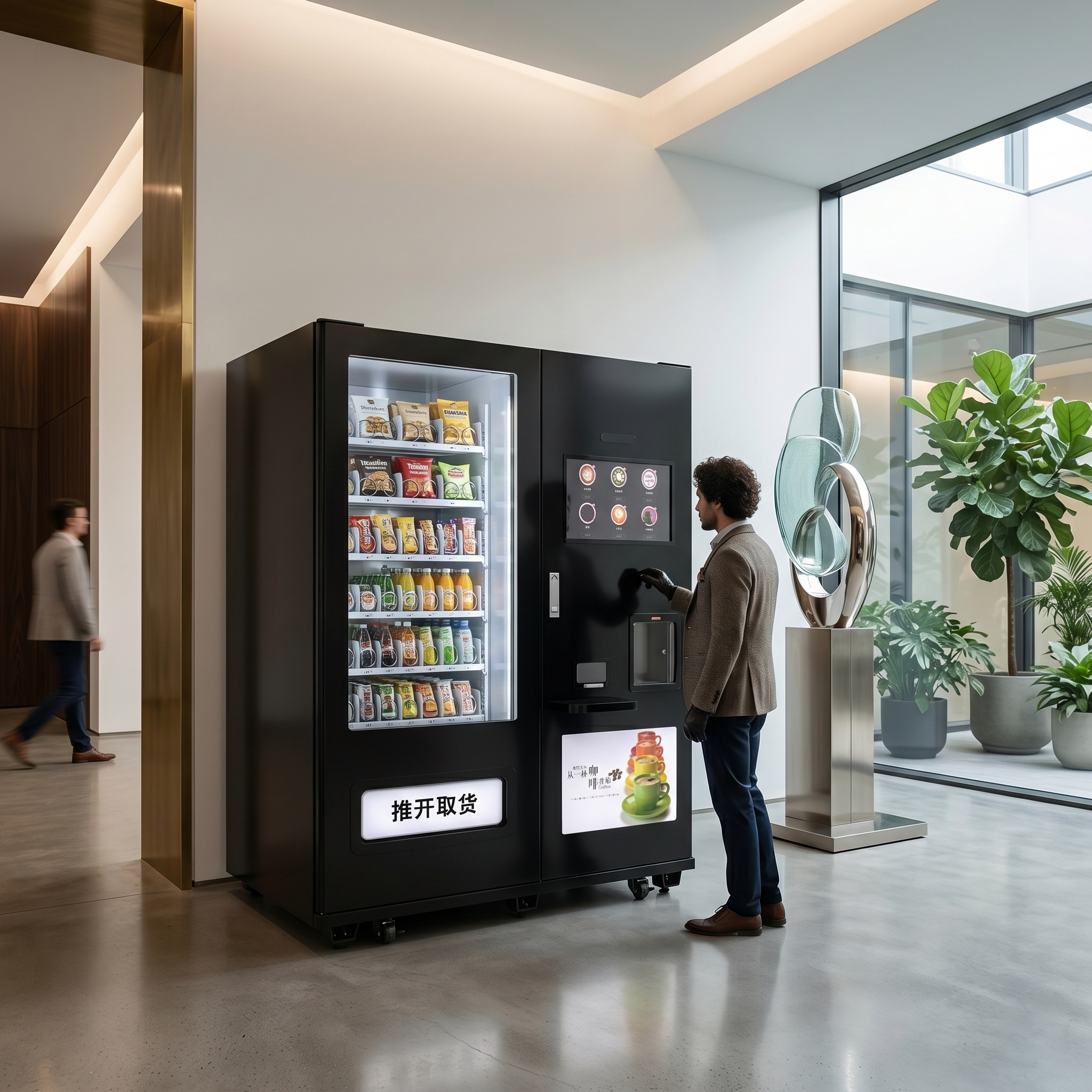 A modern smart vending machine is defined by its ability to merge traditional dispensing mechanics with digital connectivity. Unlike legacy machines that operate in isolation, smart units from top-tier Chinese factories function as networked retail nodes, offering real-time data exchange, remote troubleshooting, and interactive consumer experiences.
Which machine categories, technical configurations, and payment options matter
The physical configuration of smart vending machines varies widely based on the intended merchandise. Standard spiral-coil snack and beverage machines remain popular, but there is surging demand for elevator-style dispensers designed for fragile items, locker systems for oversized goods, and heated units for hot meals. Screen sizes are a major differentiator, with modern units frequently featuring 21.5-inch to 55-inch high-definition touchscreens for advertising and product selection.
Payment versatility is another critical configuration. Modern units must support seamless integration with global payment gateways like Nayax or Valina. This requires the inclusion of MDB (Multi-Drop Bus) protocols and DEX (Data Exchange Uniform Code) standard interfaces, enabling machines to accept EMV chip cards, NFC mobile payments (such as Apple Pay and Google Wallet), and localized QR code payment methods.
What does CE certification typically cover for vending equipment
For a vending machine to legally bear the CE mark, it must comply with several strict European directives. The Low Voltage Directive (LVD 2014/35/EU) ensures the machine is electrically safe for consumers and technicians, typically covering equipment operating between 50V and 1000V AC. Vending machines must safely handle standard 230V/50Hz power grids without risk of short circuits or electrical fires.
Additionally, the Electromagnetic Compatibility Directive (EMC 2014/30/EU) guarantees that the machine’s telemetry modules and touchscreens do not emit harmful radio frequencies that could interfere with other electronic devices, and conversely, that the machine is immune to external interference. Finally, the RoHS Directive (2011/65/EU) restricts the use of hazardous substances like lead and cadmium in the machine’s printed circuit boards and wiring.
Which comparison points should buyers use when evaluating smart vending machines
When evaluating CE-certified smart vending machines, buyers should systematically compare standard specifications against smart capabilities to ensure they are investing in future-proof technology. Key comparison points include energy efficiency, payment flexibility, and inventory tracking mechanisms.
| Feature | Standard Vending Equipment | CE-Certified Smart Vending |
|---|---|---|
| Payment Acceptance | Coin, bill validator only | Cashless, RFID, Mobile (NFC) |
| Power Consumption | 4.0 – 6.0 kWh/day | 2.5 – 3.5 kWh/day (Eco-mode) |
| Inventory Management | Manual route checks | Real-time cloud telemetry |
| User Interface | Push-button keypad | 21.5″ to 55″ HD touchscreen |
| Fault Diagnostics | On-site inspection required | Remote error code alerts |
By utilizing these comparison points, buyers can accurately assess whether a machine’s technical specifications justify its price and meet the operational demands of high-traffic commercial environments.
How Should Buyers Compare Smart Vending Machine Factories in China
Navigating the landscape of Chinese manufacturers requires a strategic approach to separate genuine, high-capacity factories from intermediaries. A thorough evaluation of a supplier’s production infrastructure, cost transparency, and quality control systems is essential to secure a reliable long-term manufacturing partner.
Which factory assessment criteria reveal real production strength
Real production strength is evidenced by a factory’s in-house capabilities rather than just their assembly lines. Buyers should look for manufacturers operating facilities of at least 10,000 to 20,000 square meters, equipped with automated laser cutting machines and CNC bending equipment for chassis fabrication. A factory capable of producing 1,000 to 3,000 units per month demonstrates the scale necessary to handle bulk orders efficiently.
Furthermore, the presence of an in-house software development team is a crucial indicator of a top-tier supplier. Smart vending requires continuous firmware updates and seamless API integrations with third-party inventory management software. Buyers should request downloads of the factory’s ISO 9001 quality management certificates and CE test reports directly from the manufacturer to verify their credentials.
What cost drivers most affect total landed cost
The ex-works (EXW) or Free on Board (FOB) price of a machine is only one component of the total landed cost. Material choices significantly impact pricing; for instance, opting for a 1.2mm galvanized steel chassis offers superior anti-vandalism protection compared to a standard 0.8mm chassis but will increase the raw material cost. Similarly, specifying globally recognized compressor brands like Embraco or Secop will add to the unit price but drastically reduce long-term maintenance expenses.
Logistics and shipping volumes are another major cost driver. A standard 40-foot High Cube (40HQ) shipping container can typically accommodate between 24 to 27 standard-sized vending machines. Maximizing container space is critical, as ocean freight costs can range from $1,500 to $4,000 per container depending on global shipping rates, effectively adding $60 to $150 in freight costs per machine.
Which comparison factors best separate suppliers on compliance and quality
Differentiating suppliers on compliance and quality requires looking beyond marketing claims and examining their standardized testing protocols. The best factories implement rigorous aging tests, running machines continuously for 48 to 72 hours before packaging to ensure refrigeration and motherboard stability.
| Supplier Tier | Production Capability | Quality Control Standards | Typical MOQ |
|---|---|---|---|
| Tier 1 (Direct OEM) | In-house sheet metal, custom API | 48-hour continuous aging test | 10 – 20 units |
| Tier 2 (Assembler) | Outsourced chassis, standard PCB | Spot checks prior to packing | 5 – 10 units |
| Trading Company | No direct manufacturing facilities | Reliant on third-party audits | 1 unit (high markup) |
By categorizing suppliers into these tiers, buyers can align their procurement strategy with their specific needs for customization, volume, and verifiable CE compliance.
What Practical Sourcing and Import Steps Reduce Risk When Ordering
Importing heavy, electrically complex equipment across international borders introduces inherent risks, from regulatory hold-ups at customs to potential transit damage. Implementing a structured sourcing and validation process is vital to mitigate these risks and ensure the hardware performs as expected upon deployment.
How should buyers verify CE documents, samples, and factory audits
The first step in risk reduction is the meticulous verification of compliance documents. Buyers must request the Declaration of Conformity (DoC) and the accompanying comprehensive test reports from recognized notified bodies (such as TUV, SGS, or Intertek). Documents should be cross-referenced to ensure the specific model numbers being ordered match those on the CE certificates.
Ordering a sample unit is an indispensable step before committing to bulk production. A sample allows the buyer’s technical team to physically test the payment gateway integration, assess the responsiveness of the touchscreen interface, and verify refrigeration performance—such as ensuring a beverage machine can drop to an internal temperature of 4°C within 45 minutes. If budget permits, hiring a third-party inspection agency to conduct a comprehensive factory audit and pre-shipment inspection (PSI) provides an additional layer of security.
What commercial terms, logistics planning, and installation requirements matter
Negotiating clear commercial terms establishes a framework for accountability. Standard international trade terms like FOB (Free on Board) or CIF (Cost, Insurance, and Freight) must be explicitly defined in the contract to determine liability during transit. Buyers must also ensure the machines utilize environmentally compliant refrigerants, such as R290 or R134a, which meet local greenhouse gas regulations in the destination country.
Post-delivery installation and maintenance planning should begin before the machines ever leave the factory. Buyers should negotiate a spare parts agreement; reputable manufacturers typically include 1% to 2% of total order value in free, high-wear spare parts (such as coin mechanisms, LED strips, or specialized cables). Exploring a supplier’s existing portfolio of standard products and securing detailed English-language service manuals will vastly simplify the installation process for local technicians.
How Can Buyers Decide Whether a CE-Certified Vending Supplier in
Choosing the right manufacturing partner ultimately comes down to aligning the factory’s capabilities with the buyer’s long-term business model. A successful procurement strategy looks beyond the initial price tag to evaluate the total lifecycle value of the equipment and the supplier’s commitment to ongoing support.
Which trade-offs matter most between price, speed, customization, and support
Buyers constantly navigate the trade-offs between price, speed to market, and the degree of customization. Purchasing off-the-shelf, standard CE-certified models allows for rapid deployment, often shipping within 15 days at the most competitive price points. However, standard models may lack the unique branding or specialized dispensing mechanisms required for niche retail concepts.
Conversely, deep customization—such as integrating proprietary robotic dispensing arms or developing a custom Android-based user interface—can extend production lead times to 30 or 45 days and require higher MOQs to absorb R&D costs. Furthermore, selecting the absolute lowest bidder often results in hidden costs down the line, particularly in the form of substandard after-sales support, delayed communication across time zones, or poorly translated technical documentation.
What final decision criteria help buyers select a supplier
The final decision should rest on a holistic evaluation of the supplier’s reliability and infrastructure. Key decision criteria include the clarity and duration of warranty terms; a standard benchmark in the industry is a 1-year warranty on the complete machine and a 3-year warranty on the compressor. Additionally, the availability of responsive, English-speaking technical support engineers who can assist with remote software diagnostics is paramount.
Further reading:
Key Takeaways
- The most important conclusions and rationale for CE certified vending China
- Specs, compliance, and risk checks worth validating before you commit
- Practical next steps and caveats readers can apply immediately
Frequently Asked Questions
Why choose a CE-certified vending machine from China?
It helps you enter the EEA faster, reduces compliance risk, and often lowers unit cost while keeping modern features like touchscreens, telemetry, and cashless payment support.
What CE directives usually apply to smart vending machines?
Most machines need compliance with LVD 2014/35/EU and EMC 2014/30/EU. If wireless modules are included, other directives may also apply depending on configuration.
How quickly can a China smart vending machine factory deliver?
Standard models are often produced in about 15–25 days. Custom builds may take longer based on screen size, payment hardware, branding, and software integration requirements.
Can YL Vending customize CE-certified machines for my brand?
Yes. YL Vending can typically support white-label branding, chassis colors, screen options, shelving layouts, and selected API or payment integrations for different product categories.
Which payment options should a CE-certified vending machine support?
Look for MDB and DEX compatibility plus EMV chip, NFC mobile payments, and gateway integration such as Nayax or Valina. This improves usability across European and international markets.

Kely
Post time: Jun-09-2026