

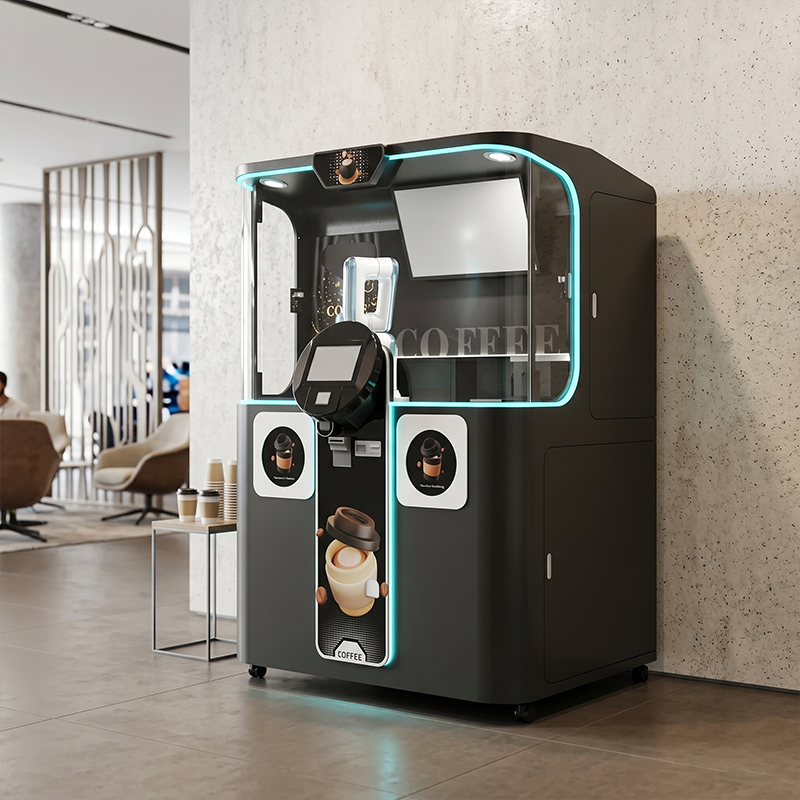
Choosing between a coffee robot and a self-service coffee kiosk affects more than drink quality—it shapes startup cost, maintenance needs, customer experience, and where the business can realistically operate. Although both models support unattended coffee service, they solve different problems: robots emphasize novelty, precision, and premium presentation, while kiosks often win on simplicity, footprint, and faster deployment. This comparison explains how each option performs in real operating environments, from office buildings to transit hubs, and what that means for revenue potential, labor savings, and customer appeal. By the end, readers will have a clearer basis for deciding which automated coffee setup fits their budget, location, and growth plan.
Why the Robot vs Kiosk Coffee Decision Matters
The automated retail beverage sector is undergoing rapid transformation, moving beyond traditional vending machines to sophisticated barista-level experiences. For commercial operators, facility managers, and entrepreneurs, choosing between a coffee robot and a standard self-service coffee kiosk represents a critical strategic decision. Both solutions eliminate the need for full-time staffing, but they cater to different capital requirements, spatial constraints, and consumer expectations.
Market drivers and customer demand
The demand for unattended retail has accelerated, driven by rising labor costs and shifting consumer preferences for contactless service. Industry data indicates that 24/7 automated coffee setups can capture up to 35% of their total daily revenue outside standard business hours, specifically between 8:00 PM and 6:00 AM. Modern consumers expect premium espresso, fresh milk, and diverse syrup options regardless of the time of day, pushing operators to invest in high-fidelity automated equipment.
Best-fit operating environments
Identifying the optimal environment is the first step in deployment. High-traffic transit hubs, such as airports and train stations, often benefit from the visual spectacle of automated systems. Conversely, corporate breakrooms, university libraries, and hospital waiting areas typically require efficient, low-footprint solutions that prioritize speed over entertainment. Operators looking to align their real estate with the right technology can explore various automated vending products to assess spatial compatibility and target demographics.
Coffee Robot vs Self-Service Kiosk: Key Differences
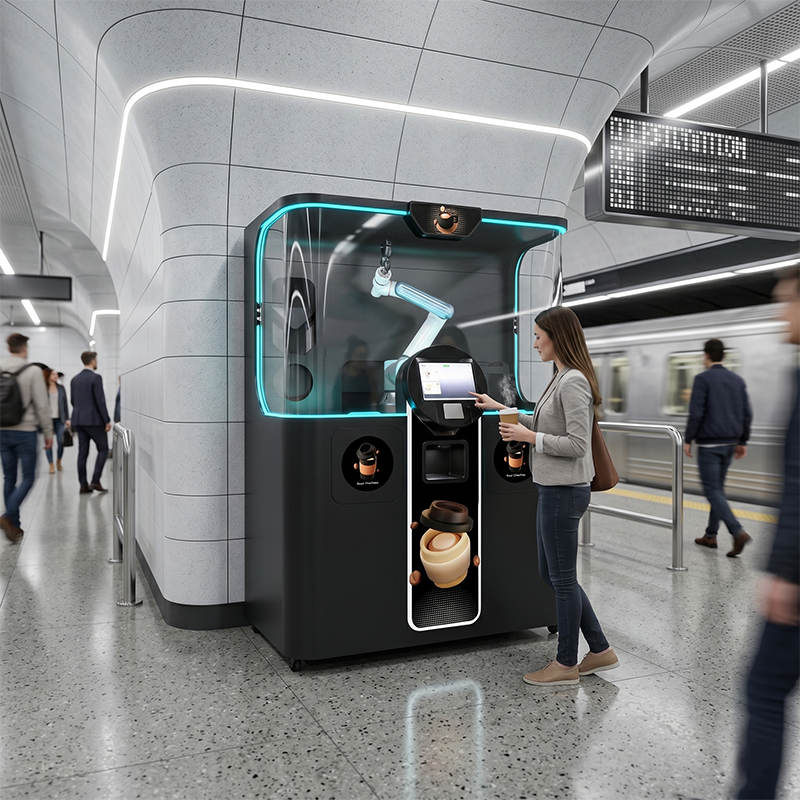
While both systems deliver premium coffee without human intervention, their architectural and mechanical approaches differ fundamentally. Understanding these differences is essential for evaluating long-term viability, maintenance schedules, and operational requirements.
Core functionality and service model
A coffee robot utilizes an articulated robotic arm—often a 6-axis collaborative robot—to mimic the motions of a human barista, physically moving cups between an espresso module, syrup dispensers, and a delivery window. In contrast, a self-service coffee kiosk houses all components internally, utilizing gravity and internal tubing to dispense coffee directly into a stationary cup. The robot model sells an experience and theatricality, whereas the kiosk model sells sheer convenience and speed.
Technical features to compare
Technical specifications vary widely between the two formats. Coffee robots require transparent safety enclosures, complex motion control software, and precise calibration to prevent spills. Kiosks rely on integrated modular components, touchscreen interfaces, and simplified fluid dynamics.
| Feature | Coffee Robot | Self-Service Kiosk |
|---|---|---|
| Mechanism | 6-axis robotic arm | Internal gravity/pump dispensing |
| Visual Appeal | High (Theatrical/Experiential) | Moderate (Functional/Sleek) |
| Average Footprint | 2.5 to 4.0 square meters | 1.0 to 1.5 square meters |
| Component Complexity | High (motion sensors, servos) | Low (solenoid valves, pumps) |
Cost, Throughput, and Customer Experience
The financial viability of an automated coffee business hinges on balancing the initial capital expenditure with the machine’s capacity to serve customers efficiently during peak operational rushes.
Total cost of ownership
Total cost of ownership (TCO) reveals a stark contrast between the two models. A fully equipped coffee robot typically demands an upfront investment ranging from $35,000 to $70,000, depending on the brand, software licensing, and custom enclosure requirements. Conversely, premium self-service coffee kiosks generally fall within the $6,000 to $15,000 range. The higher TCO for robots also includes specialized maintenance for the robotic arm and potentially higher insurance premiums due to the complex moving parts.
Speed, capacity, and reliability
Throughput directly impacts revenue, especially in high-density areas. A self-service kiosk typically dispenses a standard 12-ounce latte in 45 to 60 seconds, achieving a peak capacity of 60 to 80 cups per hour. A coffee robot, constrained by the physical movement and travel time of the arm between stations, often takes 90 to 120 seconds per beverage, limiting peak capacity to roughly 30 to 40 cups per hour. For locations with concentrated morning rushes, throughput speed is a critical variable.
Buyer comparison checklist
To aid in procurement, buyers must weigh these factors side-by-side. The following table illustrates the operational trade-offs between the two formats.
| Metric | Coffee Robot | Self-Service Kiosk |
|---|---|---|
| Initial Hardware Cost | $35,000 – $70,000 | $6,000 – $15,000 |
| Peak Speed (Cups/Hr) | 30 – 40 | 60 – 80 |
| Customer Dwell Time | 1.5 – 2.5 minutes | 0.75 – 1.0 minute |
| Target Price per Cup | $4.50 – $6.00 (Premium) | $2.50 – $4.00 (Standard) |
Operational, Compliance, and Deployment Risks
Deploying unattended retail equipment involves navigating strict health codes, safety regulations, and logistical challenges. Operators must account for the daily realities of keeping the machines clean, functional, and compliant with local laws.
Maintenance, cleaning, and monitoring
Daily maintenance routines differ significantly based on the machine’s architecture. Kiosks require standard flushing of milk lines and emptying of waste bins, usually taking an operator 15 to 20 minutes per day. Coffee robots require the same internal cleaning, plus meticulous wiping of the robotic arm, safety glass, and external sensors to maintain their premium aesthetic, which can take 30 to 45 minutes daily. Both systems rely heavily on IoT telemetry to alert operators when bean hoppers or milk fridges drop below the 10% capacity threshold.
Safety, payment, and accessibility requirements
Safety and accessibility are legally binding constraints. In the United States, machines must meet ADA (Americans with Disabilities Act) standards, requiring touchscreens and retrieval areas to be situated no higher than 48 inches from the floor. Furthermore, coffee robots must feature auto-stop collision sensors and CE/UL certifications to ensure the robotic arm cannot injure a user reaching into the dispensing bay during operation.
Footprint, utilities, and installation
Facility requirements can dictate the feasibility of a project. A self-service kiosk typically operates on a standard 110V/15A or 220V/10A circuit and can utilize internal 19-liter water jugs if direct plumbing is unavailable. Coffee robots generally demand a dedicated 220V/20A circuit, direct water lines with commercial filtration, and floor drains due to the larger volume of water used in automated rinsing cycles. To learn more about facility integration and supplier backgrounds in this space, operators can review about us materials from established manufacturers.
How to Choose the Right Coffee Solution
Selecting the optimal automated coffee system requires a methodical assessment of location dynamics, capital availability, and target audience expectations.
Step-by-step decision framework
Operators should apply a standard break-even framework before purchasing. If a location guarantees a baseline of 50 cups per day at a $4.00 price point, a $10,000 kiosk will achieve hardware ROI in approximately 4 to 5 months, assuming a standard 50% gross margin. A $50,000 robot in the exact same location would require over two years to break even. Therefore, robots must be placed in locations that support higher price points ($5.00 or more) and higher daily volumes to justify the heavy initial investment.
When a robot is better than a kiosk
A coffee robot is the superior choice for high-visibility environments where the machine serves as a destination or an attraction. Luxury shopping malls, flagship corporate headquarters, and high-end entertainment venues benefit from the modern, innovative image projected by a robotic arm. In these settings, customers are willing to pay a premium for the novelty, and the slower dispensing speed is offset by the entertainment value provided during the wait.
When a kiosk is the better choice
A self-service kiosk is the better choice for strictly utilitarian environments. Hospitals, manufacturing facilities, universities, and standard office buildings prioritize speed, reliability, and cost-efficiency over theatricality. When the primary goal is to provide excellent coffee quickly without a massive upfront investment, kiosks deliver superior ROI and operational stability. Operators ready to discuss specific deployment strategies and obtain detailed quotes should contact us to evaluate their site requirements and match them with the ideal hardware.
Further reading:
Key Takeaways
- The most important conclusions and rationale for robot vs kiosk coffee
- Specs, compliance, and risk checks worth validating before you commit
- Practical next steps and caveats readers can apply immediately
Frequently Asked Questions
Which is better for a small footprint location?
A self-service coffee kiosk is usually better. It fits in about 1.0–1.5 m², making it practical for offices, libraries, hospitals, and compact retail spaces.
When does a coffee robot make more sense than a kiosk?
Choose a coffee robot when visual appeal drives traffic, such as in airports, malls, trade shows, or flagship spaces where the barista-like performance can attract customers.
Which option serves more customers during rush hours?
A self-service kiosk typically serves more. It can produce about 60–80 cups per hour, while a coffee robot often reaches around 30–40 cups per hour.
How do startup costs compare between a coffee robot and a kiosk?
Coffee robots usually cost about $35,000–$70,000, while self-service coffee kiosks are often around $6,000–$15,000, with simpler maintenance and lower ownership costs.
Where can I compare automated coffee solutions for my site?
You can review YL Vending’s automated vending options at ylvending.com/products/ to compare machine formats, space needs, and deployment fit for your location.

Kely
Post time: Jun-13-2026