

 Introduction
For brands and operators planning a coffee vending product line, working with a manufacturer in China can offer more than lower unit cost. It can also shorten development cycles, support custom hardware and software, and make private-label expansion more practical at scale. This article explains how China coffee machine OEM partnerships are structured, what commercial buyers should evaluate before selecting a supplier, and which technical and operational factors affect long-term performance. By the end, readers will have a clearer basis for comparing manufacturers, defining OEM requirements, and reducing sourcing risk before moving into production.
Why Is a China Coffee Machine OEM Strategy Gaining Attention
The global landscape of unattended retail and automated beverage dispensing is undergoing a significant transformation. Sourcing commercial equipment through a China coffee machine OEM strategy has become increasingly attractive for international operators and brands. By leveraging mature supply chains and advanced manufacturing ecosystems, importers can achieve a 20% to 30% reduction in total production costs compared to domestic assembly, without sacrificing technological sophistication.
This strategic shift is driven by the need for rapid hardware iteration. As operators demand more intelligent, connected devices, Chinese manufacturers have positioned themselves at the intersection of precision hardware engineering and software integration, enabling faster time-to-market for custom vending solutions.
How do commercial buyers evaluate a coffee vending machine
Commercial buyers approach the evaluation of automated coffee equipment with a focus on total cost of ownership (TCO) and operational reliability. In high-traffic environments such as hospitals, universities, and corporate campuses, machines are expected to maintain an uptime of at least 99%. Consequently, buyers scrutinize the durability of core mechanical components, including grinder burrs, brewing units, and boiler systems.
Beyond mechanical endurance, operators evaluate software flexibility. An effective OEM partner must provide robust application programming interfaces (APIs) or proprietary management software that allows buyers to monitor ingredient levels, track sales data, and perform remote diagnostics, thereby reducing on-site maintenance visits by up to 40%.
Which market trends are increasing demand for China coffee machines
Several distinct market trends are accelerating the demand for customized manufacturing. The transition toward unattended retail, which is expanding at a compound annual growth rate (CAGR) of approximately 15%, requires machines capable of operating autonomously for extended periods. Consumers increasingly expect premium, café-quality beverages on demand, shifting the market preference from traditional instant powder dispensers to complex bean-to-cup systems.
Additionally, the global push toward cashless and contactless transactions mandates that modern machines integrate seamlessly with various digital payment gateways. Chinese OEMs are uniquely equipped to meet these trends, offering modular designs that can be rapidly adapted to include QR code scanners, NFC readers, and biometric payment systems tailored to specific regional markets.
What Should Buyers Compare When Selecting a Coffee Vending Machine
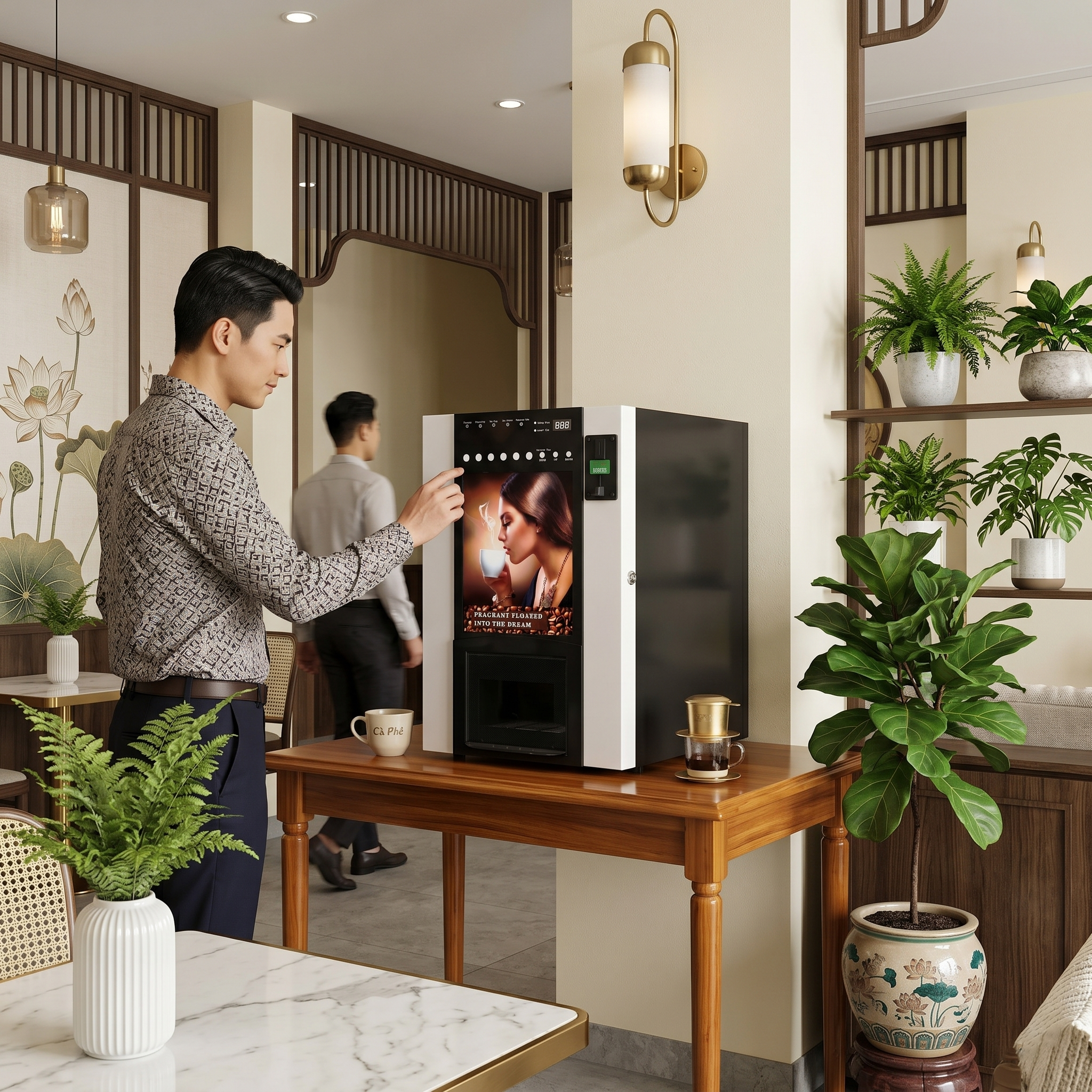 Selecting the appropriate equipment requires a meticulous comparison of technical specifications, modular capabilities, and user interfaces. Importers must align the hardware configurations with the specific consumption habits and volume requirements of their target deployment locations.
Which product specifications and beverage formats matter most
The most critical specification involves the brewing mechanism and beverage format. High-end environments demand bean-to-cup extraction, which requires commercial-grade grinders and pump pressures ranging from 9 to 15 bar to ensure proper espresso crema. Conversely, high-volume, cost-sensitive locations may favor instant soluble systems for rapid dispensing. Buyers must also evaluate boiler capacity, typically ranging from 1.5 liters for office models to over 3.0 liters for heavy commercial use, to ensure consecutive cup dispensing without temperature drops.
| Specification | Bean-to-Cup Models | Instant Powder Models |
|---|---|---|
| Extraction Pressure | 9 – 15 Bar | N/A (Gravity/Mixing) |
| Dispense Time | 45 – 60 seconds | 10 – 15 seconds |
| Maintenance Needs | High (Daily cleaning) | Low (Weekly flushing) |
| Target Environment | Premium offices, lounges | Transit hubs, factories |
Reviewing an OEM’s existing China coffee machine OEM portfolio can help buyers determine if the factory possesses the baseline architecture needed for their specific beverage formats.
How do payment options, capacity, and configuration compare
Capacity and configuration directly impact the frequency of restocking and overall profitability. Commercial machines are generally evaluated on their internal cup-holding capacity, which can range from 150 cups in compact tabletop units to over 500 cups in freestanding models. Ingredient canister volume is equally crucial; standard configurations include one coffee bean hopper (typically 1.5kg to 2kg capacity) and three to five soluble powder canisters for milk, chocolate, and tea.
Payment configuration must be highly adaptable. A standardized MDB (Multi-Drop Bus) protocol is mandatory, allowing operators to plug and play various payment peripherals. Buyers should ensure the machine’s control board can simultaneously support bill validators, coin changers, and modern cashless telemetry devices without requiring extensive software rewrites.
What support, tooling, and sample validation should buyers review
For brands seeking proprietary designs, evaluating the OEM’s tooling capabilities is essential. Customizing the exterior housing or user interface panel often involves creating new plastic injection molds. Buyers should review the supplier’s tooling timeline, which typically requires 30 to 45 days, and understand the ownership rights of these custom molds.
Sample validation is the final critical step before mass production. A rigorous validation phase involves running the prototype through hundreds of dispensing cycles to test volumetric consistency, temperature stability, and software reliability. Comprehensive technical support during this phase ensures that any necessary engineering adjustments are finalized before scaling up.
How Do Quality Control, Compliance, and Certification Affect Coffee Mach
Because coffee vending machines process consumables intended for human consumption and operate with high-wattage heating elements, regulatory compliance is non-negotiable. Rigorous quality control frameworks and adherence to international safety standards protect importers from liability and ensure market access.
Which manufacturing controls and traceability systems reduce risk
Effective risk mitigation begins on the factory floor. Leading manufacturers implement ISO 9001-certified quality management systems, ensuring consistent oversight from incoming material inspection (IQC) to final assembly. Traceability systems, often utilizing barcode or RFID tracking, allow the factory to trace every core component—such as the water pump or mainboard—back to its specific production batch.
To guarantee field reliability, factories must employ stringent end-of-line testing. This typically includes a 48-hour continuous operation burn-in test under high humidity and temperature conditions. Such rigorous manufacturing controls are designed to keep out-of-box defect rates strictly below the industry benchmark of 1%.
How do CE, CB, RoHS, and food-contact requirements apply
Market entry depends entirely on securing the correct certifications. Electrical safety is governed by standards such as CE for the European market and CB scheme certification for broader international acceptance. These standards ensure that the machine’s 1500W to 3000W heating elements and high-pressure boilers operate safely without risk of electrical shorting or fire. RoHS compliance is also mandatory, verifying that electronic components are free from hazardous substances like lead and cadmium.
Equally important are food-contact regulations. Every internal component that touches water, coffee beans, or milk powder must be certified safe for human consumption. This requires compliance with FDA standards in the US or LFGB standards in Europe. Buyers must verify that boilers are constructed from food-grade 304 or 316 stainless steel, and that all internal tubing utilizes certified food-grade silicone.
What Are the Real Cost Drivers, Lead Times, and Logistics
Accurate financial planning requires a transparent understanding of the manufacturing and logistics ecosystem. Importers must look beyond the initial factory quotation to calculate the true landed cost, factoring in development fees, production timelines, and international freight realities.
How should buyers break down tooling, BOM, and unit costs
The unit cost of a commercial coffee machine is dictated by its Bill of Materials (BOM). Typically, electronics and touchscreens account for 25% to 30% of the cost, precision mechanical parts (brewers, grinders, motors) represent 35% to 40%, and the sheet metal or plastic housing makes up 15% to 20%. The remainder covers assembly labor and factory overhead.
When developing a proprietary model, buyers must budget for tooling costs. Custom plastic injection molds for a unique machine fascia can range from $10,000 to $30,000, depending on complexity. Amortizing these tooling costs over a Minimum Order Quantity (MOQ)—often set between 50 and 100 units—is crucial for determining the final unit price and projected ROI.
What process steps shape forecasting, pilot orders, and production timing
Production timing is a critical variable in inventory forecasting. The typical lifecycle begins with a pilot order of 10 to 50 units, which requires approximately 30 to 45 days to manufacture. This pilot phase allows operators to deploy machines in controlled environments to monitor software stability and hardware performance.
Once the pilot is approved, mass production lead times generally span 45 to 60 days. Buyers must build buffer periods into their launch schedules to account for component shortages—particularly for specialized items like imported Italian water pumps or advanced telemetry boards—and the time required for final pre-shipment quality inspections.
Which trade-offs exist between sea and air freight
Logistics represent a substantial portion of the landed cost due to the size and weight of commercial vending equipment. A standard freestanding coffee machine can weigh between 40kg and 80kg, making freight strategy vital to maintaining profit margins.
| Freight Method | Average Transit Time | Cost Implication | Best Use Case |
|---|---|---|---|
| Sea Freight (FCL/LCL) | 25 – 40 Days | $100 – $200 per CBM | Mass production, routine restocking |
| Air Freight | 5 – 7 Days | Highly expensive (Weight-based) | Urgent prototypes, pilot units |
| Rail (Asia to Europe) | 15 – 20 Days | Moderate | Mid-sized urgent European orders |
Working closely with a China coffee machine OEM that understands container optimization can significantly reduce shipping costs. Designing machines with modular components or optimized packaging dimensions allows buyers to fit more units into a standard 40-foot HQ container, thereby lowering the freight cost per unit.
How Should Importers Choose the Right Coffee Vending Machine Supplier
Identifying a manufacturer capable of producing high-quality equipment is only half the challenge; securing a partner who aligns with long-term strategic goals is equally critical. A systematic approach to supplier vetting ensures a stable, scalable supply chain.
Which supplier selection checklist helps match buyer needs
A comprehensive supplier selection checklist should prioritize engineering capability over mere assembly capacity. Buyers should verify the factory’s R&D headcount; a competent OEM partner typically employs at least 10 to 15 dedicated engineers specializing in thermodynamics, fluid mechanics, and software integration. This expertise is vital for troubleshooting complex issues like temperature fluctuations during high-volume dispensing.
Furthermore, buyers must assess the supplier’s production capacity to ensure they can scale alongside the operator’s growth. A reliable factory should demonstrate the ability to produce upwards of 2,000 units per month. Conducting third-party factory audits to verify these claims, assess working conditions, and review financial stability is a highly recommended practice.
What final decision steps reduce risk and shorten launch time
To finalize the partnership and minimize intellectual property risks, importers should execute robust legal agreements. Signing a comprehensive NNN (Non-Disclosure, Non-Use, Non-Circumvention) agreement drafted under Chinese jurisdiction prevents the factory from replicating proprietary designs or selling custom machines to competitors.
Finally, establishing clear post-sale support terms is crucial for shortening deployment times and maintaining field uptime. Buyers should negotiate a Service Level Agreement (SLA) that dictates a warranty period—typically 12 to 18 months for core components—and guarantees the availability of spare parts for at least five years after the machine’s production run ends. Securing an upfront commitment for a spare parts kit (often 1% to 2% of the total order value shipped free with mass production) ensures operators can immediately service machines upon deployment.
Further reading:
Key Takeaways
- The most important conclusions and rationale for China coffee machine OEM
- Specs, compliance, and risk checks worth validating before you commit
- Practical next steps and caveats readers can apply immediately
Frequently Asked Questions
What are the main benefits of choosing a China coffee machine OEM supplier?
Lower production cost, faster customization, and mature supply chains. A capable OEM can also integrate payments, telemetry, and branding for quicker market launch.
How can I compare bean-to-cup and instant coffee vending machines?
Choose bean-to-cup for premium taste and espresso-style drinks; choose instant for faster service and lower maintenance. Match the machine to your location’s volume and price point.
What specifications matter most for commercial coffee vending machines?
Focus on brewing system, pump pressure, boiler size, cup capacity, and ingredient canisters. Also check payment compatibility, remote management, and expected uptime for your site.
Can YL Vending provide OEM customization for coffee vending machines?
Yes. YL Vending can support OEM needs such as machine branding, payment modules, software features, and configuration based on your target market and deployment scenario.
What should I ask a China OEM before placing a coffee machine order?
Ask about MOQ, lead time, certifications, spare parts, software support, API or backend access, warranty terms, and after-sales service for your country or region.

Kely
Post time: Jun-06-2026