

Introduction
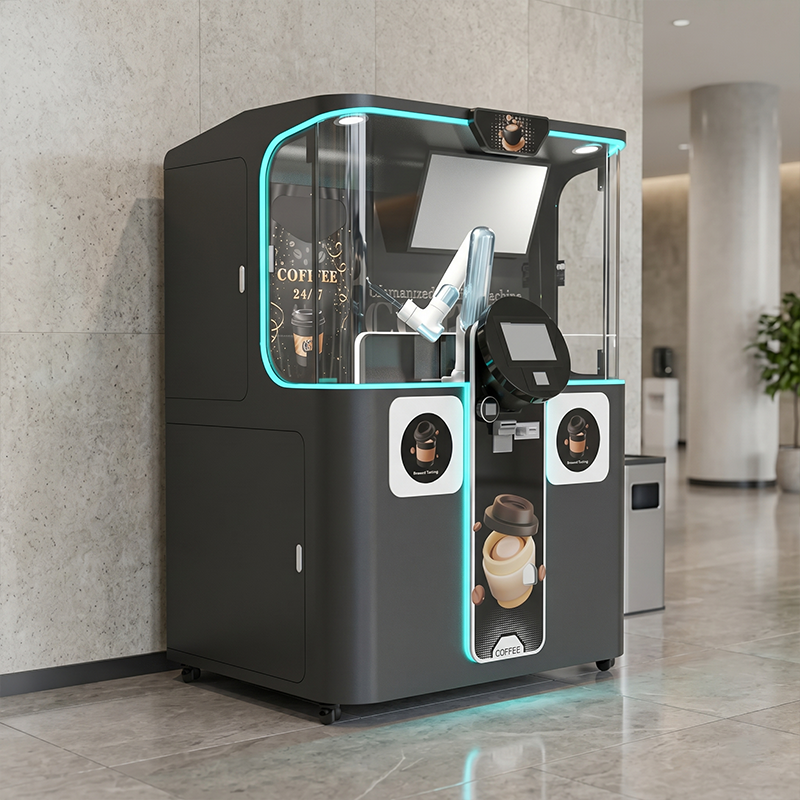
For airports, coffee service is no longer just a passenger amenity; it is a revenue and operations decision shaped by uneven traffic, labor shortages, and round-the-clock demand. An airport coffee robot addresses these pressures by delivering consistent drinks in compact spaces, extending service beyond staffed hours, and improving revenue per square foot. This article explains what buyers should look for in a commercial robot barista machine supplier, including throughput, footprint, reliability, maintenance support, payment integration, and deployment fit for terminal environments, so you can evaluate whether automated coffee service aligns with your airport’s retail and passenger experience goals.
Why Airport Coffee Robots Are a Strategic Investment
Aviation hubs are fundamentally redesigning their food and beverage strategies to maximize revenue per square foot. The deployment of automated retail solutions has transitioned from a novelty to an operational necessity, driven by the need to monetize non-traditional terminal spaces and provide premium amenities across all hours of operation.
Passenger flow, labor constraints, and 24/7 service
Airports experience highly volatile passenger flows, with extreme peaks during morning departures and steady trickles during late-night or red-eye operations. Staffing traditional cafes to accommodate this volatility often results in inefficient labor utilization, exacerbated by retail turnover rates that frequently exceed 40% annually in transit environments. An advanced airport coffee robot provides a continuous, 24/7 service model that captures revenue during off-peak hours without incurring variable shift costs. High-performance automated units can maintain a consistent throughput of 50 to 80 cups per hour, effectively matching the volume of a fully staffed dual-group espresso machine during rush periods.
Key commercial goals for buyers
Procurement directors and terminal managers prioritize solutions that optimize the revenue-to-footprint ratio. Traditional coffee concessions require minimum footprints of 15 to 20 square meters to accommodate queuing, preparation, and back-of-house operations. In contrast, automated robotic kiosks typically occupy less than 3 square meters of floor space. This ultra-compact footprint allows operators to activate dead zones, such as gate hold rooms and baggage claim areas. The primary commercial goals for buyers include achieving a capital payback period of under 18 months, increasing the transaction capture rate among transient travelers, and maintaining strict adherence to premium quality standards to justify specialty coffee price points.
Technical and Operational Specifications That Matter Most
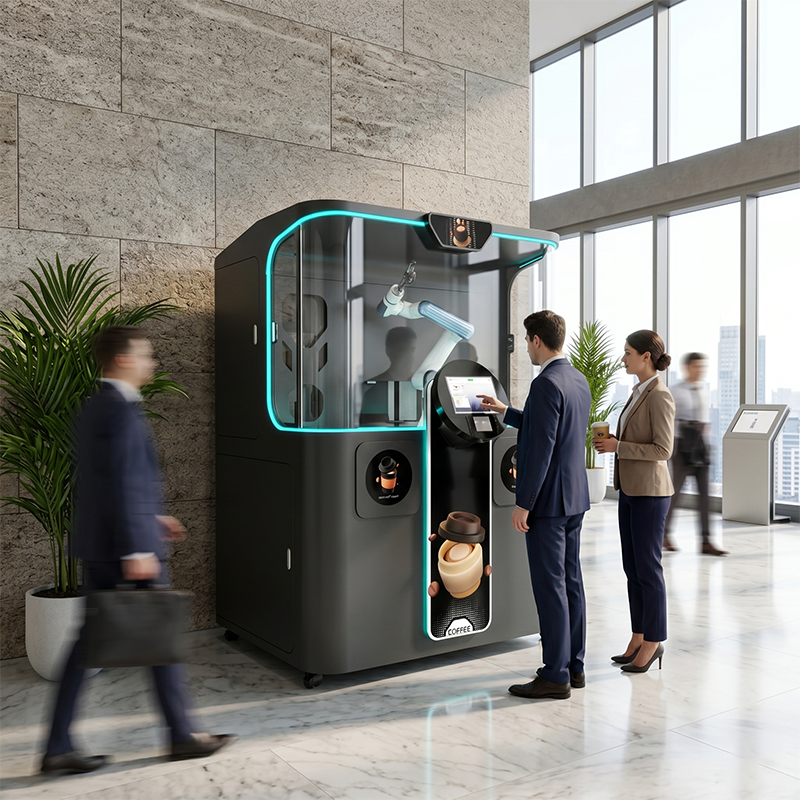
Deploying automated barista systems in high-traffic aviation environments requires rigorous evaluation of hardware capabilities. The operational intensity of an airport demands industrial-grade components capable of sustaining constant use without degradation in beverage quality.
Capacity, consistency, footprint, and uptime
Operational capacity and mechanical reliability are the cornerstones of automated transit retail. Top-tier units are engineered for a daily capacity of 150 to 200 cups before requiring physical restocking of beans, milk, and cups. To ensure commercial viability, operators must demand a documented machine uptime of at least 99.5%. Beverage consistency is achieved through precision internal components, including commercial dual-boiler systems that maintain stable thermal dynamics and rotary pumps capable of delivering a precise 9-bar extraction pressure for authentic espresso.
Integration, ingredient systems, and payment options
Modern robotic baristas must seamlessly interface with existing airport digital ecosystems. This includes API integrations for pre-ordering via airport mobile applications or loyalty programs. Ingredient systems are a critical point of differentiation; premium units utilize dual bean hoppers (typically 2x 1.5kg capacity) to offer distinct roasts, alongside sophisticated automated milk frothing systems that handle both dairy and plant-based liquid alternatives rather than powdered substitutes. Payment terminals must be universally compatible, supporting multi-currency EMV, NFC, and mobile wallet transactions while adhering to strict PCI-DSS security standards. Evaluating these features ensures the airport coffee robot meets the expectations of international travelers.
Comparison criteria for airport coffee robots
When comparing automated systems against traditional concessions, operators must evaluate specific performance metrics to determine the optimal deployment strategy. The table below outlines standard comparison criteria for terminal deployments:
| Operational Metric | Automated Barista Kiosk | Traditional Terminal Cafe |
|---|---|---|
| Physical Footprint | 2.5 – 3.5 sq meters | 15.0 – 25.0 sq meters |
| Peak Throughput | 60 – 80 cups / hour | 90 – 120 cups / hour |
| Operating Hours | 24/7 continuous | Typically 05:00 – 22:00 |
| Daily Labor Cost | Minimal (1 restock/day) | High (2-3 shifts, multiple staff) |
| Restock Interval | Every 150 – 200 cups | Continuous internal inventory |
How to Assess a Commercial Robot Barista Supplier
Procuring a commercial robotic barista is a long-term capital commitment. Evaluating the original equipment manufacturer (OEM) or supplier requires looking beyond the initial hardware specifications to assess their manufacturing maturity, software ecosystem, and post-installation support infrastructure.
Manufacturing quality, software support, and service capability
A supplier’s manufacturing quality is often validated by internationally recognized certifications, such as ISO 9001 for quality management systems. Buyers should request data on the Mean Time Between Failures (MTBF), targeting robotic arms and brewing modules rated for a minimum of 10,000 to 15,000 cycles. Software support is equally critical; the supplier must provide a robust cloud-based telemetry platform. Over-the-air (OTA) update capabilities allow operators to remotely adjust extraction profiles, monitor real-time ingredient depletion, and diagnose sensor faults before they result in machine downtime. Service capability must include a guaranteed Service Level Agreement (SLA) with maximum response times, typically requiring a technician on-site within 4 to 6 hours for critical failures.
Total cost of ownership, warranty, and spare parts
Calculating the Total Cost of Ownership (TCO) involves analyzing the initial capital expenditure against ongoing operational costs. Hardware acquisition costs for a commercial-grade airport coffee robot generally range from $30,000 to $60,000, depending on the complexity of the robotic articulation and integrated telemetry. However, buyers must also factor in monthly software licensing fees, preventive maintenance contracts (averaging $200 to $400 per month), and utility consumption. Comprehensive warranty terms are vital; industry standards dictate at least a 12-month full-coverage warranty on parts and labor, with guaranteed localized availability of proprietary spare parts for a minimum of 5 to 7 years post-purchase.
Compliance, Safety, and Logistics Factors
Installing automated food service equipment in an airport terminal involves navigating a complex matrix of regulatory approvals, safety standards, and highly restrictive logistical protocols.
Food safety, electrical, payment security, and site approval
Food safety compliance is non-negotiable. Robotic baristas must carry sanitation certifications such as NSF/ANSI 4, verifying that all food-contact surfaces are easily cleanable and resistant to microbial growth. Electrical systems must bear UL or CE marks to satisfy local building codes and airport fire marshal inspections. Furthermore, because these machines process hundreds of unsupervised transactions daily, payment security requires rigorous adherence to PCI-PTS 5.x standards to protect traveler financial data. Site approval within a terminal also requires detailed architectural submissions, proving the unit does not obstruct emergency egress routes or violate ADA (Americans with Disabilities Act) accessibility reach parameters.
Shipping, installation, utilities, customs, and onboarding
The logistics of terminal deployment are notoriously difficult. Moving a machine that often exceeds 300kg requires specialized rigging and must be coordinated during overnight maintenance windows to minimize passenger disruption. Units must clear stringent TSA or local aviation security checkpoints, requiring transparent manifests and pre-approved contractor badges. Installation demands precise utility connections; most commercial units require a dedicated 220V/30A electrical circuit and a direct plumbed water line integrated with a commercial reverse osmosis (RO) filtration system to protect the boilers from scale buildup. Customs clearance for imported machinery and the subsequent staff onboarding for daily restocking routines typically extend the deployment timeline by 3 to 4 weeks.
How Airport Operators Can Choose the Right Solution
Transitioning from concept to successful terminal deployment requires airport authorities and concessionaires to execute a structured, data-driven procurement process. Selecting the right robotic barista involves testing assumptions through controlled pilot programs before committing to fleet-wide rollouts.
Step-by-step sourcing and pilot process
The sourcing journey should commence with a highly specific Request for Proposal (RFP) outlining the terminal’s utility constraints, target demographics, and expected revenue shares. Following initial vendor shortlisting, operators are advised to implement a 90-day pilot program in a secondary concourse or high-dwell-time gate area. This pilot phase is critical for validating the supplier’s uptime claims and assessing traveler adoption rates. Success metrics must be rigidly defined prior to the pilot; for instance, a unit may need to achieve a minimum threshold of 100 cups sold per day and maintain a 98% uptime rate to qualify for a permanent, multi-unit contract.
Decision criteria for final supplier selection
Final supplier selection should be quantified using a weighted decision matrix that balances capital costs against operational reliability and user experience. Operators must look past the novelty of the robotics and focus on commercial viability and long-term partnership stability.
| Evaluation Criterion | Weighting | Key Performance Indicators (KPIs) |
|---|---|---|
| Hardware Reliability | 30% | MTBF > 10,000 cycles, verifiable 99.5% uptime |
| Beverage Quality & UX | 25% | Extraction consistency, multi-lingual UI, order speed |
| Service & Support SLA | 25% | < 4-hour on-site response, localized spare parts |
| Financial Profile (TCO) | 20% | CapEx within budget, acceptable maintenance fees |
Further reading:
Key Takeaways
- The most important conclusions and rationale for airport coffee robot
- Specs, compliance, and risk checks worth validating before you commit
- Practical next steps and caveats readers can apply immediately
Frequently Asked Questions
Why is an airport coffee robot a good investment?
It serves 24/7, reduces labor dependence, and uses under 3 square meters, helping airports monetize gate areas and other small spaces.
How many cups can an airport coffee robot handle per hour?
Commercial units typically produce about 50 to 80 cups per hour, which is suitable for most terminal rush periods.
What footprint is usually required for deployment?
Most airport coffee robot kiosks need roughly 2.5 to 3.5 square meters, far less than a traditional café.
What features should buyers check before choosing a supplier like YL Vending?
Check uptime targets, cup capacity, API integration, payment compatibility, ingredient handling, certifications, and after-sales service response.
Can the machine support international airport payment needs?
Yes, quality systems should support EMV, NFC, mobile wallets, and multi-currency payments while meeting PCI-DSS security requirements.

Kely
Post time: Jun-10-2026