

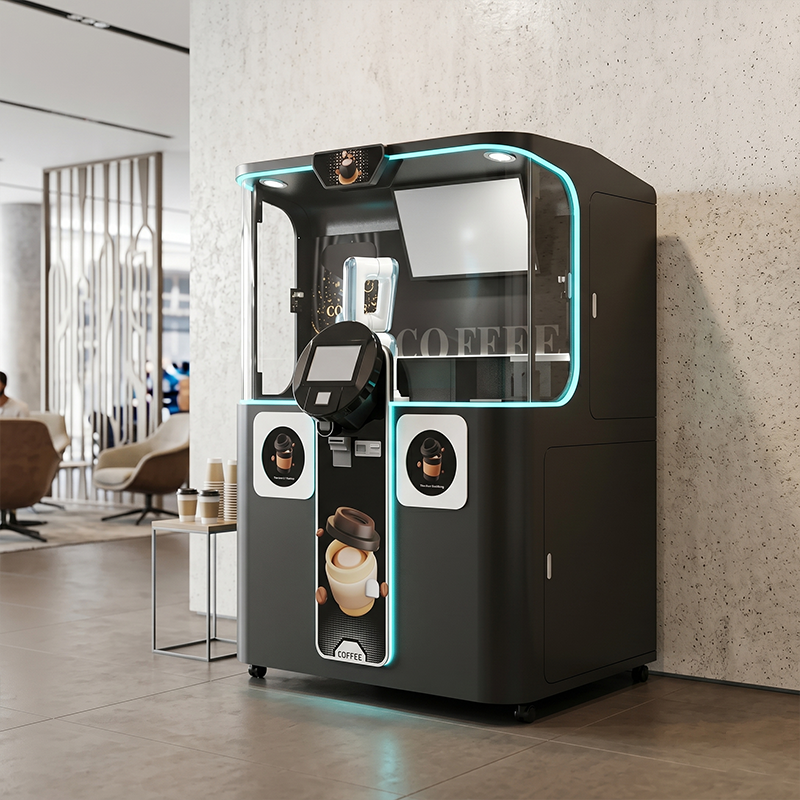
 A robotic arm coffee machine can improve operational efficiency by combining beverage preparation, customer interaction, payment, and remote monitoring in one automated workflow. The greatest gains come from reducing repetitive manual steps, standardizing recipes, extending service availability, and using operating data to plan replenishment and maintenance. Results depend on menu design, traffic volume, cleaning routines, payment integration, and site support.
- Automation reduces repeated preparation and transaction steps, but does not remove the need for cleaning, replenishment, and technical support.
- A robot coffee machine creates the most value where demand is predictable and labor coverage is limited.
- Remote monitoring helps operators identify stock, temperature, payment, and fault conditions before they disrupt service.
- Efficiency should be measured through uptime, completed orders, service time, waste, replenishment effort, and customer satisfaction.
- The best deployment combines hardware, software, menu engineering, and an operating plan rather than treating the arm as a standalone attraction.
Choosing a robotic arm coffee machine is an operational decision, not only a technology purchase. The 2022 FDA Food Code specifies a minimum handwashing duration of 20 seconds for food employees, illustrating why automated beverage systems still require clearly designed hygiene procedures. A well-configured coffee robot can improve consistency and service coverage when its workflow, sanitation controls, remote management, and replenishment model are designed together.
What Does a Robotic Arm Coffee Machine Actually Automate?
The main efficiency benefit is workflow integration: one system can coordinate ordering, ingredient preparation, cup handling, beverage delivery, and status reporting.
A conventional staffed coffee station often depends on several separate actions: receiving the order, preparing ingredients, operating the brewer, adding milk or other components, presenting the drink, collecting payment, and cleaning the work area. A robotic arm coffee machine can connect many of these actions through programmed sequences. The arm is only one part of the system; grinders, brewers, pumps, refrigeration, sensors, payment hardware, and software determine the practical result.
The machine can also make operating steps more repeatable. A digital recipe can specify ingredient selection, dispensing sequence, cup position, and presentation logic. This does not guarantee identical results in every environment because bean age, water quality, temperature, maintenance, and ingredient storage still affect the drink. It does, however, create a more controlled process than relying entirely on individual operator habits.
Automation is valuable only when the whole service loop is designed
The most effective robot coffee machine deployment connects customer demand with back-end operations.
- Customers select a menu item through a screen, mobile interface, or integrated ordering channel.
- The system validates payment and checks whether required ingredients and equipment are available.
- The machine prepares the beverage through a programmed recipe and coordinated equipment sequence.
- The operator receives status information for replenishment, cleaning, fault response, and sales analysis.
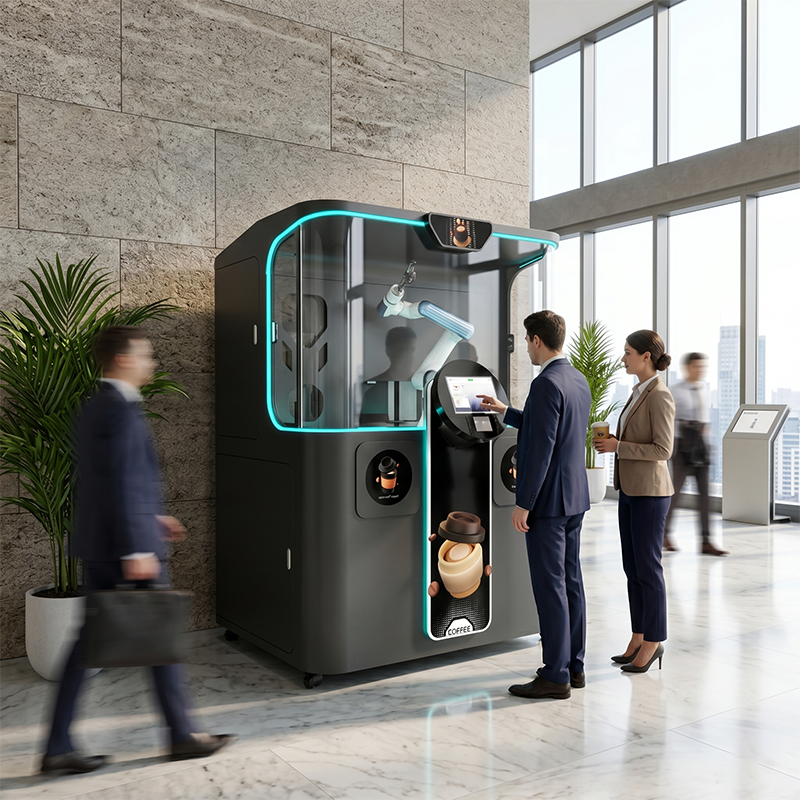
This approach is particularly relevant for offices, campuses, factories, hotels, transport facilities, and mixed-use developments where a full staffed café may be difficult to justify during every service period.
Five Ways a Coffee Robot Can Improve Operational Efficiency
1. Lower dependence on repetitive labor
A single automated station can handle repeatable preparation and transaction tasks without requiring a dedicated employee to remain beside the counter throughout the service period.
The practical labor benefit is not that every task disappears. Operators still need to refill ingredients, remove waste, clean food-contact areas, inspect equipment, and respond to exceptions. The benefit is that human attention can shift from constant order assembly to scheduled support and higher-value customer or facility work.
2. Extend service availability
An automated station can provide a more consistent service window than a small staffed counter with limited opening hours.
This matters in locations with early shifts, late meetings, overnight production, or irregular visitor traffic. A coffee robot can serve as an additional sales point when a café is closed, provided the site has suitable security, utilities, connectivity, and replenishment access. Operators should define the intended service window and response process before installation rather than assuming that automation automatically creates unattended reliability.
3. Standardize recipes and portions
Digital recipes make preparation logic easier to replicate across locations and shifts.
Standardization supports menu control, training, procurement, and customer expectations. It can also simplify the comparison of product performance between sites. However, recipes must be reviewed for local preferences, allergen communication, cup sizes, milk options, and ingredient availability. A smaller menu with well-tested recipes can be more efficient than a large menu that creates frequent exceptions and replenishment complexity.
4. Reduce avoidable downtime through monitoring
Remote monitoring turns a vending-style coffee station into a managed operating asset rather than an isolated appliance.
Useful data points include machine availability, order status, ingredient levels, payment events, temperature alerts, cleaning reminders, error codes, and daily sales patterns. The operator can use this information to prioritize site visits and prepare the correct parts or supplies. A remote dashboard cannot repair a mechanical failure, but it can shorten the time between detection and intervention.
5. Improve use of limited floor space
A single robotic coffee station can combine production and customer-facing interaction in a compact commercial footprint.
This is useful in office lobbies, hotel common areas, factory break rooms, school buildings, and transport facilities where a traditional café layout may not fit. The correct evaluation should include queue space, refill access, waste handling, electrical supply, water or drainage requirements, ventilation, accessibility, and cleaning clearance. A visually impressive installation can still perform poorly if operators cannot service it efficiently.
How to Measure Efficiency After Installation
Efficiency should be evaluated with operational evidence rather than with the presence of a robotic arm alone.
| Metric | What it measures | How to calculate it | Why it matters |
|---|---|---|---|
| Availability | Time the station is ready for orders | Ready operating time divided by planned operating time | Shows whether the asset is commercially usable |
| Order completion rate | Orders completed without operator intervention | Completed automated orders divided by total automated orders | Reveals workflow stability |
| Intervention rate | Frequency of manual assistance | Manual interventions divided by total orders | Identifies hidden labor demand |
| Waste rate | Ingredients or cups discarded | Discarded quantity divided by issued quantity | Connects recipe control with purchasing |
| Mean response time | Speed of fault or refill response | Elapsed time from alert to resolution | Shows the quality of remote operations |
Operators should record a baseline before changing the service model. Compare the automated station with the previous process using the same location, menu scope, trading periods, and accounting method. Avoid claiming labor savings from sales volume alone, because higher demand can increase replenishment, cleaning, and support requirements.
 Robotic Arm Coffee Machine Versus Other Automated Formats
The right format depends on the desired balance between interaction, throughput, footprint, and operational complexity.
| Format | Primary strength | Customer interaction | Operational consideration | Suitable environment |
|---|---|---|---|---|
| Robotic arm coffee machine | Visible automation and repeatable preparation | High | Requires coordinated cleaning, ingredient control, and service access | Public venues, offices, hotels, campuses |
| Fresh-ground automatic coffee machine | Bean-to-cup preparation with a familiar service model | Low to medium | Focuses on grinder, brewer, milk, water, and waste maintenance | Workplaces, hospitality, reception areas |
| Instant coffee machine | Simple preparation and fast menu execution | Low | Requires powder or liquid ingredient control and regular cleaning | Factories, staff areas, high-frequency locations |
| Desktop coffee vending machine | Compact deployment and flexible placement | Medium | Capacity and refill access must match the site profile | Small commercial spaces and offices |
A visible arm is most valuable when customer experience and brand differentiation influence purchase decisions. A simpler automated format may be more efficient where the priority is fast service, limited menu variety, or easy maintenance. Procurement teams should compare total operating requirements rather than judging systems by appearance.
What Can Reduce the Efficiency of a Coffee Robot?
Poor operating design can erase the benefits of automation even when the machine itself performs correctly.
Menu complexity
Every additional ingredient, cup format, customization, or preparation exception can add inventory requirements and failure points. Start with a focused menu that reflects the site audience, then expand only when sales and service data support the change.
Cleaning and food safety
Automated equipment still has food-contact surfaces, ingredient lines, dispensing areas, and waste containers that require documented attention. The FDA Food Code 2022 provides a recognized reference for food safety practices, but local authorities and site-specific procedures determine the applicable requirements. Operators should define who cleans each component, when the task occurs, how completion is recorded, and what happens when a cleaning task is missed.
Weak replenishment planning
Stockouts can interrupt sales even when the machine is technically available. Remote inventory alerts should be combined with delivery routes, minimum stock rules, shelf-life controls, and a clear ownership model. The person receiving an alert must know whether to refill, dispatch field support, or take the machine temporarily offline.
Unclear exception handling
Payment failures, cup jams, ingredient errors, network interruptions, and customer complaints need predefined responses. A system that works only in the ideal workflow will generate avoidable support costs.
How Remote Management Supports Scalable Operations
Remote management creates value when it helps an operator make faster and better decisions.
A suitable platform can connect machine status, sales information, stock signals, and service records. This allows operators to identify underperforming locations, adjust menus, schedule visits, and investigate repeated faults. The data should be presented in practical terms: which machine needs attention, what action is required, and how urgent the issue is.
Digital risk management is also relevant when a coffee robot uses cameras, customer interfaces, payment systems, or AI-enabled service functions. The NIST AI Risk Management Framework organizes AI risk work around Govern, Map, Measure, and Manage functions. Although the framework is not a coffee-machine specification, it offers a useful structure for reviewing data access, human oversight, system limitations, and incident response.
Deployment Checklist for a Single Robot Coffee Machine
A site survey should be completed before selecting the final configuration.
- Confirm electrical, water, drainage, connectivity, floor loading, ventilation, lighting, and customer access conditions.
- Define the target audience, expected demand pattern, payment preferences, language requirements, and allergen information.
- Set the initial menu around ingredient availability, cleaning effort, cup compatibility, and customer demand.
- Assign responsibility for opening checks, replenishment, cleaning, fault response, cashless payment support, and escalation.
- Agree on the performance dashboard, reporting frequency, spare-parts process, warranty coverage, and remote support method.
- Run a controlled launch, document exceptions, and revise recipes or service routines before expanding to additional sites.
For multi-country deployments, the specification should also address local payment systems, labeling, electrical requirements, language support, data handling, and food-service rules. These details often determine whether an installation remains efficient after the initial launch.
Frequently Asked Questions
Can one robotic arm coffee machine replace a staffed café?
Not in every setting. It can automate repeatable beverage and transaction tasks, but staffing may still be needed for cleaning, replenishment, maintenance, customer support, and broader food-service operations. It is better viewed as an automated service point or labor-extending asset.
Is a coffee robot suitable for an office building?
Yes, when the building has a stable user base, suitable utilities, refill access, and a clear support plan. Office deployments benefit from predictable demand, cashless payment, compact placement, and remote monitoring.
How does remote monitoring improve operations?
It helps operators identify availability problems, stock conditions, payment issues, and error codes without waiting for a customer complaint. Its value depends on accurate sensors, useful alerts, connectivity, and a defined response process.
Does automation eliminate cleaning work?
No. Automated beverage equipment still requires cleaning and sanitation of relevant food-contact and waste-handling components. The cleaning schedule should follow the equipment design, ingredients used, manufacturer instructions, and applicable local food-safety requirements.
What payment options should a robot coffee machine support?
The answer depends on the market and customer profile. Common requirements include card, mobile wallet, QR, cashless account, or campus and workplace payment integration. Operators should confirm transaction reporting, refunds, connectivity, and local currency support before procurement.
How should a buyer compare robotic coffee machines?
Compare the complete operating model: beverage quality, menu flexibility, preparation workflow, refill frequency, cleaning access, remote diagnostics, payment compatibility, service response, software integration, customization, and total ownership requirements.
What information should be included in a supplier quotation?
Request the machine configuration, menu scope, utilities, installation conditions, software functions, payment options, consumables, cleaning responsibilities, training, warranty terms, spare-parts process, lead time, customization scope, and after-sales support model.
About the Manufacturer
Yile Shangyun develops commercial self-service equipment and integrated retail solutions covering fresh-ground and instant coffee machines, desktop coffee vending systems, ice equipment, combination vending machines, and AI service terminals. Its delivery model combines hardware, software, IoT monitoring, OEM and ODM customization, and operational support for offices, hotels, schools, factories, airports, and community sites. Explore the company solutions or contact the team through the official website to discuss a suitable configuration and deployment plan.

Post time: Sep-28-2026