

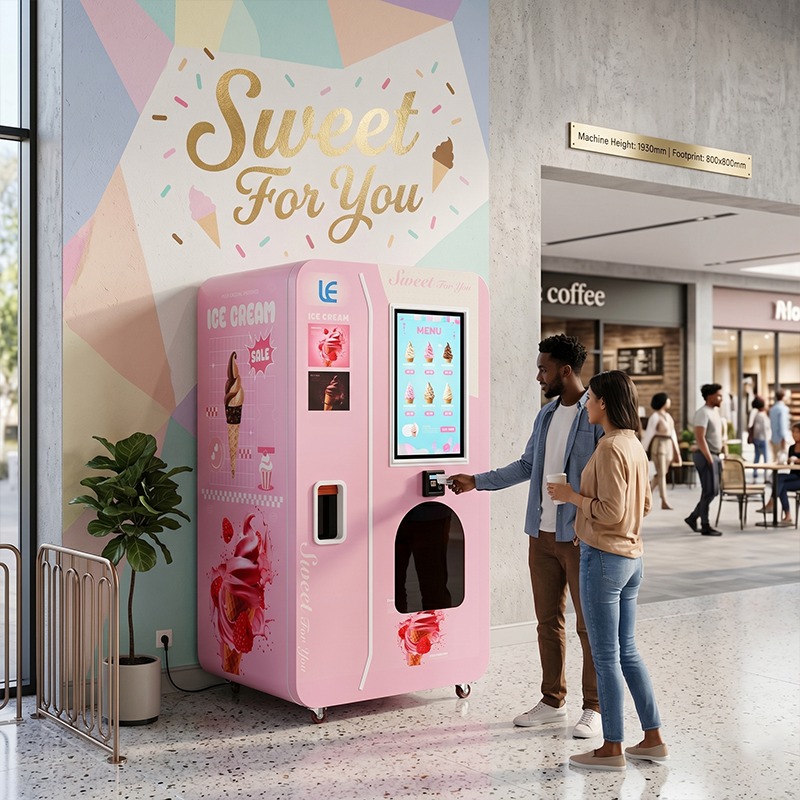
- Ice cream vending creates an additional self-service revenue point near cinemas, family zones, entrances, and waiting areas.
- Wholesale purchasing can simplify equipment deployment, product planning, spare-parts management, and multi-site standardization.
- Food safety depends on maintaining frozen products at the required temperature, controlling loading practices, and documenting cleaning checks.
- Remote monitoring can help operators track stock, payment status, alerts, and service requirements across multiple locations.
- The best shopping mall vending strategy combines equipment, software, replenishment, maintenance, and clear ownership of daily tasks.
Ice cream vending machines can benefit malls by combining convenience, compact retail infrastructure, and measurable self-service operations. The United States Food and Drug Administration Food Code identifies 41 degrees Fahrenheit, or 5 degrees Celsius, as the maximum temperature for many refrigerated time and temperature control foods; frozen dessert operators should still follow the product label, local rules, and the equipment maker’s validated operating instructions. This article explains how to evaluate wholesale deployment, placement, hygiene, economics, technology, and customer experience.
Why Shopping Mall Vending Needs More Than a Machine
The primary benefit of shopping mall vending is broader service availability without the footprint of a conventional food counter.
In a mall, customers may want a quick treat while moving between stores, waiting for a film, supervising children, or leaving an entertainment area. A staffed kiosk may be impractical in every high-potential location because it requires counter space, labor scheduling, storage, and daily opening and closing procedures. An ice cream vending machine can place a focused product offer closer to demand while preserving the option of centralized replenishment.
The commercial value comes from the operating system around the cabinet. A reliable program normally includes frozen product planning, payment processing, temperature or fault alerts, inventory visibility, cleaning procedures, customer support, and a defined route for replenishment. Without these elements, a machine may become an attractive but poorly maintained fixture.
Where an Ice Cream Vending Machine Works Best
Placement should follow customer dwell time and purchase motivation rather than simply available floor space.
| Mall environment | Customer need | Useful operating focus | Relevant measurable signal |
|---|---|---|---|
| Family entertainment zone | Quick treat and visible choice | Bright interface, simple payment, frequent restocking | Units sold by product and time period |
| Cinema or leisure entrance | Convenience before or after an activity | Fast transaction flow and queue-aware placement | Transactions by operating session |
| Food court perimeter | Alternative to a full meal purchase | Clear pricing and coordinated cleaning | Sales compared with nearby foot traffic |
| Hotel or mixed-use connection | After-hours access to a cold dessert | Remote alerts and dependable payment recovery | Downtime and service tickets |
Family-oriented zones often provide strong product-market alignment, but operators should check sightlines, electrical access, cleaning access, queue behavior, and landlord requirements before installation. A machine placed beside a crowded doorway may create obstruction, while one hidden behind retail displays may receive little attention.
How Wholesale Vending Machine Procurement Creates Scale
Wholesale procurement is most valuable when it standardizes the customer experience and reduces operational variation across locations.
A single-site buyer may focus on cabinet appearance and purchase price. A multi-site mall operator must also evaluate delivery planning, spare components, software access, payment integration, language options, warranty handling, and staff training. Standardized equipment can make operator training easier and allow common merchandising rules across properties, while customization may be justified for local products, mall branding, or regional payment methods.
Before approving a purchase, procurement teams should request a complete operating scope rather than a cabinet-only quotation. The scope should clarify what is included for installation, commissioning, payment setup, remote management, software updates, replacement parts, technical support, and preventive maintenance.
- Define the product format: packaged frozen items, cups, bars, or a mixed assortment.
- Confirm loading access, storage requirements, power requirements, and delivery routes.
- Specify accepted payment methods and the process for failed or reversed transactions.
- Request a documented cleaning and maintenance schedule suitable for the intended site.
- Agree on ownership of stock, refunds, customer complaints, and emergency service.
Product, Temperature, and Food Safety Controls
Frozen dessert vending requires a documented cold-chain routine from delivery through customer purchase.
The precise operating temperature depends on the product, package, equipment design, and applicable jurisdiction. Operators should not treat a generic marketing specification as a food safety limit. The FDA Food Code 2022 provides a recognized reference for food safety controls, including temperature requirements for time and temperature control foods. Local health authorities and product labels remain controlling where their requirements differ.
| Control area | Reference value | Why it matters | Operator action |
|---|---|---|---|
| Cold food reference in the FDA Food Code | 41 degrees Fahrenheit or 5 degrees Celsius | Helps control growth of harmful microorganisms for applicable refrigerated foods | Use the local code and product instructions when setting and checking equipment |
| Hand hygiene practice | 20 seconds | Reduces transfer of contamination during loading and cleaning | Follow the CDC handwashing procedure before handling products or food-contact surfaces |
| Temperature deviation response | Site-specific | A warm cabinet may indicate a fault, overloaded system, blocked airflow, or door problem | Isolate affected stock according to the approved food safety procedure and investigate |
The Centers for Disease Control and Prevention guidance on handwashing recommends washing with soap and water for 20 seconds. In a mall environment, the practical requirement is consistency: staff should know when to wash hands, which surfaces require cleaning, how spills are handled, and when products must be removed from sale.
Operators should also inspect seals, doors, vents, dispensing areas, payment surfaces, and visible condensation. Cleaning frequency should reflect traffic, product format, local rules, and the machine manufacturer’s instructions rather than an arbitrary schedule.
Technology That Improves Shopping Mall Vending
Remote monitoring is useful because it turns an unattended cabinet into a manageable operating point.
A connected vending platform may provide stock visibility, sales reports, fault alerts, temperature alerts, payment status, and service history. These functions help a route operator decide whether a machine needs replenishment or technical attention before a customer encounters an empty selection or failed transaction.
Data should support decisions, not replace them. A low-sales machine may need a better location, different product assortment, clearer pricing, or improved visibility. A high-sales machine may need more frequent replenishment, additional stock capacity, or a revised delivery route. Operators should review sales together with availability, downtime, refunds, and customer feedback to avoid confusing low demand with poor service.
Customer Experience and Accessibility
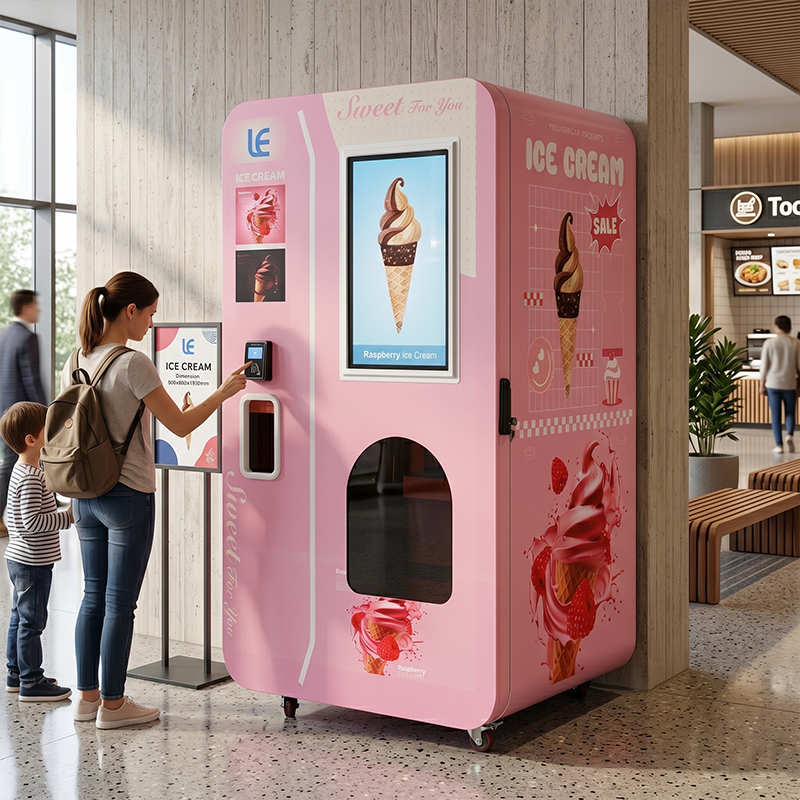
Ease of use is a commercial requirement because customers often make an ice cream purchase quickly and without assistance.
The interface should display product names, prices, allergens where required, payment instructions, and collection guidance in clear language. The purchase path should be understandable to visitors who may not know the local payment conventions. If a machine serves international shoppers, language selection and familiar payment options can reduce abandoned transactions.
Accessibility should be assessed with the mall’s facilities team and applicable local requirements. Consider reach ranges, screen visibility, floor clearance, glare, audio or visual prompts, and the ability to complete a purchase without unnecessary physical effort. The machine should not narrow an accessible route or create a hazard in a busy circulation area.
 Operational Economics: What to Measure
The correct business case compares contribution from the machine with the full cost of making it available and reliable.
Useful measures include gross sales, product margin, payment fees, rent or revenue share, electricity, replenishment labor, product waste, maintenance, refunds, downtime, and customer support. Operators should also separate one-time installation costs from recurring operating costs. A cabinet with strong sales but frequent service interruptions may produce less value than a slower machine that remains available and easy to maintain.
| Metric | What it reveals | Decision supported | Review approach |
|---|---|---|---|
| Availability rate | How often the machine can accept a valid purchase | Repair, spare-parts, or connectivity priority | Compare transaction logs with fault records |
| Product sell-through | Which items move at a given site | Assortment and shelf-space changes | Review by item, location, and season |
| Refund rate | How often transactions require recovery | Payment or dispensing investigation | Match refund records to machine events |
| Replenishment efficiency | Whether service visits match actual demand | Route and delivery planning | Compare visit time with stock movement |
These measures are especially important for a wholesale vending machine rollout because a small process weakness can repeat across multiple sites. A pilot should therefore test the complete workflow, including delivery, loading, payment recovery, cleaning, fault escalation, and customer assistance.
Common Deployment Mistakes
The most frequent failure is treating the vending cabinet as a passive appliance instead of a retail operation.
- Choosing a location only because it is vacant, without checking visibility, dwell time, electrical access, and pedestrian flow.
- Offering too many slow-moving products before sales data identifies local preferences.
- Assigning replenishment to a team without defining responsibility for cleaning, refunds, and fault escalation.
- Ignoring payment failure recovery and leaving customers without a clear support route.
- Measuring sales without checking stockouts, downtime, temperature events, and product waste.
A controlled launch should begin with a documented site survey, a limited assortment, trained operators, a fault-response process, and a review point after enough operating data has accumulated. The objective is not merely to install equipment; it is to verify that the site can sustain product quality, customer trust, and practical service costs.
How to Select a Wholesale Partner
The best supplier is one that can support the complete lifecycle of the deployment.
Ask whether the supplier can provide equipment configuration, OEM or ODM adaptation, software integration, payment localization, remote management, spare parts, technical documentation, and after-sales support. Review how the supplier handles firmware or software updates, warranty claims, replacement components, and training for local operators.
A supplier with experience across vending, beverages, coffee, ice-making, and connected service terminals may be able to coordinate a broader unattended retail environment. However, buyers should still evaluate each product category against its own hygiene, storage, maintenance, and customer-service requirements.
FAQ
Are ice cream vending machines suitable for shopping malls?
Yes, when the site has suitable power, safe circulation space, visible customer demand, and a defined replenishment and cleaning process. Family entertainment zones, cinema areas, food court edges, and mixed-use connections are common candidates.
What products can an ice cream vending machine sell?
The available assortment depends on the machine design. Common options include packaged bars, cups, cones, and other frozen products that fit the cabinet, temperature range, dispensing method, and local labeling requirements.
How often does a mall vending machine need to be restocked?
There is no universal schedule. Restocking should be based on sales velocity, cabinet capacity, delivery routes, seasonal demand, and the risk of stockouts. Connected sales and inventory data can help establish a site-specific routine.
How should operators manage food safety?
Operators should follow local food regulations, product instructions, and equipment guidance. They should monitor temperature, inspect the cabinet, maintain clean contact surfaces, control loading practices, document deviations, and remove affected stock according to the approved procedure.
Can customers pay by card or mobile wallet?
Many commercial systems can be configured for cashless payments, but supported methods depend on the payment hardware, processor, market, and local connectivity. Payment testing should be completed before launch and repeated after service work.
Does remote monitoring eliminate on-site maintenance?
No. Remote monitoring can identify alerts, sales patterns, and service needs, but staff still need to replenish products, clean surfaces, inspect the cabinet, manage physical faults, and respond to customer issues.
What should a mall request in a wholesale quotation?
Request the equipment scope, delivery terms, installation requirements, payment configuration, software functions, warranty coverage, spare-parts availability, training, maintenance responsibilities, customer support process, and any customization costs. A clear scope makes different suppliers easier to compare.
About the Manufacturer
Yile Shangyun develops commercial self-service equipment and integrated solutions for coffee, beverages, ice, vending, and AI service applications. Its approach combines hardware, software, IoT monitoring, configurable payment and language options, OEM or ODM support, and operational services. This model is designed for malls, offices, airports, hotels, schools, factories, and other unattended or lightly staffed environments. Contact the team to discuss site requirements, product configuration, and a practical deployment plan.

Post time: Sep-18-2026