

Introduction
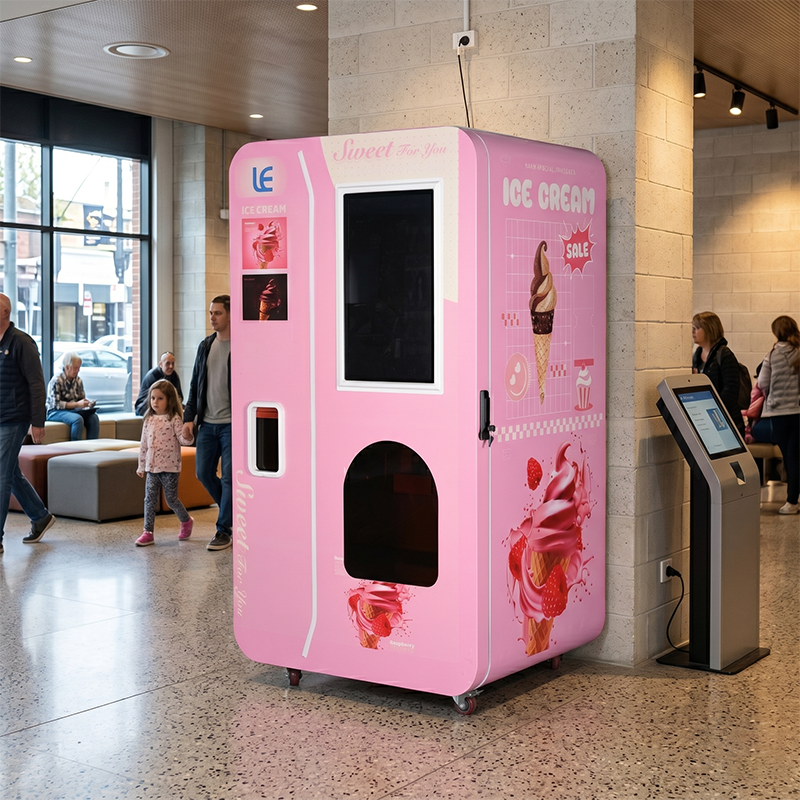
Choosing between an ice cream vending machine and an ice cream kiosk affects far more than how dessert is sold. The two formats differ in footprint, staffing, product range, customer interaction, and daily operating costs, which means the right option depends on location, volume, and service goals. This comparison explains where automated vending creates an advantage through compact, standardized, low-labor sales, and where kiosks justify their larger space and higher overhead with customization and stronger in-person engagement. By the end, readers will have a practical framework for evaluating which model fits their site, budget, and customer experience strategy.
Ice Cream Vending vs Kiosk: Key Differences
The commercial frozen dessert sector presents operators with two distinct retail deployment strategies: automated vending and traditional kiosk models. Analyzing ice cream vending vs kiosk operations reveals fundamental differences in capital allocation, operational footprint, and consumer engagement. While kiosks rely on human interaction and spatial dominance, vending leverages high-density automation to capture impulse purchases.
Spatial requirements establish the first operational boundary. A standard automated unit occupies approximately 1.5 to 2.0 square meters, allowing for micro-retail integration in tight corridors. In contrast, a fully equipped kiosk demands 10.0 to 15.0 square meters, excluding necessary customer queuing zones, effectively requiring dedicated real estate within a facility.
Equipment, product, and service model
Vending architectures typically utilize either robotic arm delivery systems for soft-serve or elevator-and-conveyor mechanisms for pre-packaged novelties. These systems prioritize high-density storage and mechanical reliability, operating within highly controlled internal micro-climates. Conversely, kiosk equipment matrices are inherently diversified, requiring commercial batch freezers, specialized soft-serve machines, and ventilated dipping cabinets.
The service model of a kiosk is consultative, allowing staff to offer samples and customize complex orders, which drives brand loyalty but introduces human error and labor constraints. In contrast, automated systems deliver absolute consistency, dispensing a standardized product from a frozen dessert machine with zero variance in portion control or presentation.
Location economics and customer throughput
Location economics diverge sharply based on customer throughput capabilities and operating hours. Vending machines generate revenue 24/7 without marginal labor costs, capturing off-peak demand in continuous-operation environments like hospitals or manufacturing facilities. However, their physical throughput is mechanically limited; a high-performance robotic vending unit processes approximately 45 to 60 transactions per hour.
A well-staffed kiosk, operating with two to three employees during peak periods, can execute 120 to 150 orders per hour. This makes the kiosk model superior for managing sudden, massive surges in foot traffic, though it suffers from zero revenue generation during unstaffed overnight hours.
| Metric | Automated Vending | Traditional Kiosk |
|---|---|---|
| Operational Footprint | 1.5 – 2.0 sq meters | 10.0 – 15.0 sq meters |
| Peak Throughput | 45 – 60 orders/hr | 120 – 150 orders/hr |
| Operating Hours | 24/7 Unattended | Fixed shift (8-12 hours) |
| Portion Variance | 0% (Mechanically fixed) | 5-10% (Human variance) |
Costs, Margins, and Labor
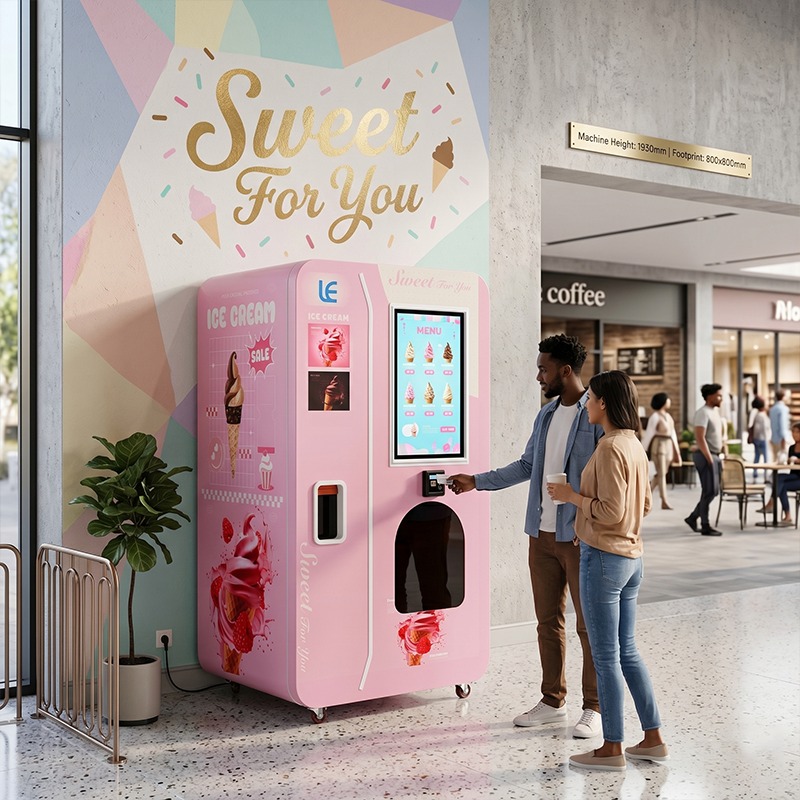
The financial architecture of frozen dessert retail requires rigorous analysis of capital expenditures (Capex), operating expenses (Opex), and unit-level economics. Operators must weigh the upfront equipment costs against long-term operational liabilities, particularly regarding the compounding cost of human capital.
Capex, opex, and maintenance
Initial Capex for an automated vending unit ranges from $5,000 for standard pre-packaged dispensers to $15,000 or more for advanced robotic soft-serve systems. Installation is generally limited to electrical and network provisioning. Kiosk development requires substantially higher Capex, typically ranging from $30,000 to $80,000, driven by custom millwork, plumbing installations, sophisticated point-of-sale systems, and multiple commercial-grade freezing units.
Opex profiles reflect the inverse of these initial costs. Kiosk operations routinely dedicate 25% to 35% of gross revenue to labor and payroll taxes, whereas vending operations incur virtually zero direct point-of-sale labor costs. Maintenance for vending involves routine mechanical servicing and software updates, whereas kiosks require ongoing commercial refrigeration maintenance, higher utility consumption, and facility upkeep.
Ticket size, upsell potential, and replenishment
Traditional kiosks excel in maximizing the average transaction value. Through strategic upselling of premium toppings, multi-scoop combinations, and complementary beverages, kiosk ticket sizes frequently average between $6.00 and $12.00. The interactive nature of human service naturally facilitates these add-ons and premium upgrades.
Vending transactions are typically rigid, yielding average ticket sizes of $3.00 to $6.00 per vend based on fixed inventory. However, vending replenishment models benefit from route-based efficiency. Operators utilize IoT telemetry to monitor inventory levels in real-time, allowing a single route technician to service 10 to 15 machines daily, which dramatically reduces the per-unit replenishment cost compared to managing complex kiosk supply chains.
Compliance, Logistics, and Site Requirements
Deploying frozen dessert infrastructure necessitates strict adherence to food safety protocols and logistical precision. The transition from a centralized production facility to the point of sale involves rigorous cold chain management and compliance with municipal health codes, which treat automated and staffed retail very differently.
Food safety, sanitation, permits, and local codes
Regulatory compliance varies significantly between unattended and staffed models. Health departments require kiosks to maintain commercial-grade sanitation standards, universally mandating three-compartment sinks for utensil washing, separate handwashing stations, and staff food handler certifications.
Automated vending circumvents many of these structural requirements by eliminating human contact with the product. High-end soft-serve frozen dessert machine units utilize advanced self-pasteurization cycles, heating the liquid mix to 65°C (149°F) nightly before returning it to holding temperatures, alongside integrated ozone or UV-C sterilization protocols. Pre-packaged vending requires minimal health permitting, provided the equipment possesses recognized UL and NSF certifications.
Cold chain, sourcing, and restocking needs
Maintaining the integrity of the cold chain is paramount for product quality. Ice cream must be stored and transported at or below -18°C (0°F) to prevent ice crystal formation and textural degradation. Kiosk sourcing relies on bulk deliveries from broadline distributors, requiring substantial on-site sub-zero storage capacity to hold inventory between weekly deliveries.
Vending operators must engineer micro-logistics networks, utilizing insulated transport totes or refrigerated sprinter vans to restock distributed fleets. Modern vending units mitigate spoilage risks by integrating multi-zone temperature sensors that automatically disable the payment terminal if internal cabinet temperatures exceed safe thresholds for more than 15 minutes, preventing the sale of compromised goods.
| Compliance & Logistics | Automated Vending | Traditional Kiosk |
|---|---|---|
| Sanitation Protocol | Automated UV/Ozone & Heat Cycles | Manual 3-compartment sink washing |
| Permitting Complexity | Low (Machine-level UL/NSF) | High (Health dept, building codes) |
| Cold Chain Threshold | -18°C (Monitored via IoT) | -18°C (Manual temp logging) |
| Restocking Frequency | Route-based (Every 2-4 days) | Bulk delivery (1-2 times weekly) |
How to Choose the Right Model
Determining the optimal deployment strategy requires aligning the retail format with the specific demographic and infrastructural realities of the target location. A rigorous site qualification process ensures maximum return on invested capital and minimizes operational friction.
Best fit by business model and site type
The comparative advantages of ice cream vending vs kiosk deployments become apparent when analyzing site typologies. Vending thrives in captive-audience environments with continuous, 24-hour occupancy, such as university dormitories, hospital cafeterias, and large-scale manufacturing plants. These locations provide consistent, predictable baseline revenue without the need to justify labor costs during low-traffic overnight shifts.
Conversely, kiosks are the superior choice for high-dwell-time leisure and entertainment venues. Theme parks, premium outlet malls, and beachfront boardwalks generate concentrated bursts of high-volume traffic where the premium pricing, brand presence, and high throughput of a staffed kiosk maximize gross profit.
Step-by-step evaluation criteria
Operators should execute a structured evaluation matrix before committing capital to either model. First, quantify baseline foot traffic; a successful vending deployment typically requires a minimum of 1,000 to 1,500 daily passersby to achieve target conversion rates of 1.0% to 2.0%.
Second, verify utility access. Kiosks require complex plumbing and high-amperage electrical panels, whereas vending units generally operate on standard 110V/220V dedicated circuits with minimal structural modification to the host facility.
Finally, project the payback period based on localized operating costs. Operators should aim for a 12- to 18-month return on investment (ROI) on vending hardware, compared to a 24- to 36-month horizon for fully built-out kiosks, factoring in the respective labor and overhead burdens of each model.
Further reading:
Key Takeaways
- The most important conclusions and rationale for ice cream vending vs kiosk
- Specs, compliance, and risk checks worth validating before you commit
- Practical next steps and caveats readers can apply immediately
Frequently Asked Questions
Which option uses less floor space for deployment?
An ice cream vending machine needs about 1.5-2.0 sq meters, while a kiosk typically needs 10-15 sq meters plus queue space. Vending fits tighter corridors and micro-retail spots.
When is an ice cream kiosk better than vending?
Choose a kiosk when you expect heavy peak traffic and want custom orders. A staffed kiosk can handle about 120-150 orders per hour, much higher than most automated units.
How do startup costs compare between vending and a kiosk?
Vending usually starts around $5,000-$15,000 per unit. Kiosks often require $30,000-$80,000 because of build-out, plumbing, POS, and multiple commercial machines.
Can an ice cream vending machine operate without staff?
Yes. Automated vending can run 24/7 with no point-of-sale labor, making it useful for hospitals, factories, and other sites with overnight or off-peak demand.
How can YL Vending help with ice cream vending deployment?
YL Vending offers commercial vending solutions and product options suitable for compact, automated frozen dessert sales. Review machine types and site-fit options on ylvending.com before choosing a model.

Kely
Post time: Jun-02-2026