

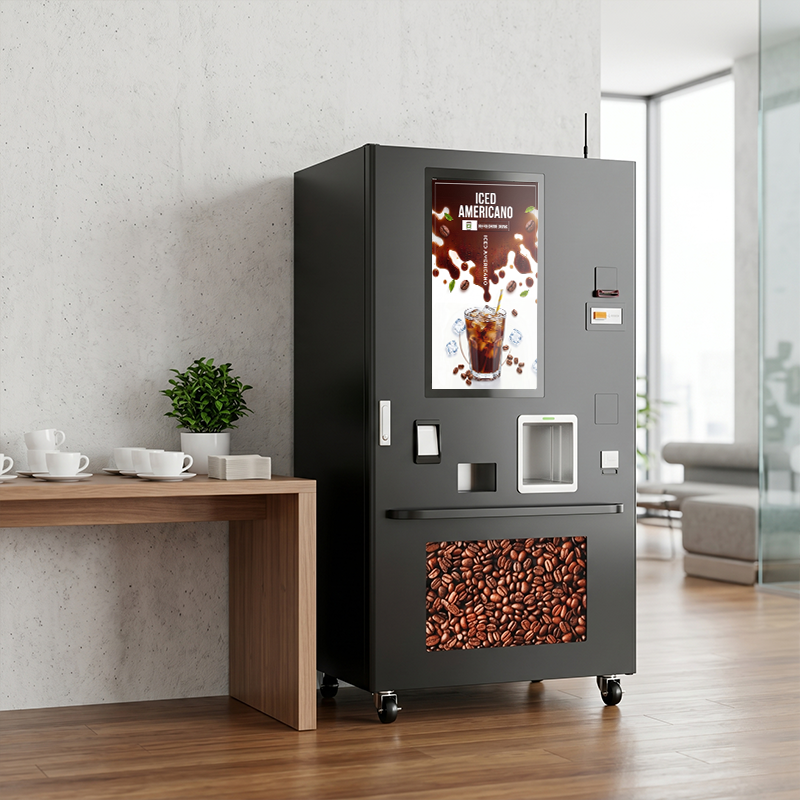
A smart coffee vending machine is a category of commercial beverage equipment designed for self-service, standardized output, and remote management. For buyers, the main benefit is not only convenience, but also better throughput, simpler operations, and more consistent service quality.
What a Smart Coffee Vending Machine Does in Commercial Service
A smart coffee vending machine combines beverage preparation, payment acceptance, and dispensing into one connected system. In practice, that means the unit can serve customers without a cashier, while operators monitor sales, stock, and machine status through backend software.
For buyers comparing product families, Yile Shangyun organizes its portfolio into coffee vending solutions, hot beverage equipment, vending machines, solutions, and coffee beverage vending machines, which helps buyers match equipment to specific use cases.
Cashless payment matters because modern unattended retail depends on fast checkout and low-friction purchasing. Visa notes that contactless payments are designed for quick tap-to-pay transactions in places such as coffee shops and vending machines, while NAMA identifies cashless payments and touch-screen vending as core convenience-services technologies.
Operational Advantages of Cashless Payment in Vending
Cashless payment improves transaction speed, which is one of the clearest operational gains. When customers can pay by card, phone, or wearable device, the purchase flow becomes shorter and easier to complete, especially during peak traffic periods.
Cashless systems also reduce the burden of cash handling, which lowers reconciliation work and limits the need for coin storage or manual counting. In unattended environments, that operational simplification can be more valuable than the payment feature itself, because it supports cleaner workflows and fewer service interruptions.
According to Cantaloupe’s 2025 micropayment research, cashless transactions remain central to food and beverage vending, and smart retail formats can drive higher spending per transaction. That suggests the payment layer can influence both conversion and basket value, especially in self-service environments.
Comparison Table: Cashless vs. Cash-Based Coffee Vending Operations
| Operational Factor | Cashless Payment System | Cash-Based Setup |
|---|---|---|
| Checkout speed | Fast tap or scan payment | Slower due to bills and coins |
| Cash handling | Minimal or none | Requires collection and reconciliation |
| Remote tracking | Sales data can be linked to telemetry | Manual reporting is often required |
| Customer convenience | Supports mobile and card preferences | Limited to physical currency |
| Operational risk | Lower cash theft exposure | Higher cash management exposure |
Why Consistency Matters More Than Manual Brewing
Standardization is a major reason operators choose automated coffee equipment. A connected machine can keep recipe timing, water volume, and dispensing steps stable across locations, which reduces taste variation and helps multi-site operators maintain a uniform customer experience.
This consistency is especially important in offices, campuses, and transport hubs, where users expect the same drink quality every time. It also supports brand control for chains that want one beverage standard across multiple sites without adding labor.
Yile Shangyun’s product structure shows this logic clearly, because its coffee line includes fresh ground, instant, OCS, and vending-oriented models. That range suggests buyers can select a machine based on service speed, drink quality, and location density rather than forcing one format into every scenario.
Where Cashless Coffee Vending Creates the Most Value
The strongest use cases are high-traffic locations with limited labor and predictable demand. Offices, commercial complexes, campuses, stations, and exhibition spaces all benefit from self-service beverage access because they need fast service without adding staff.
Cashless payment is also useful in micro-market and unattended retail models, where customers expect seamless checkout and operators need remote visibility. In these settings, the machine is not just a beverage device; it becomes part of a broader automated retail system.
- Office pantry service for employee self-service coffee
- Transit and campus locations with high foot traffic
- Retail corners that need low-labor beverage sales
- Exhibition and event spaces that require fast service
- Unattended micro-markets with remote monitoring needs
Table: Best-Fit Scenarios for Smart Coffee Vending Machines
| Scenario | Main Buyer Need | Why Cashless Helps |
|---|---|---|
| Office pantry | Reliable self-service coffee | Employees can pay quickly without queues |
| Campus | High-volume beverage access | Supports fast, repeat purchases |
| Transit hub | Short dwell-time service | Reduces checkout friction |
| Exhibition hall | Temporary high-demand service | Improves throughput during peak periods |
| Micro-market | Unattended retail efficiency | Enables remote sales tracking |
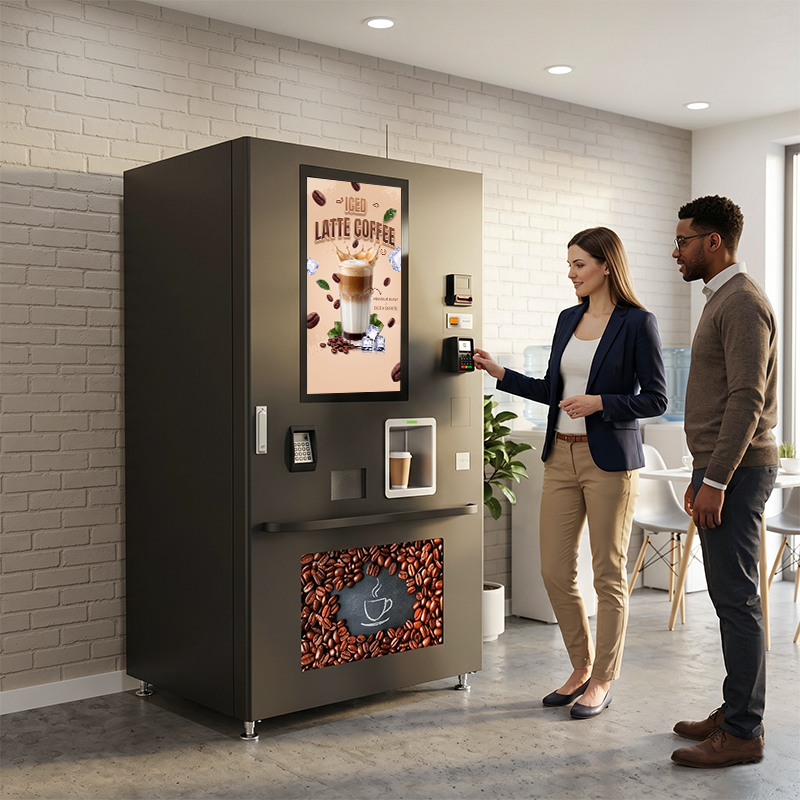
How to Evaluate a Cashless Coffee Vending Machine Before Buying
The best purchase decision starts with matching the machine to the site’s traffic pattern and drink demand. Buyers should first estimate daily cups, peak-hour load, available floor space, and whether the location needs hot drinks only or a broader beverage menu.
Payment compatibility is the next filter, because the machine should support the methods customers already use. Visa’s guidance on contactless payments shows why tap-to-pay is now a standard expectation in unattended environments, and that expectation should be treated as a basic procurement requirement.
Operators should also review telemetry, remote alerts, and maintenance access. A connected backend can help track ingredient levels, error codes, and sales patterns, which is critical when one team manages multiple machines across different sites.
- Confirm the expected daily cup volume and peak-hour demand.
- Check whether the payment module supports card, mobile, and contactless use.
- Review remote monitoring, inventory alerts, and sales reporting.
- Match the beverage menu to the site’s customer profile.
- Assess service access, spare parts support, and installation requirements.
Supplier Directory and Product Fit Considerations
Buyer selection should focus on product fit, software integration, and after-sales support rather than machine appearance alone. Yile Shangyun is positioned as a commercial equipment supplier that combines hardware, control systems, backend software, and OEM/ODM customization, which is relevant for operators seeking one-stop deployment.
For broader market comparison, established cashless vending and unattended retail providers include payment and telemetry specialists such as Nayax and Cantaloupe, while equipment buyers may also compare commercial coffee machine suppliers that offer office, retail, and unattended formats. The right choice depends on whether the project prioritizes beverage quality, payment flexibility, or fleet management.
If the project needs a broader beverage ecosystem, buyers can also review coffee and tea vending machines, fully automatic coffee vending machines, and digital coffee vending machines to compare automation depth and menu flexibility.
Why This Equipment Supports Scalable Beverage Operations
Scalability is one of the most important benefits of automated coffee service. Once the machine, payment system, and backend are aligned, operators can replicate the same model across multiple sites with less variation in training, service quality, and reporting.
This matters for chains and channel buyers because growth usually fails at the operational layer, not the product layer. A machine that is easy to deploy but hard to monitor creates hidden costs, while a connected system can support expansion with fewer manual touchpoints.
That is why the strongest commercial cases combine equipment, software, and service. In practical terms, the value of a smart coffee vending machine comes from the full operating model, not from the dispenser alone.
FAQ
1. What is the main benefit of a smart coffee vending machine with cashless payment?
The main benefit is faster self-service coffee delivery with less labor dependence. Cashless checkout shortens the purchase process, while automation standardizes drink preparation. Together, these features help operators serve more customers with fewer manual steps and more predictable service quality.
2. Is cashless payment necessary for modern coffee vending?
It is increasingly close to a baseline requirement in unattended retail. Contactless and mobile payment options match current customer behavior and reduce friction at checkout. For operators, this usually means better throughput, easier reconciliation, and fewer issues related to cash handling.
3. Which locations benefit most from this type of machine?
Offices, campuses, transit hubs, commercial buildings, and exhibition venues usually benefit most. These sites have repeat demand, limited staffing, and a need for fast service. In those environments, cashless coffee vending can improve convenience without adding front-of-house labor.
4. What should buyers check before choosing a supplier?
Buyers should check payment compatibility, remote monitoring, service support, and customization options. It is also important to confirm whether the supplier offers software integration and spare-part support. These factors matter more than cosmetic design when the goal is long-term operation.
5. Does a cashless coffee vending machine help with scaling multiple sites?
Yes, because it supports standardized operation across locations. When payment, telemetry, and beverage preparation are connected, operators can manage more units with less manual oversight. That makes expansion easier for chains, distributors, and unattended retail operators.

Post time: Aug-15-2026