

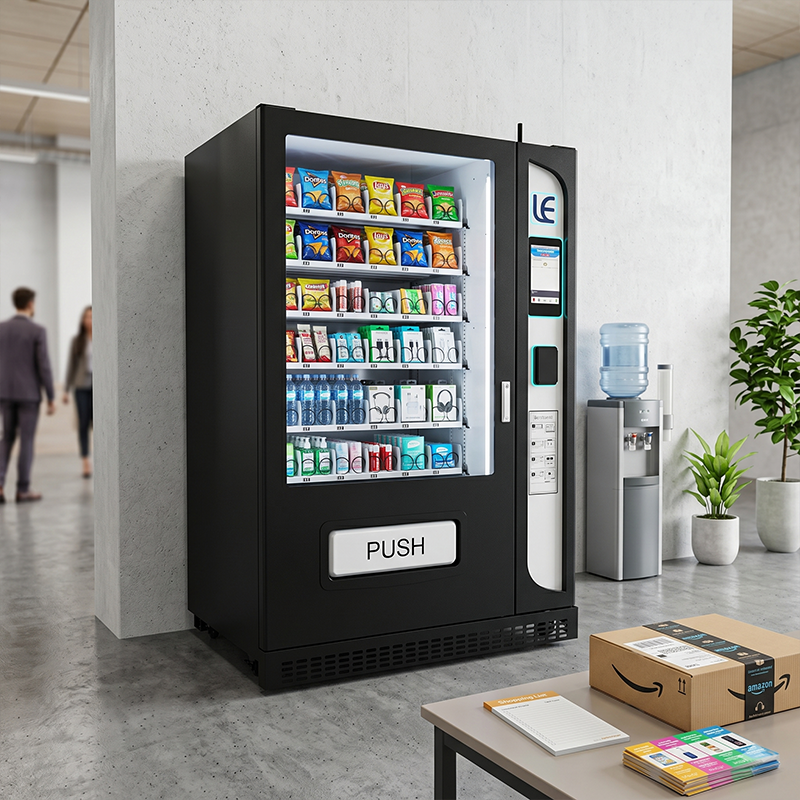
- Remote monitoring is the foundation of profitable retail automation because operators can act on stock, temperature, fault, and payment alerts before sales are lost.
- Product mix, uptime, replenishment speed, and payment conversion usually matter more than adding advanced AI features without a clear operating use case.
- Computer vision and predictive analytics should be evaluated by measurable operational outcomes, not by novelty alone.
- Food safety, cybersecurity, accessibility, and serviceability must be designed into the machine and its software from the beginning.
Smart vending machine profitability depends on the complete operating system around the cabinet: product selection, payment acceptance, telemetry, maintenance, replenishment, and customer experience. The FDA Food Code identifies 41 degrees Fahrenheit or below as a cold-holding benchmark for time and temperature control foods, showing why connected temperature monitoring matters in unattended retail. This guide explains which features create measurable value and how operators can evaluate them.
What Features Make Smart Vending Machines More Profitable for Operators?
Start with the profit equation, not the feature list
The most profitable vending configuration improves gross sales while controlling four recurring costs: inventory loss, labor, payment friction, and service downtime. A machine can have an attractive touchscreen and still underperform if popular items sell out, refrigeration faults go unnoticed, or the operator needs to visit the location for every small issue.
Operators should therefore connect every requested feature to a business question. Does it increase completed transactions? Does it reduce a visit? Does it prevent spoilage? Does it help the team select better products? This approach separates useful retail automation from technology that adds complexity without improving the operating model.
| Feature area | Primary operator objective | Editorial priority score | Useful performance signal |
|---|---|---|---|
| Inventory telemetry | Prevent stockouts and unnecessary visits | 5 of 5 | Low-stock alerts and replenishment accuracy |
| Cashless payment | Reduce checkout friction | 5 of 5 | Payment approval and abandoned-session trends |
| Remote diagnostics | Protect uptime and lower service cost | 5 of 5 | Fault alerts, resolution time, and repeat faults |
| Dynamic pricing | Manage demand and near-expiry inventory | 3 of 5 | Margin and sell-through by time period |
| Computer vision | Improve item recognition and checkout control | 3 of 5 | Recognition accuracy and exception rate |
The priority scores in this table are an editorial decision framework, not an industry benchmark. An operator should adjust them according to product category, site traffic, labor cost, food-safety requirements, and service geography.
Remote monitoring turns a vending machine into an operating platform
Real-time telemetry is usually the highest-value feature in a connected vending operation because it lets staff manage exceptions instead of checking every machine on a fixed schedule. A useful dashboard should show sales, inventory, temperature, door status, payment events, power status, and active faults in one place.
Inventory monitoring is valuable only when it supports a practical replenishment workflow. The system should distinguish between a full slot, a low-stock slot, a sold-out slot, and an item that is unavailable because of a mechanical fault. Combining this information with historical sales allows operators to build routes around actual need rather than habit.
Remote diagnostics can also reduce avoidable service calls. A technician who knows the error code, affected compartment, recent temperature history, and transaction status before arriving can bring the appropriate part or resolve a software issue remotely. The result is not simply lower maintenance cost; it is a higher probability that the machine remains available during peak demand.
Cashless payments and checkout design affect conversion
Payment flexibility is a direct revenue feature because a customer who cannot use a preferred payment method may abandon the purchase. A commercial smart vending machine should be able to support the payment methods relevant to the target country, such as contactless cards, mobile wallets, QR-based payments, and, where appropriate, cash.
Payment security must be treated as an operating requirement rather than a marketing statement. The PCI Security Standards Council merchant guidance provides a useful reference for understanding payment-security responsibilities. Operators should also confirm how card data is handled, whether the payment terminal is certified by the relevant provider, and how refunds and disputed transactions are managed.
The interface should minimize unnecessary steps. Clear pricing, visible product availability, accessible instructions, multilingual support, and a clear refund path are practical conversion features. A touchscreen is not automatically better than physical selection buttons; the correct choice depends on the environment, customer profile, lighting, gloves, weather exposure, and maintenance capability.
AI features should solve specific retail problems
AI creates value when it improves a measurable decision, such as product recognition, demand forecasting, assortment planning, or anomaly detection. It creates limited value when it is added only to make a machine appear innovative.
Computer vision can support an AI vending machine by recognizing products placed in a shopping area, detecting an unusual access event, or helping reconcile expected and actual inventory. Before deployment, operators should test performance under real conditions, including reflections, poor lighting, similar packaging, blocked camera views, and customers handling several products at once.
Demand forecasting can recommend replenishment quantities by location and time period. It should account for weekends, school terms, shift patterns, weather-sensitive products, local events, and product substitutions. Forecasting should assist the operator rather than silently change the assortment without review.
AI governance is also relevant when cameras, customer data, or automated decisions are involved. The National Institute of Standards and Technology AI Risk Management Framework organizes AI risk management around four functions: govern, map, measure, and manage. Operators can apply this model by defining permitted data use, mapping failure scenarios, measuring recognition and alert quality, and maintaining a process for correction.
Refrigeration, temperature control, and food safety cannot be optional
Temperature monitoring is essential for chilled food and beverage vending because an unattended machine can continue accepting sales after a refrigeration problem begins. The control system should record temperature trends, issue threshold alerts, and support a clear response procedure for quarantine, inspection, and product removal.
The FDA Food Code 2022 is a useful reference for food-service operators because it addresses temperature control, hygiene, equipment, and safe handling practices. Local authorities may impose different or additional requirements, so a deployment plan should be reviewed against the rules of the installation location.
| Operating condition | Recommended system response | Numeric reference | Operator action |
|---|---|---|---|
| Cold-held product within control range | Continue sales and log readings | 41 degrees Fahrenheit or below | Maintain routine checks |
| Temperature approaches the configured limit | Send an early warning | Use a site-approved warning threshold | Review refrigeration load and door activity |
| Temperature exceeds the approved limit | Escalate and consider sales suspension | Above the approved cold-holding limit | Inspect, isolate affected products, and service the unit |
The 41-degree Fahrenheit reference in the table comes from the FDA Food Code benchmark cited above. It is not a universal replacement for local legal requirements or a product-specific hazard analysis.
Serviceability determines whether automation remains profitable
A connected machine still needs physical maintenance, and serviceability often separates a profitable deployment from an expensive one. Operators should assess access to filters, brewing components, refrigeration modules, payment hardware, dispensing mechanisms, cleaning areas, and diagnostic logs before purchasing.
For coffee vending, automated grinding, dosing, brewing, rinsing, waste handling, and milk-system management can reduce operator workload, but each additional subsystem introduces a cleaning and maintenance responsibility. Fresh-ground coffee can support a premium experience, while instant coffee systems may suit locations where speed, simplified operation, and easy maintenance are more important.
A maintenance-friendly design should provide clear cleaning prompts, replaceable wear components, guided troubleshooting, and remote software updates with rollback or recovery procedures. Service records should identify recurring faults by machine, location, component, and operating condition. This allows the operator to decide whether a problem requires training, a part redesign, a configuration change, or a different product assortment.
Use site-specific configuration to improve return on space
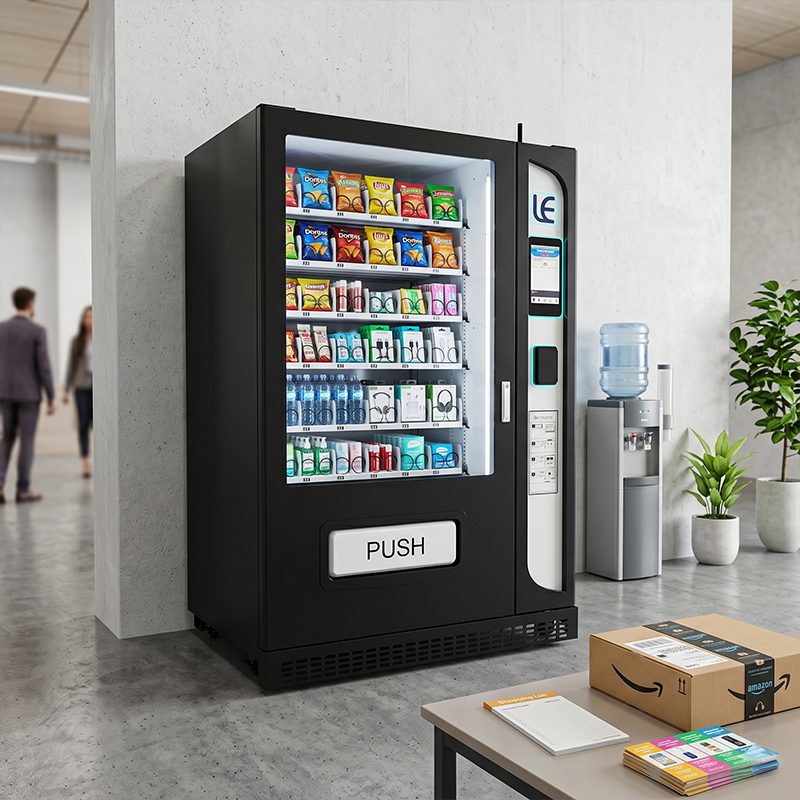
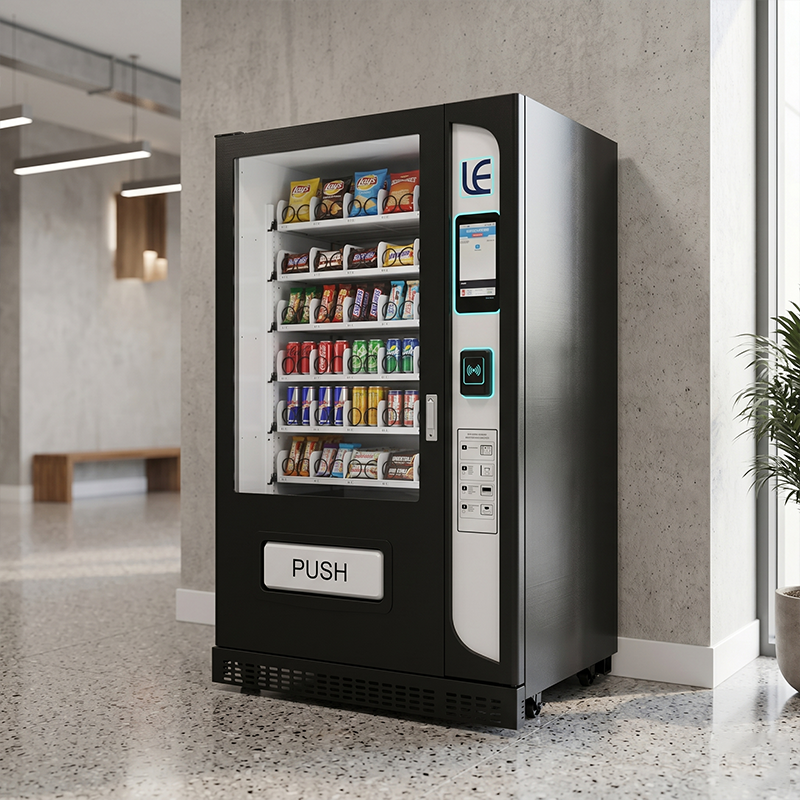
The right machine format depends on the location’s demand pattern, available footprint, product temperature requirements, and replenishment access. A compact tabletop coffee unit may suit an office lobby or small commercial space, while a combination vending machine or micro-market terminal may be more appropriate for snacks, beverages, and mixed purchases.
Airports and hotels may prioritize multilingual interfaces, premium beverage presentation, and payment flexibility. Factories may prioritize durability, fast transactions, and access during shift changes. Schools and campuses may need stronger product controls, clear nutrition information, and seasonal assortment changes. Offices may gain more from coffee quality, low noise, and simple staff replenishment than from a large product wall.
- Define the customer mission: quick drink, meal replacement, coffee break, late-night purchase, or essential convenience.
- Measure the operating constraints: power, connectivity, floor space, delivery access, security, cleaning access, and local compliance.
- Select the product architecture: fresh-ground coffee, instant coffee, chilled drinks, ambient snacks, ice, or a mixed assortment.
- Choose the smallest feature set that supports the mission, then add analytics and AI after the basic workflow is stable.
- Review sales, stockouts, faults, refunds, cleaning events, and replenishment time before expanding to more sites.
What operators should compare before purchasing
A procurement comparison should evaluate the complete solution rather than the cabinet alone. Ask whether the supplier provides hardware, software, installation guidance, payment integration, spare parts, training, remote support, and a defined escalation process.
| Evaluation category | Questions to ask | Evidence to request | Numeric review field |
|---|---|---|---|
| Uptime support | How are faults detected and escalated? | Sample dashboard and service workflow | Response time target in hours |
| Inventory control | Can stock levels be viewed by slot and location? | Replenishment report and alert example | Alert lead time in hours |
| Payment integration | Which local methods and currencies are supported? | Payment-provider documentation | Supported payment methods count |
| Cleaning and maintenance | Which tasks are daily, periodic, or technician-only? | Maintenance and sanitation schedule | Cleaning tasks per operating cycle |
| Data and security | Who owns operational data and how is access controlled? | Data policy and user-role matrix | User roles required |
The numeric review fields are procurement prompts rather than universal specifications. A supplier should provide the actual values for the proposed configuration, and the operator should compare them against its own labor model and site requirements.
Common mistakes that reduce smart vending profitability
Feature overload is a common mistake because every additional subsystem can increase training, support, and failure complexity. Start with reliable dispensing, payment, telemetry, temperature control where required, and a replenishment process that staff can execute consistently.
Ignoring product-market fit is another frequent problem. A technically advanced unit will not compensate for the wrong assortment, unsuitable price points, poor placement, or limited opening-hour demand. Use early sales data to test product rotation and remove slow-moving items before investing in broader automation.
Underestimating connectivity and service coverage also creates hidden cost. Confirm network options, offline payment behavior, data synchronization, remote access permissions, spare-part availability, and technician coverage before installation.
How a complete solution supports long-term operation
A strong supplier relationship should cover equipment selection, custom exterior design, menu configuration, payment localization, language options, software integration, installation, training, and after-sales support. This is particularly important for overseas deployments where payment practices, language needs, electrical conditions, food handling rules, and service expectations vary by market.
Yile Shangyun combines commercial self-service equipment with software and operational support across fresh-ground coffee machines, instant coffee machines, tabletop coffee vending, combination vending, micro-market terminals, ice-making equipment, ice dispensers, and AI service terminals. Its OEM and ODM capability can support customized appearance, menus, languages, payment options, and functional configurations. Buyers should still validate the exact specification, service scope, integration responsibility, and compliance requirements for each project before signing a purchase agreement.
FAQ
What is the most important feature in a smart vending machine?
Remote monitoring is often the most important starting feature because it gives operators visibility into inventory, temperature, payment events, and faults. Its value depends on accurate sensors, useful alerts, and a team that acts on the information.
How does an AI vending machine increase revenue?
AI may increase revenue by improving product recognition, reducing checkout friction, forecasting demand, identifying high-performing assortments, and detecting unusual events. The effect should be measured through transaction completion, sell-through, stockout frequency, refunds, and margin rather than through AI capability alone.
Are cashless payments necessary for retail automation?
Cashless payments are strongly recommended where customers commonly use cards, mobile wallets, or QR payments. The correct payment mix depends on the country, customer base, transaction value, connectivity, refund process, and payment-provider costs.
What data should a vending operator monitor?
Monitor sales by product and location, inventory status, stockouts, machine faults, temperature history where relevant, payment outcomes, refunds, cleaning events, replenishment time, and service visits. These signals connect customer demand with operating cost.
Can smart vending machines sell fresh food safely?
They can support fresh-food sales when the machine, products, monitoring process, cleaning routine, and local food-safety controls are appropriate. Temperature alerts do not replace inspections, documented procedures, or the requirements of local authorities.
Is computer vision better than traditional vending controls?
Not always. Computer vision can help with flexible product recognition and loss prevention, but traditional coils, spirals, shelves, or sensor systems may be easier to maintain for a narrow assortment. Choose the control method that delivers reliable transactions at the target site.
What should be included in a vending machine service agreement?
The agreement should define installation, software access, payment integration, connectivity responsibilities, preventive maintenance, spare parts, response procedures, training, warranty coverage, data ownership, remote support, and escalation for unresolved faults.
About the Company
Yile Shangyun is a commercial self-service equipment manufacturer and solution provider focused on coffee, beverage, ice, vending, and AI service terminals. Its capabilities combine equipment manufacturing, OEM and ODM customization, IoT connectivity, back-office management, and operational support for offices, airports, schools, factories, hotels, cafés, campuses, and communities. Buyers can discuss configuration, localization, deployment, and service requirements with the company before selecting a project solution.

Post time: Sep-04-2026