

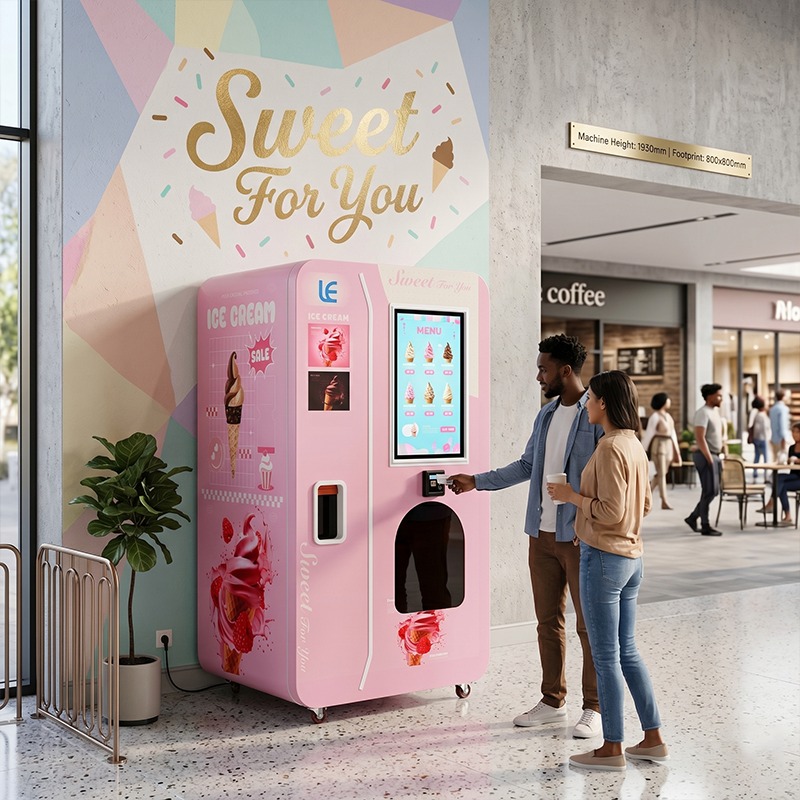
Choosing an OEM factory for ice cream robot wholesale affects far more than unit price. The right partner determines production consistency, food-contact safety, software stability, spare-parts support, and how easily machines can scale across malls, parks, campuses, or franchise networks. Buyers should assess whether a factory can deliver reliable hardware, customized branding and configuration, compliant manufacturing processes, and responsive after-sales service for multi-unit deployment. This article outlines the practical criteria that matter most, from engineering capability and quality control to remote management, maintenance planning, and total cost of ownership, so you can compare suppliers with fewer blind spots and make a lower-risk purchasing decision.
Why OEM Ice Cream Robot Supplier Selection Matters
The automated retail sector is expanding rapidly, making the procurement of reliable unmanned equipment a strategic priority for commercial operators. For businesses engaging in OEM ice cream robot wholesale, selecting the right manufacturing partner dictates not only the initial capital expenditure but also the long-term operational viability of the fleet. A rigorous supplier selection process minimizes downtime, controls maintenance costs, and ensures a seamless consumer experience.
Automation trends, labor costs, and service consistency
Automation in the food service industry directly addresses the escalating challenge of labor shortages and rising wages. By deploying robotic dispensers, operators can reduce location-based labor costs by 40% to 60% while ensuring exact portion control. Every serving maintains a strict weight variance of less than 5 grams, delivering service consistency that human operators struggle to match during peak hours.
Buyer profiles that benefit most
The primary beneficiaries of these automated systems are multi-location operators, including shopping mall management groups, theme parks, and corporate campus caterers. Buyers deploying clusters of 10 to 50 units require a supplier capable of scaling production without compromising build quality. Franchisees also benefit from the standardized user experience and centralized software management that a competent OEM factory provides.
What Buyers Should Verify in an OEM Ice Cream Robot
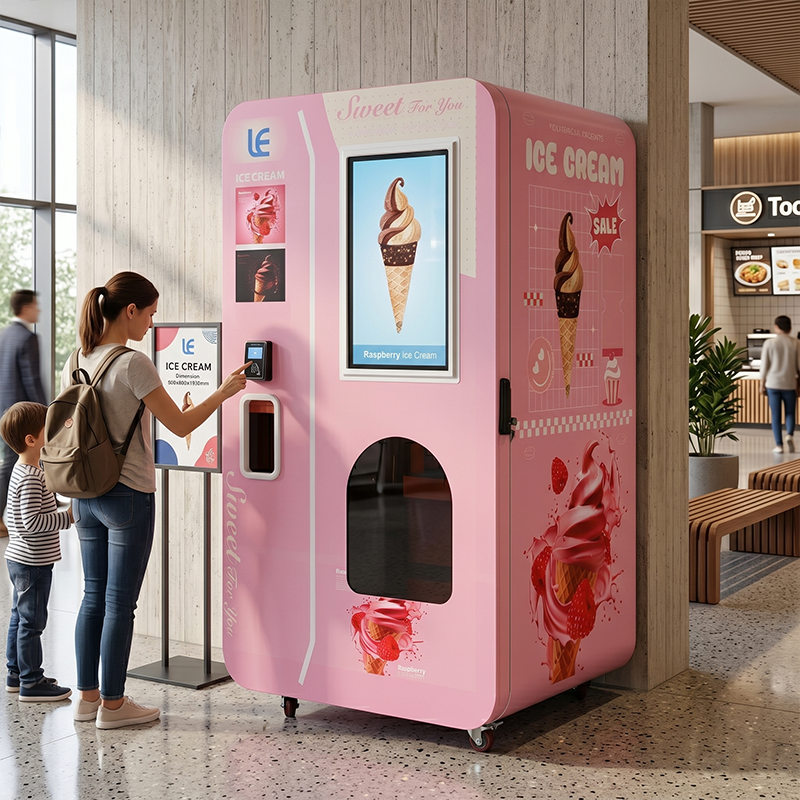
Evaluating a factory requires moving beyond glossy brochures to scrutinize their engineering depth and production capabilities. Buyers must ensure the manufacturer can translate specific market requirements into functional, durable hardware.
Product definition and OEM scope
The scope of an OEM (Original Equipment Manufacturer) agreement dictates how much of the machine can be tailored. Buyers must define whether they require simple cosmetic branding—such as vinyl wraps and custom UI logos—or deep structural modifications like alternative payment gateways, proprietary robotic arm kinematics, and customized dispensing nozzles. Clear product definition prevents scope creep and unexpected engineering fees during the prototyping phase.
Production capacity, engineering, and quality control
A factory’s production capacity and quality control infrastructure directly impact fulfillment reliability. Buyers should look for facilities capable of producing at least 300 to 500 units per month to support wholesale scaling. Furthermore, strict quality control protocols should be in place, targeting an out-of-box defect rate of under 1.5%. Exploring a manufacturer’s existing products can provide valuable insight into their baseline engineering standards and component sourcing.
Specification comparison criteria
Comparing technical specifications is vital for aligning the hardware with the intended deployment environment. Buyers must evaluate throughput, footprint, and power requirements to ensure compatibility with commercial real estate constraints.
| Specification | Commercial Standard | High-Performance OEM Standard |
|---|---|---|
| Dispense Time | 45 – 60 seconds | 25 – 35 seconds |
| Flavor Capacity | 3 – 4 flavors | 6+ flavors with mix-ins |
| Footprint | > 2.5 sq. meters | < 1.8 sq. meters |
| Power Consumption | 3.5 kW (Peak) | 2.2 kW (Peak, energy efficient) |
Compliance, Safety, and Performance Standards to Check
Ice cream robots operate at the intersection of complex robotics and strict food safety regulations. Navigating these requirements is non-negotiable for commercial deployment, as non-compliance can lead to immediate operational shutdowns and liability issues.
Food-contact, electrical, software, and regional certifications
The machinery must comply with a matrix of regional and international standards. Food-contact surfaces must utilize FDA-approved materials, predominantly 304 or 316-grade stainless steel, to prevent contamination. Electrically, the units require UL or CE certification to ensure fire and operator safety, while the payment terminals and wireless communication modules must meet FCC or equivalent regional telecommunications standards.
Sanitation design and temperature control
Bacterial growth is a primary risk in dairy dispensing. High-quality OEM factories integrate automated sanitation designs, such as daily ozone sterilization cycles and programmable heat treatment (pasteurization) that safely raises internal system temperatures to 65°C or higher overnight. During standard operation, the storage hoppers must reliably hold temperatures between -18°C and -22°C to maintain product integrity and texture.
Factory testing, acceptance benchmarks, and documentation
Before a unit leaves the factory floor, it must undergo rigorous acceptance testing. A reputable supplier will provide documentation proving a Mean Time Between Failures (MTBF) exceeding 10,000 dispense cycles. Factory testing should include a mandatory 48-hour continuous run test under simulated environmental conditions—such as 35°C ambient heat and 80% humidity—to stress-test the compressors and robotic actuators.
How to Compare Costs, Lead Times, and Sourcing Options
Strategic sourcing requires a comprehensive analysis of the total financial commitment, spanning from initial tooling to final site installation. Proper cost modeling prevents budget overruns and ensures a predictable return on investment.
Tooling, MOQ, spare parts, and warranty cost drivers
Upfront costs are heavily influenced by the extent of customization. Tooling fees for bespoke exterior panels or custom hoppers can add significant capital expenditure. Minimum Order Quantities (MOQs) typically start at 5 to 10 units for standard white-label machines, but may scale to 50+ units for heavily customized chassis. Buyers must also budget for spare parts kits, particularly for high-wear components.
| Cost Driver | Typical % of Total Cost | Standard Warranty Expectation |
|---|---|---|
| Robotic Arm / Actuators | 25% – 30% | 12 – 24 Months |
| Refrigeration System | 20% – 25% | 24 – 36 Months |
| Touchscreen & Software UI | 10% – 15% | 12 Months |
| Chassis & Metal Housing | 15% – 20% | 36 – 60 Months |
Lead times, packaging, shipping, and installation planning
Accurate timeline planning prevents costly delays in rollout schedules. Standard white-label orders generally feature lead times of 30 to 45 days, whereas custom OEM projects may require 60 to 90 days for engineering and production. Buyers must also verify that the factory uses ISPM-15 compliant wooden crates for international shipping, ensuring the delicate robotics are protected against vibration and moisture during maritime transit.
Sample qualification and factory audit steps
Before committing to a volume order, buyers should initiate a sample qualification phase. This involves purchasing a single unit to field-test software stability, payment gateway integration, and hardware durability. Simultaneously, conducting a factory audit—either in person or via a certified third-party inspector—verifies ISO 9001 compliance and labor practices. For specific procurement inquiries and sample arrangements, buyers can reach out to suppliers directly via their contact us channels.
How to Make the Final Supplier Decision
The final supplier selection shapes the operational trajectory of an automated retail business. It requires synthesizing qualitative observations from the negotiation phase with quantitative performance data.
Warning signs of an unsuitable supplier
Certain red flags can indicate a high-risk manufacturing partner. A lack of transparent API documentation suggests poor software capabilities, which will hinder integration with the buyer’s existing telemetry or ERP systems. Furthermore, communication delays exceeding 48 hours during the initial quoting phase often foreshadow severely degraded support once the purchase order is signed. High employee turnover on the factory floor is another critical indicator of inconsistent build quality.
Decision criteria for price, reliability, and support
Ultimately, the decision must balance the initial unit price against the Total Cost of Ownership (TCO) over the machine’s projected 5 to 7-year lifespan. A supplier offering a unit for 15% less upfront may cost exponentially more in downtime and emergency maintenance. Buyers should prioritize partners who offer robust Service Level Agreements (SLAs), sophisticated remote diagnostic capabilities, and a proven track record of maintaining 99% machine uptime in active commercial environments.
Further reading:
Key Takeaways
- The most important conclusions and rationale for OEM ice cream robot wholesale
- Specs, compliance, and risk checks worth validating before you commit
- Practical next steps and caveats readers can apply immediately
Frequently Asked Questions
What OEM customization should buyers define upfront?
Specify branding, UI language, payment gateway, nozzle design, robot motion, and telemetry needs before prototyping to avoid scope creep and surprise engineering fees.
How can buyers verify an ice cream robot factory’s production reliability?
Ask for monthly capacity, QC流程, defect-rate data, and factory test reports. For wholesale programs, a practical benchmark is 300–500 units/month with under 1.5% out-of-box defects.
Which certifications matter most for an OEM ice cream robot?
Check FDA-compliant food-contact materials, CE or UL electrical safety, and FCC or local wireless/payment compliance. These are essential for legal deployment and lower operational risk.
What performance specs should wholesale buyers compare first?
Focus on dispense time, flavor capacity, footprint, and peak power draw. Strong OEM models often target 25–35 seconds per serve, 6+ flavors, under 1.8 m², and about 2.2 kW peak.
What after-sales support should buyers request from a supplier like YL Vending?
Request spare-parts plans, remote diagnostics, software update support, operator training, and clear warranty terms. These services reduce downtime across multi-location deployments.

Kely
Post time: Jun-16-2026