

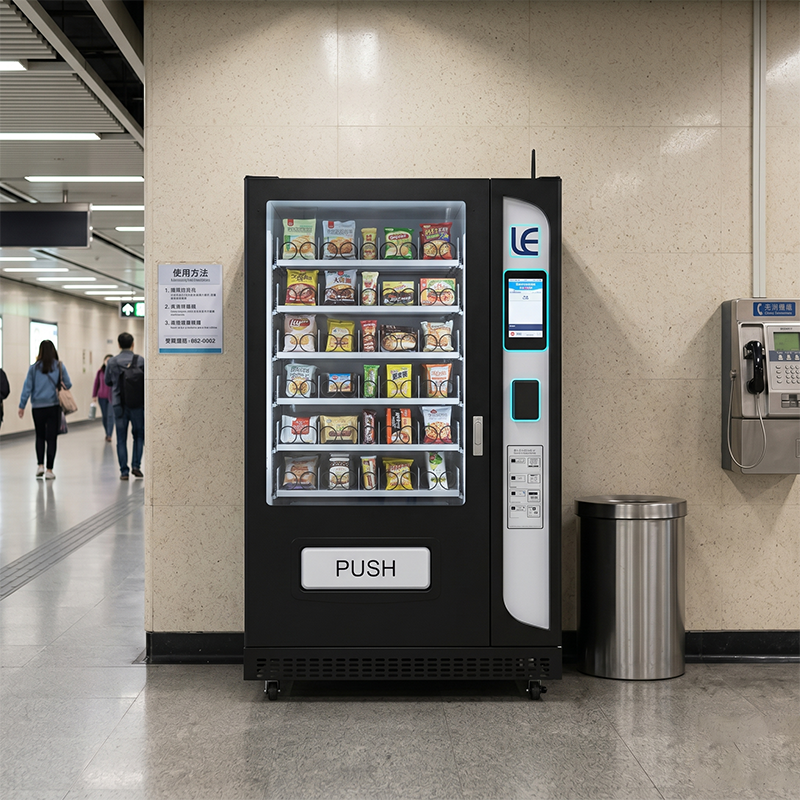
- Computer vision and sensor fusion help machines recognize products, customer actions, and operating conditions.
- IoT connectivity turns a vending cabinet into a remotely managed retail asset.
- Edge computing supports fast local decisions when connectivity is limited.
- Cloud dashboards connect inventory, payments, maintenance, sales, and analytics.
- Food safety, cybersecurity, payment compliance, and serviceability are as important as artificial intelligence.
Modern AI vending machines are best understood as connected retail systems rather than conventional cabinets with a screen. The FDA Food Code 2022 provides a current reference for retail food safety practices, while the NIST AI Risk Management Framework explains how organizations can manage risks across the AI lifecycle. This article explains the technologies behind smart vending machine platforms, how they work together, and what buyers should evaluate before deployment.
What is an AI vending machine?
An AI vending machine is an automated retail terminal that uses software intelligence, connected sensors, and automated hardware to sell products with limited staff intervention. Traditional vending equipment usually waits for a payment and selection command. A modern system can also observe stock levels, identify product movement, detect abnormal conditions, recommend maintenance, and transmit operating data to a remote management platform.
The commercial value comes from integration, not from artificial intelligence alone. A high-performing deployment links the cabinet, payment device, product database, cloud platform, operator dashboard, and service process. This allows a retailer, property manager, or foodservice operator to manage many locations through one operating workflow.
Core technologies inside a smart vending machine
Computer vision and product recognition
Computer vision helps the machine interpret products and customer interactions without requiring every action to be entered manually. Cameras can observe item movement, shelf activity, door access, and visible machine conditions. In a cashierless configuration, vision software may compare the opening and closing state of a compartment with the products removed.
Vision is not a complete solution by itself. Lighting, packaging changes, reflective surfaces, product overlap, privacy controls, and camera placement can affect accuracy. A responsible system therefore combines vision with weight sensors, shelf sensors, door switches, barcode readers, or transaction records. Sensor fusion provides more reliable evidence than any single input.
IoT sensors and telemetry
IoT connectivity allows the vending machine to report its condition and activity to an operations platform. Typical telemetry may include temperature, door status, payment status, inventory events, water level, waste-bin status, compressor condition, and fault codes.
Telemetry changes maintenance from a purely reactive process into a condition-based workflow. An operator can prioritize a refrigeration warning, investigate repeated payment failures, or schedule replenishment before a high-demand location becomes empty. The value is especially clear in airports, factories, campuses, hotels, and office buildings where travel time between machines affects operating cost.
Edge computing
Edge computing processes selected data near the machine instead of sending every event to a remote server. This can reduce response time for door control, payment feedback, safety interlocks, and local vision decisions. It also helps maintain essential functions during temporary network interruptions.
Cloud systems remain important for reporting, fleet management, configuration, and long-term analytics. The practical design is usually hybrid: time-sensitive control runs locally, while non-urgent information is synchronized with the cloud. Buyers should ask which functions remain available offline and how transactions are reconciled after reconnection.
Cloud management software
Cloud software turns individual machines into a manageable fleet. A useful dashboard should provide role-based access, live status, sales reports, stock alerts, device configuration, remote diagnostics, and service history. It should also support different locations, languages, currencies, tax rules, and product catalogs when machines operate across markets.
Software quality directly affects retail automation results. A visually attractive interface is less important than accurate event records, clear alerts, exportable data, and reliable integration with enterprise systems. Operators should verify whether the platform supports application programming interfaces, webhooks, or standard data exports before signing a long-term equipment contract.
Digital payments and identity security
Modern vending equipment commonly supports cashless payments through cards, mobile wallets, QR codes, or local payment methods. A payment flow should be fast, understandable, and resilient to network interruptions. It should also separate payment credentials from ordinary machine telemetry wherever possible.
Payment security must be evaluated independently from the vending interface. The PCI Security Standards Council overview of PCI DSS explains the role of payment data security controls. Buyers should ask who is responsible for certification scope, tokenization, terminal updates, transaction disputes, refunds, and regional payment compliance.
Automated dispensing and electromechanical control
Artificial intelligence cannot compensate for unreliable dispensing hardware. Motors, spirals, elevators, conveyors, doors, locks, pumps, grinders, boilers, refrigeration units, and product detection sensors must work together predictably.
Different product categories require different mechanisms. Packaged snacks may use spirals or pushers, bottled drinks may require elevators or controlled release, and fresh coffee requires a sequence involving grinding, dosing, brewing, dispensing, cleaning, and waste handling. A suitable machine therefore begins with the product and service model rather than with a generic cabinet design.
How AI vending machines manage inventory
Inventory intelligence combines sales records, sensor readings, product configuration, and replenishment rules. The system can estimate what remains, identify fast-moving products, and generate a refill task for an operator. It may also distinguish between an item sold, an item stuck in the delivery path, and an item removed during a service visit.
Inventory accuracy depends on disciplined operations. Product changes must be recorded, planograms must match the physical layout, and staff must follow consistent loading procedures. A machine with advanced analytics but poor catalog discipline can produce misleading alerts.
| Technology layer | Primary function | Useful operator signal | Typical operational decision |
|---|---|---|---|
| Sales software | Records purchases and refunds | Units sold by location and period | Adjust assortment or pricing |
| Weight or shelf sensors | Estimates physical stock | Low-stock or mismatch alert | Schedule replenishment |
| Computer vision | Observes product movement | Unrecognized or disputed event | Review transaction or service case |
| Temperature telemetry | Monitors controlled conditions | Temperature excursion | Inspect product safety and refrigeration |
| Cloud analytics | Combines fleet data | Demand pattern by site | Change assortment or visit frequency |
AI vending machine applications by environment
The best deployment strategy matches technology to the customer journey and the operating environment. A single configuration should not be copied unchanged from an office to an airport or from a hotel to a factory.
- Offices: Cashless payment, compact equipment, beverages, snacks, and remote stock alerts can support convenience during extended building hours.
- Airports and transit sites: Fast transactions, multilingual interfaces, high availability, remote monitoring, and clear service escalation are priorities.
- Schools and campuses: Product rules, age-appropriate assortments, accessibility, payment controls, and maintenance visibility require careful planning.
- Factories and logistics sites: Durable hardware, shift-based demand forecasting, wide product selection, and dependable operation in demanding environments are important.
- Hotels and hospitality venues: Compact presentation, branded menus, room-area placement, and support for drinks or freshly prepared products can improve guest convenience.
Fresh coffee and prepared beverages require a different architecture
Fresh coffee vending adds process control requirements that do not apply to packaged goods. The machine must coordinate ingredient storage, grinding or dosing, water delivery, brewing, dispensing, cleaning, and waste collection. Consistency depends on calibration, ingredient quality, temperature management, and a repeatable cleaning routine.
Operators should examine the complete service cycle rather than judging a machine only by its menu screen. Important questions include how often the milk or water system requires attention, how cleaning is verified, how waste is removed, whether recipes can be configured remotely, and what happens when an ingredient is unavailable.
The FDA Food Code 2022 is a useful reference for food safety principles in retail and foodservice contexts. Local authorities and site-specific rules still determine the applicable requirements, so international deployments need regional review rather than automatic reliance on one code.
Comparison of technology architectures
| Architecture | Local intelligence | Cloud dependence | Best fit | Main limitation |
|---|---|---|---|---|
| Basic connected vending | Low | Moderate | Packaged products and simple telemetry | Limited product recognition |
| Sensor-assisted vending | Moderate | Moderate | Inventory visibility and fault alerts | Requires sensor calibration |
| Vision-enabled cabinet | High | Moderate | Open-shelf or cashierless experiences | Lighting and privacy management |
| Integrated beverage terminal | High | High | Automated coffee and drink preparation | More cleaning and service tasks |
| Fleet retail platform | Variable | High | Multi-site operation and analytics | Integration and governance complexity |
What buyers should evaluate before deployment
The right buying decision depends on the operating model, not the largest list of technical features. A procurement team should test the complete journey from purchase to replenishment and service.
- Define the products, temperature ranges, preparation steps, and expected customer flow.
- Confirm payment methods, local language needs, tax treatment, refunds, and connectivity options.
- Request a data map showing what the machine collects, where it is stored, and who can access it.
- Test replenishment, cleaning, fault recovery, and remote configuration with real staff.
- Review spare parts, response procedures, software updates, warranty terms, and training.
- Measure availability, transaction completion, stock accuracy, service visits, and waste after launch.
Privacy should be designed into the system when cameras or customer identifiers are used. The NIST framework is relevant because it encourages organizations to address governance, measurement, and risk management rather than treating AI as a standalone feature. Operators should minimize data collection, define retention periods, restrict access, and provide appropriate notices where required.
Common deployment mistakes
The most common failure is selecting equipment before defining replenishment and service ownership. A machine may perform well in a demonstration but fail commercially if nobody is assigned to refill ingredients, clean contact surfaces, handle refunds, or respond to alerts.
Another mistake is treating remote monitoring as a substitute for field procedures. Telemetry can indicate a low stock level, but it cannot ensure that a technician loads the correct product, follows sanitation procedures, or resolves a recurring mechanical issue. The strongest programs connect alerts to documented responsibilities and service-level expectations.
Operators should also avoid over-automating the customer experience. A clear product name, visible price, accessible payment flow, and understandable error message often matter more than a complex conversational interface. AI should reduce friction, not make a simple purchase harder.
FAQ
How does an AI vending machine recognize products?
It may use computer vision, barcode reading, weight measurement, shelf sensors, or a combination of these technologies. Sensor fusion is generally more dependable than relying on one input because packaging, lighting, and product placement can change.
Can a smart vending machine operate without an internet connection?
Some systems can continue selected local functions during an outage, such as displaying products or processing certain queued events. The exact behavior depends on the payment architecture and software design. Buyers should confirm offline transaction handling and synchronization rules.
What products work best in an AI vending machine?
Packaged snacks, bottled drinks, fresh coffee, prepared beverages, and selected convenience goods can work well. Product size, temperature control, shelf life, packaging, dispensing behavior, and replenishment frequency should guide the equipment choice.
How is inventory tracked?
Inventory can be estimated through sales records, weight sensors, shelf sensors, computer vision, barcode scans, or manual service confirmation. The most reliable programs combine automated readings with disciplined loading and adjustment procedures.
Are AI vending machines suitable for fresh coffee?
Yes, but fresh coffee systems require more operational control than packaged-product cabinets. Buyers should evaluate ingredient storage, recipe consistency, water quality, cleaning, waste handling, temperature management, and service access.
What payment methods should a vending machine support?
The answer depends on the target market. Card payments, mobile wallets, QR payments, local payment networks, and cash may each be relevant. The operator should also verify refunds, settlement, terminal updates, security responsibilities, and network fallback behavior.
How can operators measure whether retail automation is working?
Useful measures include transaction completion, machine availability, stock accuracy, sales by product, replenishment frequency, service response, waste, refund volume, and customer complaints. The baseline should be defined before launch so that operational changes can be evaluated objectively.
About the solution provider
The solution provider develops commercial self-service equipment across automated coffee, beverage, ice, vending, and AI service applications. Its delivery model combines hardware, cloud management, customization, and operational support for offices, airports, campuses, factories, hotels, and community locations. OEM and ODM capabilities can support customized appearance, menus, languages, payment methods, and functions. Buyers can review the company website for product information and contact options before requesting a project discussion.

Post time: Oct-05-2026