

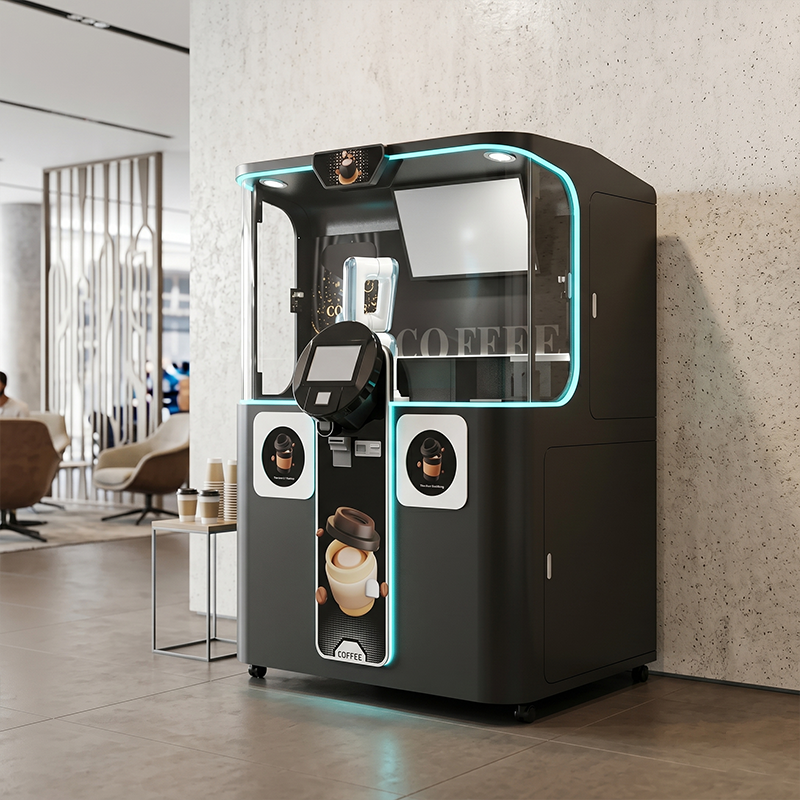
China has become a key sourcing destination for robot barista systems because it combines mature robotics manufacturing, commercial coffee equipment expertise, and scalable customization under one supply chain. For buyers evaluating unattended coffee kiosks, the challenge is not just finding a factory, but identifying manufacturers that can deliver reliable hardware, stable software, service support, and export-ready compliance. This article explains where to look for dependable coffee robot manufacturers in China, what signals separate serious suppliers from trading intermediaries, and how to assess product quality, integration capability, and long-term sourcing risk before placing an order.
Why Source Robot Baristas from China
The global transition toward unattended retail has positioned robotic coffee kiosks as a high-yield asset for commercial operators. Sourcing these complex mechatronic systems requires a strategic approach, and China has emerged as the premier manufacturing hub. The country’s advanced supply chain ecosystem integrates commercial espresso technology with industrial robotics, enabling operators to deploy fully automated barista stations at scale.
Market demand and buyer fit
Unattended coffee solutions address critical vulnerabilities in the hospitality sector, specifically labor shortages and the demand for 24/7 service availability. Commercial buyers—ranging from airport authorities to corporate campus managers—require robust systems capable of mimicking human barista movements while maintaining strict consistency. China robot barista sourcing provides access to manufacturers that understand these high-traffic operational demands and engineer their machines to handle continuous output without fatigue.
Cost, scale, and customization advantages
The primary driver for offshore procurement is the compelling cost-to-performance ratio. Capital expenditure for a fully equipped robotic coffee kiosk from Chinese manufacturers typically ranges from $15,000 to $35,000, significantly lower than European or North American equivalents, which often exceed $70,000. This capex reduction accelerates the return on investment (ROI) timeline to an average of 8 to 14 months, depending on location footfall. Furthermore, established facilities demonstrate impressive scalability, often maintaining production capacities exceeding 500 units per month, which is critical for operators planning rapid network expansion. Learn more about manufacturer scale and capabilities.
| Metric | Traditional Coffee Shop | Robotic Coffee Kiosk (China Sourced) |
|---|---|---|
| Initial Setup Cost | $80,000 – $250,000 | $15,000 – $35,000 |
| Labor Costs | High (Multiple shifts) | Minimal (Restocking only) |
| Operating Hours | 12-16 hours/day | 24/7/365 |
| Deployment Time | 3-6 months | 30-45 days |
How to Identify a Reliable Manufacturer
Core technical and commercial capabilities
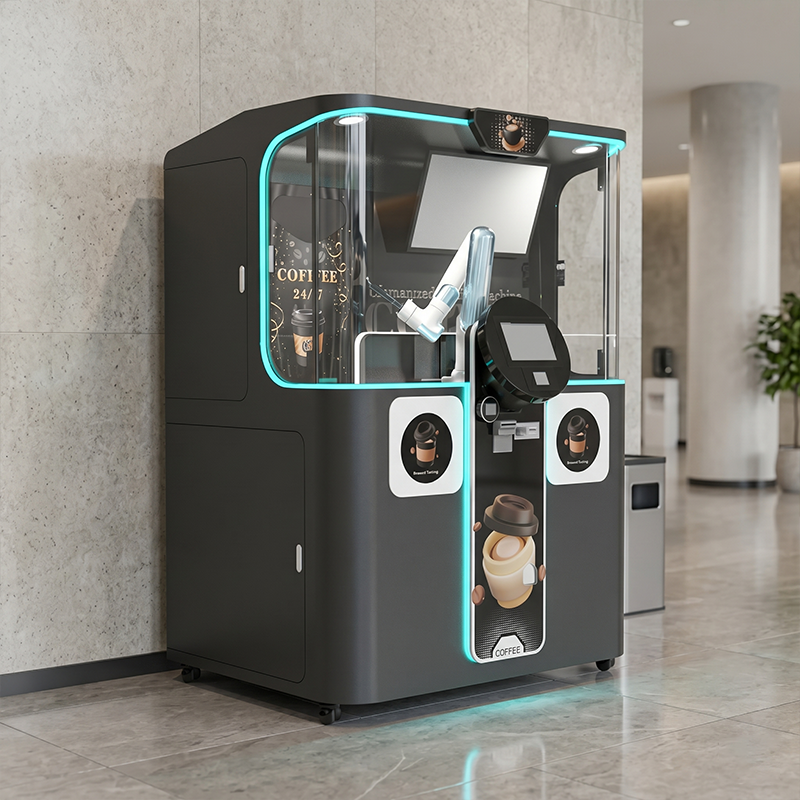
Core technical competency is non-negotiable when evaluating suppliers. The robotic components typically utilize 6-axis collaborative robots (cobots) that require a repeatability precision of ±0.03mm to ensure spill-free operations and precise latte art execution. Additionally, commercial buyers must assess the manufacturer’s software architecture. Reliable vendors offer open APIs or comprehensive SDKs, allowing operators to integrate the kiosk’s telemetry with proprietary enterprise resource planning (ERP) or localized payment processing systems.
Product scope and customization options
A manufacturer’s product portfolio reveals their engineering maturity. Top-tier suppliers offer modular designs featuring dual-grinder configurations, automated cup dispensers with capacities of 200 to 300 cups, and multi-syrup flavor stations. This modularity allows operators to tailor the machine footprint and beverage menu to specific demographic preferences without incurring exorbitant bespoke engineering fees. Evaluating the range of available configurations helps buyers ensure the hardware aligns with their intended retail environment.
Key comparison criteria
When comparing shortlisted suppliers, procurement teams must scrutinize minimum order quantities (MOQs) and production lead times. A reliable manufacturer will typically accommodate an MOQ of 1 to 5 units for pilot testing, scaling up to container-volume orders with standard lead times of 30 to 45 days. Furthermore, buyers should evaluate the supplier’s supply chain transparency, specifically their sourcing of critical sub-components like burr grinders and boiler valves, which dictate the machine’s long-term durability and operational uptime.
How to Evaluate Quality and Compliance
Unattended retail relies on near-perfect uptime; a broken machine generates zero revenue and damages brand reputation. Consequently, evaluating a manufacturer’s quality control protocols and regulatory compliance is a critical phase in the sourcing lifecycle.
Hardware and beverage performance metrics
The intersection of robotics and coffee brewing demands rigorous performance metrics. The espresso extraction module must consistently deliver 9 to 15 bars of pressure to ensure specialty-grade beverage quality. Dispensing speed is equally critical for high-footfall locations; a reliable robotic kiosk should complete a complex beverage in 45 to 60 seconds. During factory evaluations, buyers should request mean time between failures (MTBF) data, targeting a hardware failure rate of less than 1% across a 100,000-cycle continuous stress test.
Certifications and food safety compliance
Importing commercial food and electrical equipment requires strict adherence to regional safety standards. A credible manufacturer will proactively provide documentation for electrical safety and food-grade material compliance.
| Certification | Region | Primary Focus |
|---|---|---|
| CE | Europe | Health, safety, and environmental protection |
| FCC | USA | Electromagnetic interference limits |
| UL / ETL | North America | Electrical safety and fire risk mitigation |
| NSF / FDA | Global / USA | Food-grade materials and sanitation standards |
Failure to secure machines with these specific certifications can result in customs seizures or denial of operating permits by local health departments.
Spare parts, warranty, and remote support
Post-sale support dictates the operational lifespan of the kiosk. Standard industry warranties from reputable Chinese manufacturers cover 12 to 24 months for non-consumable hardware. More importantly, buyers must verify the manufacturer’s remote diagnostic capabilities. The system should support over-the-air (OTA) software updates and real-time error logging, enabling technicians to resolve up to 70% of software-related faults remotely without dispatching a mechanic to the physical site.
Where to Find and Verify Suppliers
Locating a capable supplier requires looking beyond generic B2B directories and understanding the geographical clustering of China’s advanced manufacturing sectors. Strategic sourcing involves methodical verification to mitigate risks associated with cross-border procurement.
Sourcing channels and industry clusters
The manufacturing of automated vending and mechatronic systems is heavily concentrated in specific regional clusters. Guangdong province, particularly Shenzhen and Guangzhou, serves as the epicenter for robotics, IoT integration, and commercial vending equipment. The Yangtze River Delta is another prominent hub. Procurement teams often leverage specialized industry exhibitions, such as the China International Vending Machines and Self-service Facilities Fair, to physically interact with the hardware and initiate direct factory discussions rather than relying solely on digital storefronts.
Factory audits and supplier verification
Before committing capital, conducting a comprehensive factory audit is mandatory. Buyers should deploy third-party inspection agencies to verify ISO 9001 quality management systems and ISO 14001 environmental standards. A standard audit, typically costing between $300 and $600, will assess the facility’s incoming quality control (IQC) for raw materials, in-process quality control (IPQC) on the assembly line, and final outgoing quality assurance (OQA). This physical verification confirms true production capacity and filters out shell companies.
Factory-direct vs OEM vs ODM
Sourcing models significantly impact profit margins and brand control. Purchasing factory-direct standard models (white-labeling) avoids trading company markups, yielding savings of 20% to 30%. However, brands seeking unique aesthetic designs or proprietary brewing workflows will engage in Original Design Manufacturing (ODM) or Original Equipment Manufacturing (OEM) contracts. OEM/ODM partnerships require higher upfront tooling costs and larger MOQs (often 20+ units) but provide a defensible market position through exclusive hardware IP.
How to Finalize the Sourcing Decision
The final stage of the procurement process involves structuring commercial agreements that protect intellectual property, ensure financial security, and establish a clear roadmap for deployment and scaling.
Pricing, contracts, and software ownership
Contract negotiations must explicitly define software ownership and ongoing licensing fees. While the hardware is a one-time capital expense, manufacturers often charge a white-label SaaS fee ranging from $20 to $50 per unit, per month, for cloud telemetry and user interface hosting. Buyers should negotiate source code escrows or guaranteed API maintenance clauses to protect against vendor lock-in. Standard payment terms in the industry require a 30% telegraphic transfer (T/T) deposit to initiate production, with the remaining 70% balance payable only after successful factory acceptance testing (FAT) and prior to shipping.
Pilot rollout and procurement roadmap
A structured procurement roadmap minimizes operational risk. Buyers should avoid ordering commercial quantities immediately. Instead, best practices dictate purchasing a 1- to 3-unit pilot batch. This pilot phase, typically lasting 90 days, allows operators to test the user interface, validate the payment gateway integrations, and assess the machine’s resilience in a live retail environment. Upon successful validation of the MTBF metrics and customer acceptance, operators can confidently execute blanket orders for 50 or more units to achieve network scale.
Further reading:
Key Takeaways
- The most important conclusions and rationale for China robot barista sourcing
- Specs, compliance, and risk checks worth validating before you commit
- Practical next steps and caveats readers can apply immediately
Frequently Asked Questions
What is a typical price range for a robot barista from China?
Most China-sourced robotic coffee kiosks cost about $15,000 to $35,000, depending on arm type, cup capacity, payment options, and menu customization.
How can I tell if a Chinese coffee robot supplier is a real manufacturer?
Ask for factory videos, production capacity, OEM cases, and pilot MOQ terms. Reliable OEMs usually support 1–5 units for testing and offer 30–45 day lead times.
What technical features should I check before buying a robot barista?
Confirm 6-axis cobot precision, stable espresso components, open API or SDK access, payment integration, cup dispensing capacity, and remote telemetry for operations monitoring.
Can YL Vending help with customized robot barista solutions?
Yes. YL Vending offers configurable unattended coffee solutions, including machine options, integration support, and product customization for different locations and menu needs.
What certifications or quality checks should I request from the supplier?
Request food-contact compliance, electrical safety certifications for your market, factory QC records, component brand lists, and test reports for brewing consistency and machine uptime.
Post time: Jun-25-2026