

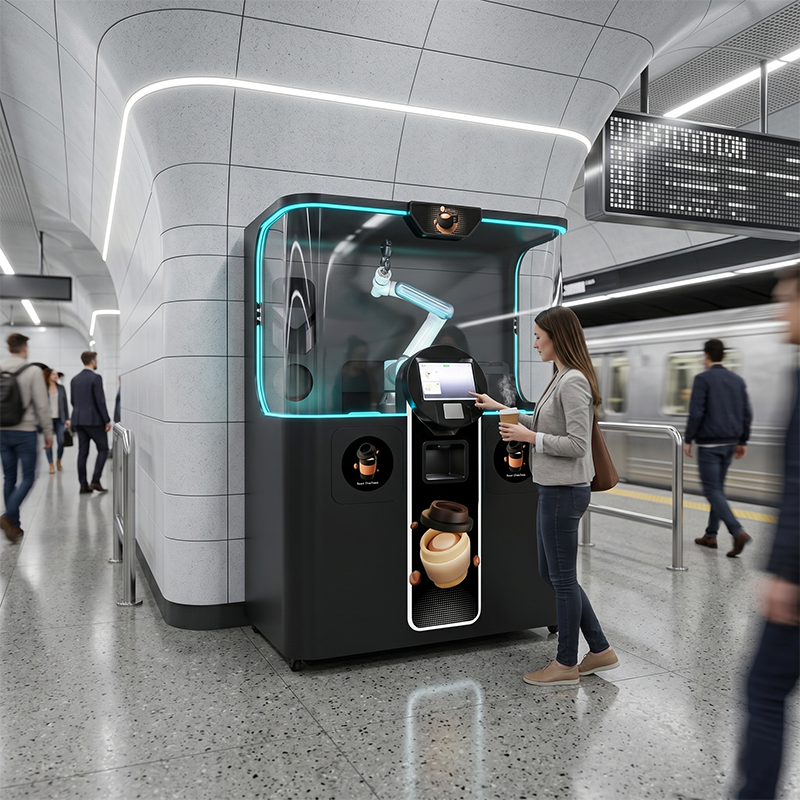
Finding a reliable robot barista machine supplier is less about brand visibility and more about engineering depth, service capability, and real-world commercial performance. In a market where uptime, drink consistency, and maintenance efficiency directly affect revenue, the right supplier should offer more than automated coffee hardware. This article explains how professional suppliers differ from general equipment vendors, what technical and operational standards matter most, and which companies are best suited for high-volume business use. By the end, readers will have a clearer framework for comparing suppliers and selecting a partner that can support long-term automated coffee operations.
Why Choosing a Professional Robot Barista Supplier Matters
The automation of specialty coffee has transitioned from a futuristic novelty to a high-margin operational necessity for commercial food service. As labor costs rise and consistency becomes paramount, sourcing the right equipment requires partnering with a professional robot barista supplier capable of delivering commercial-grade reliability.
Selecting the right manufacturing partner dictates the long-term viability of an automated coffee deployment. An inadequate supplier can lead to high downtime, inconsistent extraction, and negative customer experiences, directly impacting return on investment.
How professional suppliers differ from general equipment vendors
Professional suppliers engineer their systems from the ground up specifically for high-volume food service, whereas general equipment vendors often retrofit standard vending components with basic robotic arms. A specialized manufacturer focuses on the intricate kinematics required to replicate a human barista’s movements.
For example, premium automated systems utilize 6-axis robotic arms featuring a repeatability tolerance of ±0.1mm. This precision ensures that tamping pressure, milk frothing angles, and pouring speeds remain identical across thousands of cycles, a feat impossible for standard 4-axis or retrofitted industrial arms.
Best-fit business scenarios for robot barista solutions
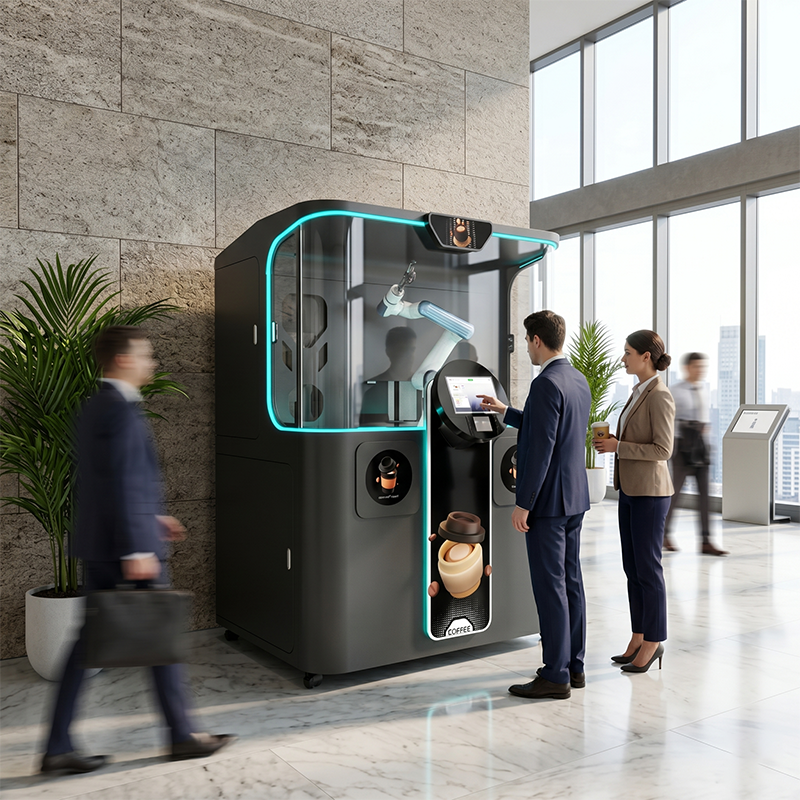
Automated coffee systems excel in environments where high throughput, 24/7 availability, and a minimal footprint are required. Airports, university campuses, corporate lobbies, and high-traffic shopping malls represent the most profitable deployment zones.
In these scenarios, a commercial-grade unit must sustain an output of 50 to 70 cups per hour during peak rushes. Professional suppliers design their machines with dual-boiler systems and rapid-cooling modules to maintain this continuous volume without thermal degradation or mechanical failure.
What Defines a Professional Robot Barista Supplier
Core technical and product capabilities
At the hardware level, the core capability lies in the brewing mechanism. Professional units must guarantee an espresso extraction pressure that remains stable between 9 and 15 bars, utilizing commercial-grade burr grinders with micro-metric adjustments.
Furthermore, the robotic arm’s payload capacity is a critical specification; it typically requires a 3 to 5 kg rating to safely and swiftly handle full cups, portafilters, and milk pitchers without straining the servo motors over time.
Integration, customization, and software support
A standalone machine is insufficient for modern retail. Professional suppliers provide comprehensive software ecosystems that include open APIs for seamless Point of Sale (POS) integration and mobile ordering applications.
Cloud telemetry is equally critical. Advanced systems boast a data synchronization latency of under 200 milliseconds, allowing operators to monitor bean hopper levels, milk temperatures, and daily sales metrics in real-time across a distributed fleet.
Service, training, and after-sales standards
The true test of a supplier’s professionalism is their commitment to keeping the machines operational. Industrial-grade robot baristas are built with a Mean Time Between Failures (MTBF) exceeding 15,000 cycles.
To support this, top-tier manufacturers integrate automated, self-flushing cleaning protocols that activate after every milk-based drink, alongside 24/7 remote diagnostic capabilities that allow engineers to push firmware updates and troubleshoot sensor faults without dispatching a technician.
How to Compare Robot Barista Suppliers
Systematic evaluation of potential manufacturing partners prevents costly deployment errors. Operators must look past marketing brochures and analyze objective criteria, regulatory compliance, and total lifecycle costs.
Key supplier comparison criteria
When evaluating options, buyers should categorize suppliers based on their technical maturity and component quality. The table below outlines the stark differences between Tier 1 professional manufacturers and Tier 2 budget assemblers.
| Feature | Tier 1 Professional Supplier | Tier 2 Budget Supplier |
|---|---|---|
| Robotic Arm Kinematics | 6-axis, ±0.1mm repeatability | 4-axis, ±0.5mm repeatability |
| Peak Output Capacity | 50-70 cups/hour | 30-40 cups/hour |
| Software Ecosystem | Real-time API & Cloud telemetry | Basic offline reporting only |
| Component Lifespan | >15,000 cycles (MTBF) | <5,000 cycles (MTBF) |
Certifications, food-contact compliance, and market access
Regulatory compliance is non-negotiable for commercial food and beverage equipment. A reputable supplier will hold active certifications such as NSF/ANSI 25 for food equipment, CE for European market access, and UL for North American electrical safety.
Additionally, all food-contact surfaces—including hoppers, tubing, and brewing chambers—must comply with FDA or equivalent international standards, utilizing food-grade silicone and 304 or 316-grade stainless steel to prevent contamination and corrosion.
Total cost of ownership, spare parts, and uptime
The initial Capital Expenditure (CAPEX) for a commercial robot barista typically ranges from $30,000 to $65,000 depending on the configuration. However, the Total Cost of Ownership (TCO) is heavily influenced by maintenance and uptime.
Buyers must evaluate the supplier’s spare parts inventory and logistics. A professional partner will offer a global parts dispatch Service Level Agreement (SLA) of 48 hours or less for critical components like solenoid valves and servo motors, ensuring machine downtime is kept to an absolute minimum.
How to Vet a Robot Barista Supplier
Thorough due diligence is necessary before signing purchasing contracts or committing to a fleet rollout. Vetting requires a combination of direct factory audits and structured, real-world pilot programs.
Factory verification and sourcing process
Operators should ideally conduct on-site or live virtual audits of the supplier’s manufacturing facility. Key indicators of a capable factory include ISO 9001 quality management certification and a demonstrated production capacity exceeding 100 units per month.
| Audit Area | Critical Verification Point | Minimum Acceptable Standard |
|---|---|---|
| Quality Control | ISO 9001 Certification | Active, verifiable certificate |
| Production Scale | Monthly Unit Output | >100 units/month capacity |
| Supply Chain | Component Sourcing | Tier-1 commercial coffee modules |
| Testing | Pre-shipment Burn-in | 72-hour continuous operation |
Pilot testing, acceptance standards, and contract terms
Before a mass rollout, operators should negotiate a pilot testing phase. Professional suppliers typically accommodate this with a Minimum Order Quantity (MOQ) of 1 to 3 units for field testing.
During the pilot, the contract should establish clear acceptance standards, including a 99% hardware uptime guarantee over a 90-day period, along with strict parameters for drink consistency, such as maintaining espresso yield volumes within a ±2ml variance.
How to Choose the Right Robot Barista Supplier
The final selection comes down to aligning the supplier’s strategic roadmap with the operator’s specific expansion plans. When ready to initiate a project, reaching out to a professional robot barista supplier directly is the most effective way to begin the specification process.
Matching supplier strengths to business needs
Operators must match hardware specifications to their target environment. A high-volume transit hub requires a machine optimized for speed and durability, while a premium specialty coffee brand may prioritize a supplier capable of intricate milk art programming and custom chassis branding.
If customization is required, buyers should evaluate the supplier’s engineering lead times. Modifying the exterior housing or developing a bespoke touch-screen User Interface (UI) typically requires a 4- to 8-week development cycle from a well-resourced manufacturer.
Final selection signals of a reliable partner
Beyond the technical specifications, the final signals of a reliable partner are found in their business practices. Dedicated account managers, transparent product development roadmaps, and clear intellectual property protections are hallmarks of a mature supplier.
Financially, professional suppliers offer standard, transparent payment terms—such as a 30% deposit upon order confirmation and a 70% balance prior to shipment—backed by a minimum 12-month comprehensive warranty on all non-consumable moving parts.
Further reading:
Key Takeaways
- The most important conclusions and rationale for professional robot barista supplier
- Specs, compliance, and risk checks worth validating before you commit
- Practical next steps and caveats readers can apply immediately
Frequently Asked Questions
What should I check first when choosing a professional robot barista supplier?
Start with output capacity, arm precision, API support, and after-sales service. For commercial sites, prioritize 50–70 cups/hour, 6-axis motion, and remote diagnostics.
Which locations are best suited for robot barista machines?
High-traffic sites work best, such as airports, campuses, malls, and office lobbies. These locations benefit most from 24/7 operation, fast service, and consistent drink quality.
Why is 6-axis precision important in a robot barista machine?
A 6-axis arm improves repeatability for tamping, pouring, and cup handling. This helps maintain stable drink quality and reduces errors during peak-volume operation.
Can YL Vending robot barista machines integrate with POS or mobile ordering?
Yes, YL Vending highlights open API support for POS integration and app-based ordering. Ask for your exact software compatibility and telemetry options before deployment.
What certifications should a professional robot barista supplier provide?
Look for CE, UL, and food-equipment compliance such as NSF/ANSI where required. These help confirm market access, electrical safety, and suitability for commercial beverage service.

Kely
Post time: Jun-18-2026