

Introduction
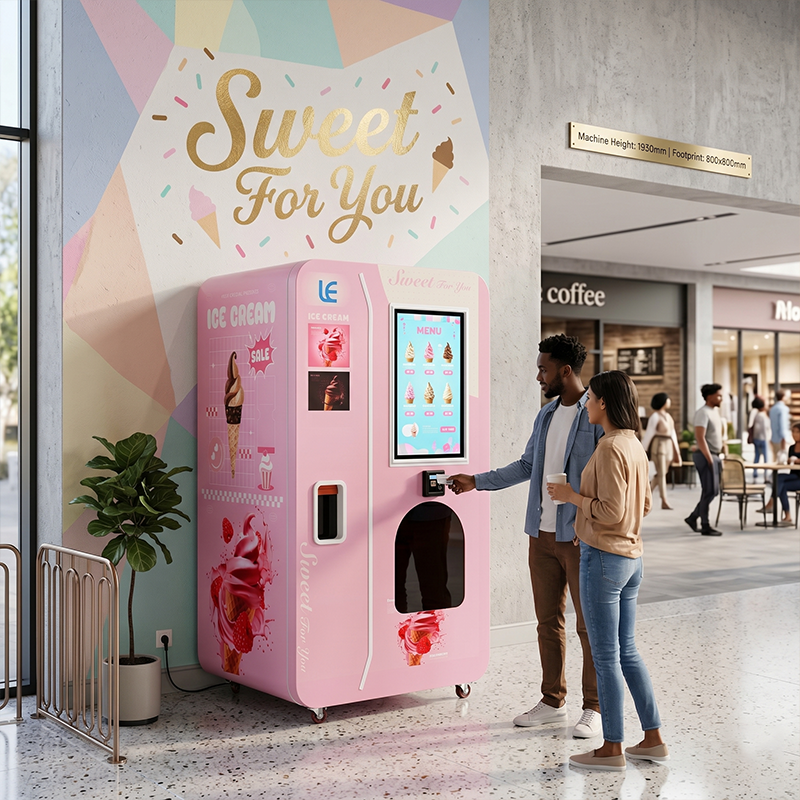
Amusement parks rely on fast, high-margin food sales, and ice cream vending machines fit that demand especially well in hot, crowded settings. A wholesale amusement park ice cream machine can reduce lines, support impulse purchases, and lower staffing pressure while serving guests in under a minute. This article explains why these machines work in high-traffic venues, what operating and revenue models park managers should compare, and which features matter most for reliability, capacity, and guest experience. From seasonal demand spikes to labor savings and placement strategy, the following sections outline how automated ice cream sales can strengthen both service speed and profitability.
Business Case for Ice Cream Machines in Amusement Parks
Amusement parks operate in high-traffic, dynamic environments where food and beverage sales represent a significant portion of overall profitability. Integrating automated dessert solutions addresses critical operational bottlenecks while capitalizing on consumer demand for immediate refreshment.
Guest traffic, impulse purchases, and labor efficiency
During peak summer months, large crowds and elevated temperatures drive up to a 40% increase in impulse food purchases. Traditional staffed kiosks often struggle to meet this sudden demand, resulting in queue abandonment and lost revenue. Automated vending machines handle transactions and dispensing in under 60 seconds, efficiently capturing sales that would otherwise be lost to long wait times.
Furthermore, labor efficiency is a critical metric for facility managers. Operating a traditional ice cream stand requires scheduling multiple shifts, managing breaks, and handling cash. Replacing a fully staffed, three-person kiosk with a high-capacity automated machine can save an amusement park an average of $40,000 to $50,000 annually in labor and associated overhead costs, directly improving the bottom line.
Operating models that fit park revenue goals
Park operators can choose between several financial models when deploying unattended retail. Revenue-sharing agreements with third-party operators eliminate upfront capital expenditure, though the park typically only retains 10% to 20% of gross sales. Conversely, a direct ownership model requires an initial capital investment but yields significantly higher margins, often reaching up to 80% per vend.
For high-traffic park zones, the return on investment (ROI) for direct ownership is typically achieved within 8 to 14 months. By integrating tailored automated retail solutions, parks can align their equipment choices with specific revenue targets, balancing immediate cash flow needs with long-term profitability.
Ice Cream Machine Types and Configuration Options
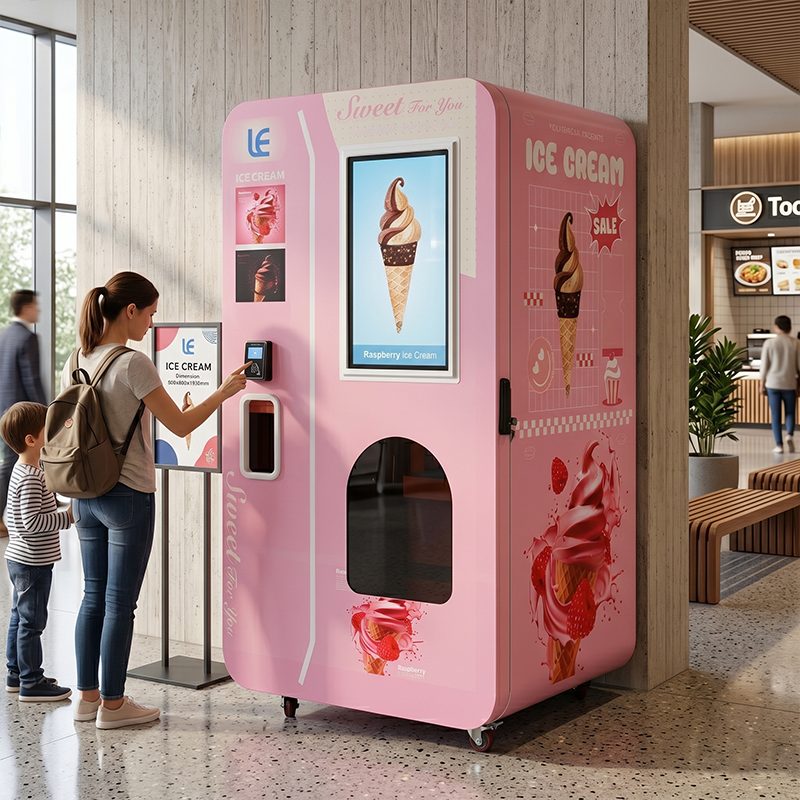
Procuring the correct hardware requires aligning the equipment’s capabilities with the specific operational environment of the amusement park. There are several primary architectures available for commercial deployment, each offering distinct advantages in capacity and guest experience.
Robotic vending, novelty freezers, and soft serve systems
The market offers three main categories of automated dessert dispensers. Traditional novelty freezers are the most common, utilizing a simple drop-mechanism or elevator lift to dispense pre-packaged ice cream bars. Soft serve systems require liquid dairy mix and utilize internal freezing cylinders to dispense fresh product into cones or cups.
Recently, robotic vending has emerged as a premium option. These machines feature articulated robotic arms that assemble and serve the ice cream behind a transparent viewing window. The high entertainment value of robotic systems often increases unit sales by up to 25% compared to static machines, as the dispensing process itself becomes a minor park attraction. Buyers can explore various ice cream machine products to find the ideal format for their venues.
Key technical specifications for commercial use
Commercial ice cream machines must adhere to rigorous technical specifications to survive continuous use in an amusement park. The refrigeration system is paramount; operators should look for industrial-grade compressors utilizing eco-friendly R290 or R404a refrigerants to maintain internal temperatures at a consistent -18°C (0°F).
Capacity is another critical specification. A standard commercial novelty machine should hold between 300 and 500 individual units to minimize restocking frequency during peak park hours. For soft serve machines, dual 15-liter hoppers are standard for high-volume locations. Additionally, machines slated for outdoor or semi-outdoor use must feature advanced insulation and ambient temperature ratings capable of operating efficiently in environments up to 40°C (104°F).
How to compare machine options for procurement
When evaluating different models, procurement teams must balance capital cost, throughput speed, and maintenance requirements. A comprehensive comparison helps identify the best fit for specific park zones.
| Machine Type | Dispense Time | Max Capacity | Ideal Park Location | Est. Capital Cost |
|---|---|---|---|---|
| Novelty Elevator Vending | 15 seconds | 400 units | Transit corridors | $4,000 – $8,000 |
| Robotic Soft Serve | 45-60 seconds | 250 servings | Plazas, rest areas | $15,000 – $35,000 |
| Smart Freezer (RFID) | 10 seconds | 300 units | Indoor arcades | $3,000 – $6,000 |
Comparing these parameters ensures that high-traffic areas receive fast-dispensing units, while slower-paced rest areas can accommodate the longer dispense times of experiential robotic units.
Compliance, Food Safety, and Site Planning
Deploying unattended food service equipment requires strict adherence to local health codes, electrical standards, and safety regulations. Amusement parks must ensure that every machine meets rigorous commercial standards before installation to mitigate liability and ensure continuous operation.
Food safety, electrical, accessibility, and payment requirements
Unattended food vending machines are subject to stringent health department regulations. Any machine dispensing perishable dairy must feature an automated health timer. This safety mechanism instantly locks out the payment system if internal holding temperatures exceed -18°C (0°F) for frozen novelties or 4°C (39°F) for liquid dairy mix for more than 30 consecutive minutes, preventing the sale of spoiled food.
Beyond food safety, machines must comply with accessibility and payment standards. Under the Americans with Disabilities Act (ADA) or equivalent international standards, all user interfaces, payment terminals, and product retrieval bins must be positioned no higher than 48 inches from the ground. Furthermore, payment terminals must support EMV chip and contactless payments (NFC) while maintaining PCI-DSS compliance to secure guest financial data.
Outdoor conditions, power, drainage, and queue layout
Site planning for outdoor and semi-outdoor placements involves critical infrastructure assessments. Machines exposed to the elements require NEMA 3R or IP65-rated enclosures to protect internal electronics from rain, dust, and humidity. Power requirements typically dictate dedicated 20-amp circuits operating on 220V/50Hz or 110V/60Hz, depending on regional electrical standards.
Drainage is an often-overlooked factor. Machines with automatic defrost cycles generate condensation that must be properly routed to a floor drain or evaporated via an internal heated pan to prevent slip hazards on the park concourse. Finally, queue layout must be considered; a single robotic soft-serve machine can draw a crowd, so site planners should allocate a 50-square-foot clear zone to accommodate 5 to 10 waiting guests without obstructing main thoroughfares or ride entrances.
Sourcing, Logistics, and Total Cost of Ownership
The financial viability of an automated ice cream program extends far beyond the initial purchase price. Facility managers and procurement officers must account for the total cost of ownership (TCO) across the equipment’s lifespan, which averages 7 to 10 years in commercial amusement settings.
Domestic versus overseas supplier evaluation
Choosing between domestic and overseas suppliers is a primary factor in project budgeting. Sourcing domestically typically offers faster lead times, often delivering units within 2 to 4 weeks, alongside localized customer support. However, this convenience comes at a premium, with base unit costs generally higher.
Conversely, partnering with established overseas manufacturing hubs can reduce upfront hardware capital expenditures by 30% to 40%. Buyers willing to navigate international logistics can read more about global manufacturing capabilities and vending compliance standards. However, maritime shipping adds 4 to 8 weeks to the project timeline, and procurement teams must calculate import tariffs (which can range from 10% to 25%), customs brokerage fees, and inland freight to determine the true landed cost.
Major cost drivers across purchase, operation, and service
Total cost of ownership encompasses acquisition, operations, and long-term maintenance. While the base unit represents the largest capital outlay, ongoing operational costs dictate long-term profitability. Preventative maintenance—including condenser cleaning, seal replacements, and software updates—typically costs between $500 and $800 annually per machine.
Telemetry and inventory management software represent another recurring expense, generally requiring software-as-a-service (SaaS) licensing fees of $10 to $20 per month per machine. Transaction fees from cashless payment processors also deduct 2.5% to 3.5% from gross revenue, which must be factored into the retail pricing strategy of the ice cream products.
Procurement and rollout steps to reduce project risk
To mitigate financial and operational risks, amusement parks should adopt a phased procurement and rollout strategy rather than a massive immediate deployment.
| Cost Category | Year 1 Estimate (Per Unit) | Years 2-5 Estimate (Annual) |
|---|---|---|
| Hardware Acquisition | $12,000 | $0 |
| Shipping & Installation | $1,500 | $0 |
| Maintenance & Parts | $300 | $600 |
| Telemetry & Software | $180 | $180 |
Initiating a pilot program with 3 to 5 units allows management to test location viability, monitor actual dispense rates, and evaluate the supplier’s technical support responsiveness. Once the pilot achieves the target 12-month ROI and proves operational stability, the park can confidently execute a broader fleet rollout.
How to Choose the Right Ice Cream Machine for Your
Finalizing a procurement decision requires a strategic alignment of the park’s demographic profile, physical footprint, and long-term food and beverage strategy. Selecting the right hardware ensures maximum uptime and guest satisfaction.
Decision criteria by park size, traffic, and menu strategy
Park size and average daily attendance heavily influence equipment selection. Smaller regional parks or family entertainment centers (under 500,000 annual visitors) often benefit from deploying 2 to 3 high-capacity, pre-packaged novelty freezers. These units have fewer moving parts, minimizing maintenance overhead for smaller technical teams.
In contrast, mega-parks hosting over 2 million annual visitors can leverage complex robotic soft-serve stations as standalone destination attractions. The menu strategy is equally critical: offering a simple menu of 4 to 6 pre-packaged items maximizes transaction speed, whereas a customizable soft-serve menu with multiple syrup and topping options increases the average transaction value but reduces overall hourly throughput.
What to request in proposals, warranties, and service agreements
When requesting proposals (RFPs) from manufacturers, procurement teams must demand transparency regarding minimum order quantities (MOQs), which are often set between 1 and 5 units for commercial buyers. It is vital to secure comprehensive warranties; standard commercial terms should cover the compressor and refrigeration deck for a minimum of 3 years, and all internal electronic components for at least 1 year.
Service level agreements (SLAs) are the final critical component. Because amusement parks generate the vast majority of their revenue during a narrow 100-day summer window, equipment downtime is exceptionally costly. SLAs must guarantee a maximum 48-hour response time for critical part dispatch and technical support to ensure the ice cream machines remain operational during peak attendance periods.
Further reading:
Key Takeaways
- The most important conclusions and rationale for amusement park ice cream machine
- Specs, compliance, and risk checks worth validating before you commit
- Practical next steps and caveats readers can apply immediately
Frequently Asked Questions
What type of amusement park ice cream machine works best in high-traffic areas?
Novelty elevator vending and smart freezer models are best for transit corridors because they dispense in 10–15 seconds and handle heavy rush periods efficiently.
How quickly can an amusement park ice cream vending machine serve guests?
Most commercial units dispense in under 60 seconds. Fast novelty machines can deliver in about 10–15 seconds, helping reduce queue abandonment during peak hours.
What capacity should an ice cream machine have for amusement parks?
For packaged ice cream, choose machines holding about 300–500 units. In busy parks, this reduces restocking stops and supports all-day sales.
Are YL Vending ice cream machines suitable for outdoor amusement park use?
Yes, if you select models built for semi-outdoor or outdoor conditions, with strong insulation and operation ratings up to 40°C (104°F).
Should an amusement park buy or revenue-share an ice cream vending machine?
Buy if your park has steady foot traffic and wants higher margins, often up to 80% per vend. Revenue sharing fits operators who prefer lower upfront investment.

Kely
Post time: Jun-08-2026