

Introduction
AI coffee robots have become a noticeable feature in shopping malls because they do more than serve drinks: they attract attention, use small footprints efficiently, and help operators influence where people stop and how long they stay. For mall managers, these kiosks combine automation, visual novelty, and steady beverage demand in a format that fits busy corridors and underused spaces. For retailers and property teams, the value lies in both customer experience and measurable traffic effects. This article explains why AI coffee robots work so well in mall environments, how they support footfall and dwell time, and what makes them a practical commercial tool rather than just a passing curiosity.
Why AI Coffee Robots Drive Mall Traffic
Shopping malls are undergoing a structural transformation, shifting from traditional retail hubs to hybrid experiential centers. As property managers seek to maximize dwell time and optimize underutilized floor space, the integration of autonomous food and beverage solutions has become a primary strategy. The deployment of an automated barista acts as a high-tech anchor that consistently draws pedestrian interest without requiring the extensive square footage of a full-scale cafe.
The visual appeal of robotic articulation combined with the sensory experience of freshly ground espresso creates a micro-attraction within the concourse. This dynamic helps landlords activate dead zones in mall layouts, turning transitional hallways into profitable rest areas that encourage shoppers to linger longer.
How AI coffee robots fit mall traffic goals
Mall operators rely on strategic tenant placement to control pedestrian flow and eliminate cold spots within the property. Automated coffee installations are uniquely positioned to serve as mid-journey waypoints. By placing these units near high-traffic intersections or secondary entrances, operators can increase localized foot traffic by an estimated 12% to 18%.
Furthermore, these robotic kiosks operate continuously, capturing early morning mall walkers and late-night cinema crowds outside standard retail hours. This 24/7 availability maximizes the utility of the commercial space, ensuring that visitors always have access to premium amenities regardless of the operating hours of adjacent brick-and-mortar tenants.
Which consumer trends favor automated coffee service
Modern shoppers demand both experiential retail and frictionless transactions. The post-pandemic shift toward contactless service has accelerated the adoption of automated kiosks, but consumers are no longer willing to sacrifice quality for convenience. An advanced AI coffee robot bridges this gap by delivering specialty-grade beverages without human interaction.
Speed of service is another critical driver. Advanced robotic arms can complete a complex espresso extraction and milk frothing sequence in precisely 45 to 60 seconds. This rapid fulfillment satisfies the immediate gratification expected by today’s consumers while providing a visually engaging process that highly appeals to the digital-native demographic.
What Defines an AI Coffee Robot in Mall Operations
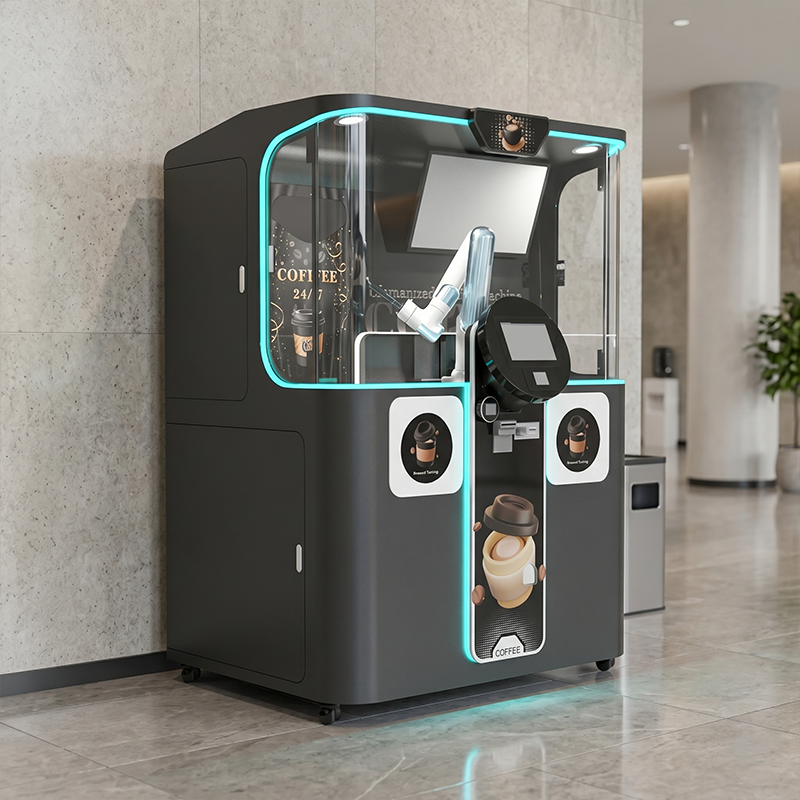
The architecture of an automated barista extends far beyond the mechanisms of legacy vending machines. In a commercial mall environment, an AI-driven coffee solution represents a sophisticated convergence of industrial robotics, Internet of Things (IoT) telemetry, and computer vision. These systems are designed to replicate the exact movements and decision-making processes of a human barista, ensuring consistent cup quality under high-volume conditions.
Operational success in a mall setting requires hardware that can self-regulate and adapt to fluctuating environmental variables, such as ambient humidity and temperature, which directly affect espresso extraction.
Which features set AI coffee robots apart
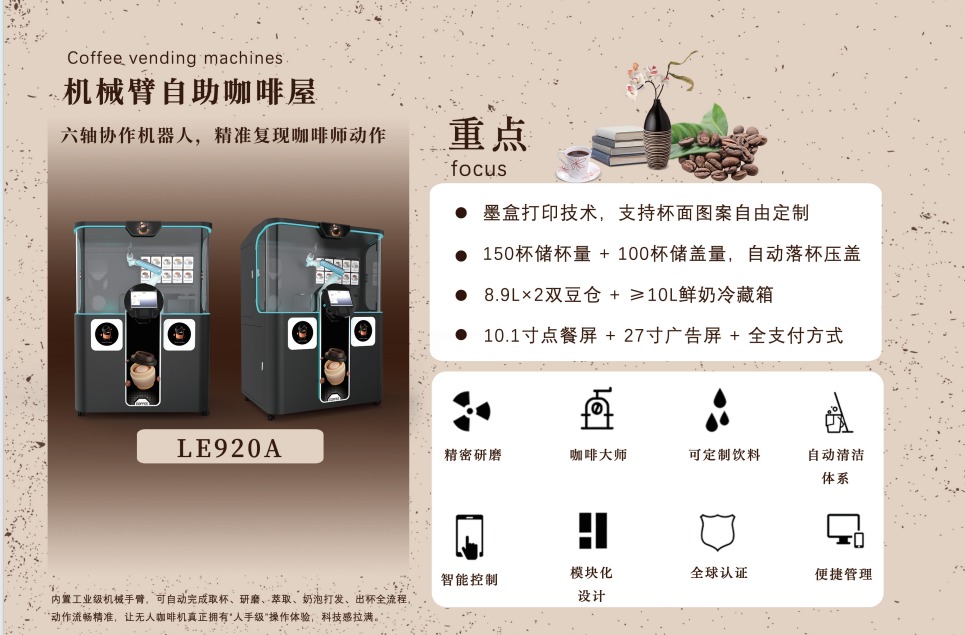
Unlike legacy vending infrastructure that relies on linear actuators and instant powder mixes, modern automated coffee solutions utilize a 6-axis robotic arm capable of complex, multi-directional articulation. This allows the system to handle standard commercial portafilters, tamp grounds, and steam milk with exact volumetric control.
Precision is a defining characteristic. High-end systems maintain a dosing accuracy of ±0.1 grams and regulate water temperature to within 0.5°C of the target profile. Additionally, integrated computer vision systems monitor the workspace for spills, verify cup placement, and ensure the robotic arm clears the service window safely, contributing to an operational uptime exceeding 99.8%.
How operators should evaluate AI coffee robot solutions
Procurement teams and facility managers must analyze multiple technical dimensions when selecting an automated coffee platform. Key evaluation metrics include payload capacity, kinematic repeatability, and the robustness of the software API for integration into existing mall loyalty applications. An effective AI coffee robot should seamlessly communicate with cloud dashboards to report inventory levels and diagnostic alerts in real time.
| Feature | Legacy Vending | AI Robotic Coffee |
|---|---|---|
| Grinding Mechanism | Pre-ground / Instant powder | Fresh bean-to-cup precision burr |
| Motion Control | Simple linear dispensing | 6-axis industrial robotic arm |
| Dosing Precision | ±2.0 grams | ±0.1 grams |
| Telemetry | Basic coin/bill count | Full IoT cloud diagnostics |
| Average Uptime | 85-90% | 99.8%+ |
Why Shopping Malls Prefer the AI Coffee Robot Model
Commercial real estate managers face constant pressure to optimize the yield per square foot of their properties. Traditional food and beverage tenants require extensive build-outs, complex leasing agreements, and significant utility allocations. The robotic coffee model circumvents these hurdles by offering a plug-and-play revenue stream with a remarkably dense operational footprint.
By replacing labor-intensive service models with autonomous execution, malls can offer premium coffee experiences in locations where a standard cafe would be spatially or economically unfeasible.
How footprint, utilities, throughput, and maintenance affect adoption
The physical dimensions of an automated kiosk are highly favorable for mall deployment. A typical unit requires only 2.5 to 3.0 square meters of floor space, allowing it to fit under escalators or within narrow concourse islands. Utility requirements are standardized, generally needing only a dedicated 220V/30A electrical circuit and standard water line access, though many units feature self-contained water reservoirs.
Throughput capacity is engineered for peak retail rushes. A dual-arm or optimized single-arm system can process 60 to 80 cups per hour. Maintenance is largely predictive, driven by IoT sensors that notify off-site technicians only when physical replenishment or component servicing is actually required, drastically reducing on-site labor hours.
What trade-offs matter for landlords, operators, and retailers
The adoption of autonomous coffee kiosks involves specific economic trade-offs. For operators, the initial capital expenditure (CAPEX) is substantial, often ranging from $35,000 to $60,000 per unit depending on the robotic specifications. However, this is offset by a 70% to 80% reduction in operating expenses (OPEX) due to the elimination of barista wages, benefits, and training costs.
Landlords benefit from premium rent models, often structured as a flat footprint leasing fee plus a percentage of gross sales. Retailers in the immediate vicinity benefit from the “halo effect” of increased shopper dwell time, though they must accept the aesthetic presence of a high-tech kiosk adjacent to their storefronts.
Which comparison points best show advantages over traditional coffee kiosks
Direct comparisons highlight the operational superiority of robotic systems over traditional manned kiosks in specific retail contexts. The most striking difference lies in the ratio of revenue potential to overhead costs.
| Metric | Traditional Coffee Kiosk | AI Coffee Robot Kiosk |
|---|---|---|
| Footprint Required | 15 – 25 sq. meters | 2.5 – 3.0 sq. meters |
| Monthly Labor Cost | $3,500 – $5,000+ | $0 (Fully Automated) |
| Peak Throughput | 40 – 50 cups/hour | 60 – 80 cups/hour |
| Operating Hours | 10 – 12 hours/day | 24/7 continuous |
| Build-out Time | 4 – 8 weeks | 24 – 48 hours |
While a traditional kiosk offers human hospitality, the robotic alternative provides unmatched consistency, zero staffing-related closures, and the ability to operate profitably in lower-traffic zones where a manned kiosk would operate at a loss.
What Compliance and Supply Chain Factors Matter Most
Deploying autonomous food service equipment in public commercial spaces requires rigorous adherence to local and international compliance frameworks. Because these systems handle consumable goods and process digital payments without human oversight, the liability matrix is complex.
Stakeholders must ensure that both the hardware and the supporting software ecosystem meet strict regulatory standards to mitigate health, security, and operational risks.
How food safety, payment security, and data governance affect deployment
Sanitation protocols dictate the engineering of automated coffee systems. Units must achieve compliance with standards such as NSF/ANSI 25, which governs food and beverage dispensing equipment. To meet these requirements, top-tier robots execute 100% automated high-temperature flush cycles every 4 hours, utilizing UV-C sterilization for dispensing nozzles.
Equally critical is the digital infrastructure. Payment terminals must maintain PCI-DSS compliance to secure EMV and NFC transactions against skimming or interception. Furthermore, because these kiosks collect telemetry and user interaction data, the underlying software must adhere to data governance frameworks like GDPR or CCPA, ensuring consumer privacy is maintained during loyalty program integrations.
Which sourcing, hardware, and service factors reduce operational risk
Supply chain resilience directly impacts the viability of a robotic deployment. Operators must source equipment from manufacturers that guarantee long-term parts availability and robust warranty support. Evaluating the Mean Time Between Failures (MTBF) is essential; commercial-grade robotic arms should be rated for an MTBF exceeding 15,000 hours to ensure they can survive the rigors of a high-traffic mall.
Partnering with an established AI coffee robot manufacturer provides access to standardized service level agreements (SLAs) and localized technician networks. This reduces the operational risk associated with prolonged downtime, ensuring that a malfunctioning pump or sensor can be diagnosed remotely and swapped within a 24-hour window.
How Stakeholders Should Evaluate Investment Decisions
Capital allocation for retail automation demands a structured analytical approach. Property managers and independent operators must look past the novelty of robotics and evaluate the deployment strictly as a cash-flowing asset.
A successful rollout requires precise site selection, accurate demand forecasting, and a clear understanding of the unit economics associated with specialty coffee margins.
What evaluation steps to follow before deployment
Initial feasibility studies should begin with pedestrian traffic analysis. A baseline threshold of 3,000 daily passersby within a 50-meter radius is generally required to sustain a healthy conversion rate. Operators should utilize heat-mapping software or mall Wi-Fi analytics to identify the optimal micro-location for the kiosk.
Following site selection, stakeholders must model the supply logistics. This involves calculating the replenishment frequency based on hopper capacity (typically 2 to 4 kilograms of beans) and milk refrigeration limits. A rigorous financial model should account for raw material costs, electricity, internet connectivity, and the mall’s revenue-sharing agreements.
Which criteria show when an AI coffee robot is a strong fit
A deployment is deemed financially viable when the projected breakeven timeline aligns with the operator’s capital strategy. In a premium mall environment, a strong fit is indicated by an expected ROI horizon of 8 to 14 months. This is typically achieved when the unit consistently dispenses 70 to 100 cups per day at an average ticket price of $4.00 to $5.00.
Beyond pure financials, qualitative criteria also signal a strong fit. Malls with a high concentration of technology-forward tenants, luxury retail, or extensive entertainment wings (such as cinemas and arcades) provide the ideal demographic overlap for autonomous coffee adoption, maximizing both the utility and the experiential value of the investment.
Further reading:
Key Takeaways
- The most important conclusions and rationale for AI coffee robot
- Specs, compliance, and risk checks worth validating before you commit
- Practical next steps and caveats readers can apply immediately
Frequently Asked Questions
Why are AI coffee robots popular in shopping malls?
They attract attention, serve fresh drinks fast, and fit small spaces. Malls use them to increase dwell time, activate low-traffic areas, and serve customers beyond normal café hours.
How fast can an AI coffee robot make a drink?
Most advanced units complete espresso and milk preparation in about 45 to 60 seconds, helping malls serve rush-hour shoppers quickly without long queues.
What makes an AI coffee robot better than a traditional vending machine?
It uses fresh beans, precise dosing, and a robotic arm for barista-style preparation. This improves drink quality, consistency, and customer experience compared with instant or pre-mix vending.
What should mall operators check before buying an AI coffee robot?
Focus on uptime, cloud monitoring, dosing accuracy, API integration, and space requirements. On ylvending.com, operators can review product and solution options for mall deployment.
Where should an AI coffee robot be placed in a mall?
Best locations include high-traffic intersections, secondary entrances, cinema zones, and underused corridors. These spots help boost visibility, capture all-day traffic, and turn dead space into revenue.

Kely
Post time: May-29-2026