

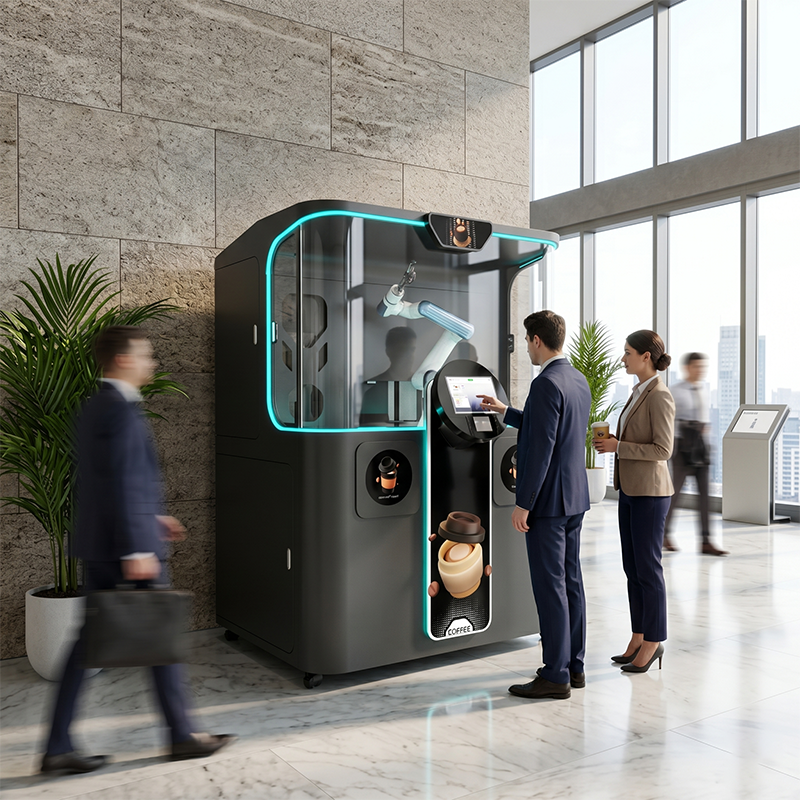
 Commercial single robotic arm coffee machines are popular for OEM orders because they combine visible automation, consistent drink preparation, compact deployment, and flexible branding in one platform. For operators, the main value is not the robotic arm alone: it is the ability to standardize recipes, support remote management, simplify labor planning, and adapt the machine to local menus, payments, languages, and service environments.
- A single robotic arm can create a clear automation story while keeping the customer-facing workflow compact.
- OEM buyers can adapt the enclosure, menu, payment system, language, and software functions to local requirements.
- Commercial success depends on cleaning access, ingredient replenishment, remote monitoring, and service support as much as mechanical performance.
- Freshly brewed, instant, and tabletop formats serve different traffic, space, and maintenance conditions.
- The strongest OEM programs connect hardware, software, operations, and after-sales support instead of selling an isolated machine.
Robotic arm coffee machine OEM programs are attractive because they answer three procurement priorities at once: consistent preparation, reduced dependence on on-site labor, and a branded self-service experience. Brewing quality still depends on controllable fundamentals; the National Coffee Association recommends water between 195 and 205 degrees Fahrenheit for brewing. The right commercial coffee machine therefore combines automation with measurable recipe control, safe maintenance routines, and a deployment plan suited to each location.
Why a Robotic Arm Creates OEM Appeal
The strongest reason for choosing a robotic arm coffee machine is that the arm makes an automated process visible, repeatable, and easy to explain to end users.
In an office lobby, airport, hotel, or campus, customers can see the machine move through a defined preparation sequence. That visibility can help turn a vending transaction into a service experience. For an OEM buyer, the same motion also provides a recognizable product identity that can be integrated into a custom enclosure, branded user interface, or themed retail environment.
A single-arm architecture can also reduce mechanical complexity compared with a system that uses several independent handling mechanisms. This does not automatically make every design better. The arm must still reach the cup, ingredients, brewing module, waste area, and cleaning positions without creating difficult access points. Procurement teams should evaluate the complete motion path rather than judging the machine by appearance alone.
| OEM evaluation area | Why it matters | Questions to ask |
|---|---|---|
| Motion design | Determines visibility, reach, cycle logic, and service access | Can technicians reach the brew, dispense, and waste zones without removing major panels? |
| Recipe control | Supports consistent taste across locations | Can operators adjust beverage parameters remotely or by approved service access? |
| Brand integration | Turns equipment into a customer-facing retail asset | Can the enclosure, screen, language, and menu be adapted without changing the core platform? |
| Operational software | Connects sales, stock, alarms, and service activity | Does the system provide remote status, inventory alerts, and transaction reporting? |
How OEM Coffee Machine Customization Supports Local Markets
OEM value comes from adapting a proven equipment platform to a buyer’s commercial model rather than starting every project from zero.
Typical customization may include exterior panels, colors, screen layouts, payment methods, beverage names, language options, cup sizes, ingredient configurations, and connection to a cloud management platform. These elements matter because a machine installed in a factory can have different requirements from one installed in an airport or hotel.
Payment integration deserves early attention because the preferred method varies by country, venue, and customer group. A deployment may require cashless payment, QR-based payment, bank-card acceptance, employee account billing, or a combination of methods. The buyer should confirm transaction ownership, settlement responsibility, data access, and offline behavior before production approval.
Menu localization is equally important. A compact machine may need to support espresso-based beverages, milk drinks, flavored beverages, decaffeinated options, or local serving preferences. The menu should be designed around ingredient shelf life, refill frequency, cleaning requirements, and expected demand rather than simply listing every possible drink.
Commercial Coffee Machine Performance Depends on Workflow
A commercial coffee machine succeeds when its full workflow is reliable from ingredient loading to customer collection.
Freshly ground systems can provide a more visible bean-to-cup proposition, but they usually require closer attention to grinders, brewing components, grounds waste, and cleaning. Instant systems can be appropriate where rapid preparation, simplified handling, and predictable replenishment are more important than a visible grinding process. Tabletop machines can fit smaller spaces, while floor-standing units may offer stronger presence and greater storage capacity.
Brewing control should be treated as an engineering requirement, not only a marketing statement. The National Coffee Association explains that brewing water is generally recommended at 195 to 205 degrees Fahrenheit. A buyer should ask how the machine monitors or controls temperature, how recipes are locked, and how operators verify beverage consistency during routine service.
| Machine format | Best-fit environment | Primary strength | Main operational concern |
|---|---|---|---|
| Freshly brewed bean-to-cup | Offices, hotels, campuses, premium self-service areas | Visible preparation and fresh-ground positioning | Cleaning, grounds waste, grinder care, and ingredient replenishment |
| Instant beverage system | Factories, high-throughput locations, staff areas | Fast preparation and simplified operation | Ingredient storage, flavor consistency, and powder management |
| Tabletop coffee vending unit | Small offices, convenience areas, reception spaces | Compact footprint and flexible placement | Counter space, refill access, and customer visibility |
| Robotic presentation system | Showrooms, airports, malls, branded venues | Visible automation and differentiated experience | Motion reliability, safety design, and service access |
Why Remote Management Matters in Unattended Coffee
Remote monitoring converts a coffee machine from a standalone appliance into an operational asset.
Operators need visibility into availability, ingredient levels, waste status, cleaning reminders, error codes, payment events, and sales patterns. Without this information, a machine can remain physically installed but commercially unavailable because of an empty ingredient bin, full waste container, blocked outlet, payment fault, or overdue cleaning task.
IoT design also introduces cybersecurity and privacy responsibilities. The National Institute of Standards and Technology guidance on IoT cybersecurity and privacy risks recommends considering security and privacy throughout the device lifecycle. For an OEM project, this means clarifying device identity, account permissions, software updates, data retention, network access, and responsibility for incident response.
A useful operating dashboard should help answer practical questions quickly: Which machines are online? Which locations need replenishment? Which error has repeated? Which drinks sell by time and site? Which maintenance action is overdue? These answers support route planning and reduce unnecessary site visits.
Cleaning, Food Safety, and Serviceability
Serviceability is one of the most important differences between an attractive prototype and a commercially deployable machine.
Cleaning procedures should identify every surface and component that contacts water, milk, coffee, powder, cups, or waste. The process should state who performs the task, how often it is required, what tools are needed, how completion is recorded, and what happens if the task is missed.
Food safety requirements vary by jurisdiction and application, so OEM buyers should review local rules before launch. The U.S. Food and Drug Administration Food Code is a useful reference for retail food operations; its cold-holding provisions specify 41 degrees Fahrenheit or below for time and temperature control foods. That figure should not be copied blindly into every market, but it illustrates why milk storage, temperature monitoring, and local compliance review must be addressed during system design.
Technicians should be able to access the brewing unit, ingredient containers, waste areas, payment module, and control electronics without excessive disassembly. A good OEM specification includes cleaning access, spare-parts availability, troubleshooting instructions, remote diagnostics, and escalation procedures before the first shipment.
Choosing a Robotic Arm Platform for Different Locations
The best machine configuration is determined by traffic pattern, space, staffing, product mix, and replenishment access.
- Airports and transport hubs: prioritize fast customer decisions, multilingual interfaces, cashless payment, high visibility, and rapid service response.
- Office buildings: prioritize beverage quality, compact placement, employee convenience, remote stock alerts, and scheduled cleaning.
- Schools and campuses: prioritize simple menus, payment flexibility, safe operating design, accessible service procedures, and transparent ingredient information.
- Factories and industrial sites: prioritize throughput, durable construction, easy refilling, shift-based demand analysis, and minimal operator intervention.
- Hotels and hospitality venues: prioritize presentation, menu personalization, quiet operation, guest usability, and integration with the venue’s service concept.
Before approving an OEM order, buyers can score each candidate from 1 to 5 on deployment fit, service access, payment readiness, software visibility, menu flexibility, and replenishment effort. This is a planning framework rather than an industry performance benchmark; its purpose is to expose weak areas before the machine enters production.
| Decision category | Priority score range | Evidence to collect |
|---|---|---|
| Site compatibility | 1 to 5 | Floor or counter space, power, network, customer flow |
| Serviceability | 1 to 5 | Cleaning steps, access panels, spare parts, technician time |
| Commercial fit | 1 to 5 | Expected demand, menu, price model, payment method |
| Digital operations | 1 to 5 | Alerts, dashboards, inventory data, software ownership |
| Localization | 1 to 5 | Language, payment, labeling, electrical and regulatory review |
What OEM Buyers Should Confirm Before Production
The most reliable procurement process turns broad customization requests into documented acceptance criteria.
- Define the target locations, customer groups, menu, expected operating hours, and replenishment model.
- Confirm electrical, network, payment, language, labeling, and local compliance requirements.
- Approve the user journey from payment selection through cup collection and error recovery.
- Test cleaning access, ingredient loading, waste handling, remote alerts, and technician procedures.
- Agree on pilot quantities, spare parts, software support, training, warranty boundaries, and change control.
Buyers should also distinguish between a demonstration unit and a production-ready platform. A demonstration may prove that the robotic arm can complete a sequence. A production program must prove repeatable operation, safe cleaning, reliable payment, stable connectivity, manageable replenishment, and supportable maintenance across real locations.
Why the Hardware-Software-Service Model Is More Valuable
The commercial advantage of an OEM coffee machine increases when hardware, software, and operating services are designed as one system.
A manufacturer that supports coffee equipment, beverage systems, vending equipment, ice solutions, and intelligent service terminals can help buyers plan a broader unattended retail environment. Coffee may attract users, while snacks, cold drinks, ice, consumables, and other automated services improve the usefulness of the same site.
This broader approach is especially relevant for overseas projects. A successful rollout may require multilingual interfaces, local payment integration, remote support, regional spare-parts planning, and a clear division of responsibility between the equipment supplier, distributor, site operator, and payment provider.
For procurement teams, the central question is therefore not simply whether the arm looks advanced. The better question is whether the supplier can support the complete operating loop: configure, deploy, monitor, replenish, clean, repair, analyze, and improve.
FAQ
Why are single robotic arm coffee machines popular for OEM orders?
They combine visible automation with a compact architecture that can be adapted for branding, menu design, payment integration, and remote management. This makes them suitable for buyers that want a differentiated self-service experience without developing every subsystem independently.
Can an OEM coffee machine support different languages and payment methods?
Many OEM projects can be configured for multiple languages and payment methods, but the exact options depend on the software platform, payment provider, country, network environment, and local compliance requirements. These items should be confirmed during technical specification.
Is a robotic arm coffee machine suitable for high-traffic locations?
It can be suitable when the drink menu, preparation workflow, replenishment plan, cleaning process, and service response are designed for the site’s traffic pattern. Mechanical appearance alone does not prove throughput or reliability.
What is the difference between freshly brewed and instant coffee machines?
Freshly brewed systems typically emphasize bean-to-cup preparation and a visible fresh-ground experience. Instant systems generally emphasize fast preparation, simplified handling, and easier ingredient management. The better choice depends on taste positioning, traffic, labor, and maintenance capacity.
How important is remote monitoring?
Remote monitoring is important for unattended or lightly staffed sites because it can reveal connectivity problems, stock conditions, error states, cleaning reminders, and sales activity before an operator makes a service visit.
What cleaning questions should OEM buyers ask?
Ask which parts require daily or scheduled cleaning, how milk and beverage-contact components are sanitized, how waste is handled, how cleaning completion is recorded, and whether technicians can access service areas without extensive disassembly.
What should be included in an OEM contract?
The agreement should define customization scope, acceptance testing, software ownership, payment integration, packaging, installation, training, spare parts, warranty boundaries, remote support, change control, and responsibility for local compliance review.
About the Manufacturer
Yile Shangyun develops commercial self-service equipment and integrated operating solutions across coffee, beverages, vending, ice, and intelligent service terminals. Its capabilities include OEM and ODM customization for machine appearance, menus, languages, payments, functions, and connected management tools. The company supports applications in offices, airports, schools, factories, hotels, campuses, and communities, helping buyers connect equipment deployment with monitoring, replenishment, maintenance, and ongoing commercial operations. Contact the team to discuss a tailored machine program and site requirements.

Post time: Sep-16-2026