

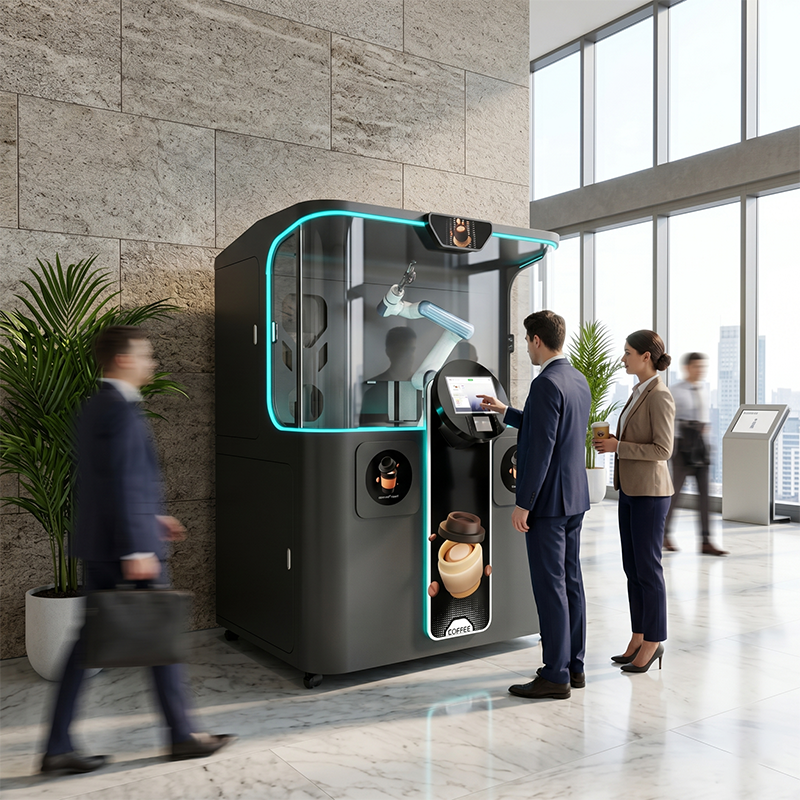
Premium shopping centers need amenities that do more than serve a function—they must enhance the atmosphere, support luxury branding, and use space efficiently. Robot coffee machines meet that need by combining specialty beverage service with automation, visual appeal, and consistent performance in a compact footprint. They can extend service hours, activate underused areas, and give visitors a memorable stop between boutiques without the overhead of a full café. This article explains why these systems fit high-end retail so well, from customer experience and operational efficiency to revenue potential and the broader role they play in modern experiential shopping.
What Defines a Robot Coffee Machine in Retail
Common service models and formats
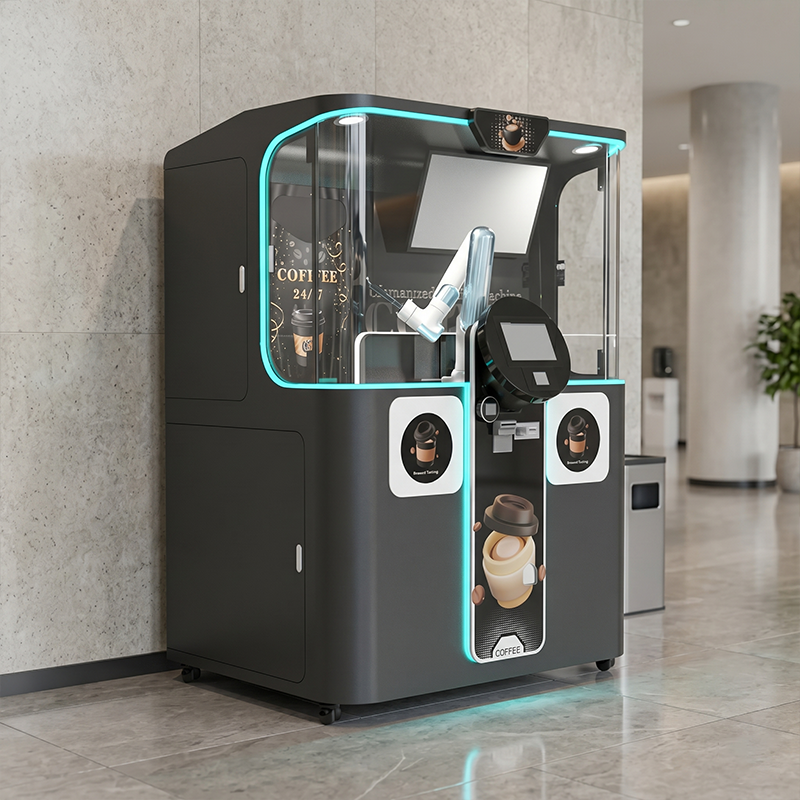
Automated coffee systems generally deploy in two primary formats tailored to different architectural and operational needs. The first is the standalone enclosed kiosk, a self-contained unit featuring transparent safety glass that allows a 360-degree view of the robotic mechanics. The second is the wall-integrated or modular counter system, which sits flush against existing retail architecture, presenting a sleek, built-in aesthetic ideal for VIP lounges or concierge areas. When selecting products for a commercial environment, developers must weigh the visual impact of a standalone unit against the space-saving nature of a wall-integrated design.
| Format Type | Typical Footprint | Cup Capacity per Restock | Average Setup Time |
|---|---|---|---|
| Standalone Kiosk | 2.5 – 4.0 sq meters | 150 – 200 cups | 1 – 2 days |
| Wall-Integrated | 1.5 – 2.5 sq meters | 100 – 150 cups | 3 – 5 days |
Key technical and operating requirements
To maintain continuous operation in a high-traffic retail setting, these machines rely on a complex network of technical requirements. At the core is a 6-axis industrial robotic arm capable of millimeter-level precision. Supporting this hardware is an array of IoT (Internet of Things) sensors and telemetry systems that monitor ingredient levels, water pressure, and component temperatures in real-time. Operators receive automated alerts when milk, beans, or cups drop below a 15 percent threshold, enabling proactive restocking. Additionally, sophisticated software interfaces are required to process touchless payments, manage localized digital menus, and handle queue management during peak traffic hours.
How Robot Coffee Machines Compare with Traditional Coffee Service
Evaluating automated barista systems requires a direct comparison with traditional, human-staffed coffee kiosks. While both aim to deliver high-quality caffeinated beverages, their underlying economic models, operational resilience, and service delivery methods are fundamentally opposed. Understanding these differences allows shopping center management to forecast long-term viability and operational overhead accurately.
Cost, staffing, and efficiency differences
The most pronounced divergence between automated and traditional coffee services lies in the cost structure and labor dependency. A traditional coffee kiosk operating 12 hours a day typically requires 2.0 to 4.0 full-time equivalent (FTE) employees to manage brewing, cashier duties, and breaks. In contrast, an automated system requires approximately 0.2 FTE, limited entirely to daily cleaning and restocking routines that take under 30 minutes. While the initial capital expenditure (CapEx) for a robotic unit is significantly higher, the near-elimination of ongoing labor costs (OpEx) drastically alters the return on investment.
| Metric | Robot Coffee Machine | Traditional Coffee Kiosk |
|---|---|---|
| Active Staffing Requirement | 0.2 FTE (restocking/cleaning) | 2.0 – 4.0 FTE (baristas/cashiers) |
| Operating Hours | 24/7 capability | Typically 10 – 12 hours/day |
| Peak Throughput | 50 – 60 cups/hour | 80 – 120 cups/hour (with 2+ staff) |
| Production Consistency | 100% precise to programmed recipe | Variable based on operator skill |
Customer experience and service limitations
Despite the operational efficiencies, robotic systems do face specific service limitations when compared to human baristas. A robot executes programmed recipes with absolute mathematical consistency, entirely eliminating human error, under-extraction, or incorrect milk texturing. However, it cannot replicate the personalized hospitality, casual conversation, or intuitive customer service that a highly skilled barista provides. Furthermore, while traditional cafes can easily adapt to off-menu requests or highly complex dietary substitutions on the fly, automated systems are strictly limited to their pre-programmed syrup and milk matrices. For luxury environments where high-touch interpersonal service is a core brand pillar, this lack of human interaction must be weighed against the benefits of speed and consistency.
What Operational and Compliance Factors Shape Deployment
Deploying sophisticated robotics in a public retail environment involves rigorous adherence to health, safety, and facility standards. Because these machines combine industrial moving parts with food service and high-voltage electrical components, property managers must navigate a multi-layered compliance landscape before the first cup is served.
Food safety, electrical, and site compliance
Regulatory compliance is the foremost hurdle in deployment. As food service equipment, the internal components—especially those handling fresh milk and water—must carry certifications such as NSF (National Sanitation Foundation) or local equivalent food safety ratings to ensure non-toxic, easily cleanable surfaces. The systems also require robust electrical and safety approvals, such as CE or UL listings. Facility managers must ensure the site provides dedicated 220V/16A (or regional equivalent) power drops equipped with 30mA Residual Current Devices (RCD) to mitigate electrical hazards. Additionally, strict plumbing codes mandate commercial-grade water filtration systems and secure drainage connections to prevent leaks in premium retail spaces.
Rollout planning and partner coordination
Successful installation requires meticulous coordination between the hardware vendor, facility management, and IT departments. Site preparation must be completed weeks in advance, ensuring that hardwired ethernet connections for IoT telemetry, reinforced flooring capable of supporting equipment weighing upwards of 400 kilograms, and dedicated water lines are perfectly positioned. Partnering with a vendor that understands commercial architecture is critical; learning more about us and our deployment frameworks can help property managers streamline this complex integration and avoid costly rollout delays.
Commercial evaluation criteria
From a commercial standpoint, evaluating a deployment involves analyzing the projected ROI timeline and total cost of ownership. Decision-makers should look beyond the initial hardware invoice and evaluate ongoing maintenance contracts, software licensing fees for the point-of-sale interface, and ingredient supply chain costs. A standard commercial evaluation typically targets a break-even point within 12 to 18 months, assuming a conservative capture rate of 2 to 3 percent of passing foot traffic. Evaluating the warranty terms and the Service Level Agreements (SLAs) for emergency technician dispatch is also vital to minimizing downtime.
How Shopping Centers Should Make the Final Decision
The decision to integrate automated coffee technology into a premium shopping center should be driven by a clear understanding of the property’s demographic profile, spatial constraints, and overall experiential strategy. It is not merely an equipment purchase, but a strategic upgrade to the facility’s amenity ecosystem.
Key trade-offs for decision-makers
Decision-makers face several key trade-offs when finalizing this investment. The most prominent is balancing the high upfront capital expenditure against long-term operational savings. Property managers must also weigh the novelty and aesthetic draw of a robotic arm against the loss of a traditional, seated cafe environment that encourages extended social gatherings. Furthermore, the reliance on high-tech hardware means that when mechanical failures occur, they require specialized technician support rather than a quick fix by a shift manager. Facility leaders must ensure their operational budget can accommodate premium maintenance tiers to guarantee high uptime.
When robot coffee machines are the right fit
Robot coffee machines are the right fit for shopping centers characterized by high, continuous foot traffic, particularly those with strong tech-forward demographics or significant international tourism. They excel in environments where visitors demand high-quality, specialty beverages but prioritize speed and convenience over a sit-down dining experience. If a retail space boasts over 300 daily visitors to a specific concourse and suffers from a lack of premium food-and-beverage options due to spatial constraints, automation provides an ideal solution. To explore how these systems can be tailored to a specific commercial footprint, property developers should contact us for a comprehensive site assessment and feasibility analysis.
Further reading:
Key Takeaways
- The most important conclusions and rationale for Robot Coffee Machines
- Specs, compliance, and risk checks worth validating before you commit
- Practical next steps and caveats readers can apply immediately
Frequently Asked Questions
How much space does a robot coffee machine need in a luxury mall?
Most units fit within about 2.5 to 4.0 square meters, making them practical for corridors, atriums, VIP lounges, or other underused retail areas.
Can robot coffee machines operate around the clock in shopping centers?
Yes. They can provide 24/7 beverage service, which helps serve early staff, late shoppers, and holiday traffic without shift scheduling issues.
What makes a robot coffee machine different from a standard coffee vending machine?
A true robot coffee machine uses whole beans, commercial espresso components, and automated barista steps like grinding, tamping, and precise extraction for higher-quality drinks.
Which robot coffee machine format is better for high-end shopping centers?
Standalone kiosks suit open areas and create stronger visual impact, while wall-integrated models save space and blend better into premium interiors like lounges or concierge zones.
Where can shopping center operators explore robot coffee machine solutions from YL Vending?
Operators can review commercial models, formats, and project options at ylvending.com/products/ and learn more about the company at ylvending.com/about-us/.

Post time: Jun-21-2026