

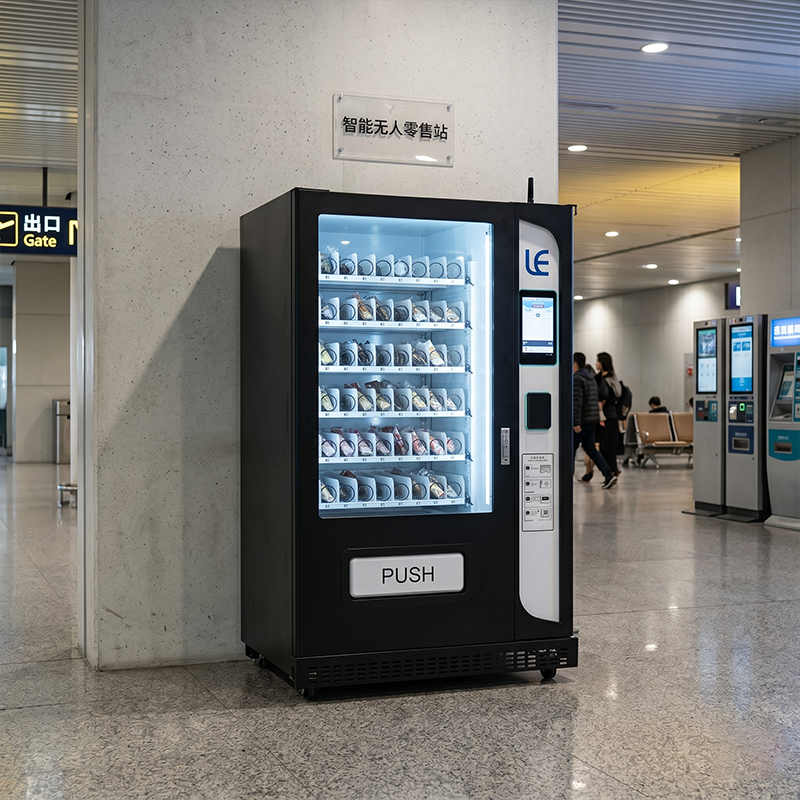
In busy rail stations and airports, retail has to work within tight space limits, irregular traffic peaks, and constant demand from travelers who need quick access to drinks, snacks, and travel essentials. Smart vending machines fit this environment because they combine compact footprints, round-the-clock availability, and data-driven product management in a way traditional shops often cannot. This article explains why train station vending machine deployment has become such an effective retail strategy, from matching passenger flow and dwell time to improving operational efficiency, revenue capture, and service quality in modern transit hubs.
Why Train Station Vending Machines Are a Strategic Retail Channel
The commercial landscape within transit hubs has undergone a structural transformation. Airport terminals and railway concourses are maximizing their yield per square meter by shifting away from low-efficiency retail formats toward automated, high-density solutions. This shift is driven by the unique operational demands of transit infrastructure, where space is at a premium and consumer purchasing windows are highly compressed.
Rather than relying solely on traditional brick-and-mortar convenience stores, facility managers and retail operators are integrating advanced automated dispensing systems. These systems capture lost revenue during off-peak hours while maintaining a minimal physical footprint, creating a highly strategic retail channel tailored specifically for transient demographics.
Passenger flow, dwell time, and 24/7 demand
Passenger flow in major metropolitan transit hubs routinely exceeds 100,000 daily commuters, generating a continuous, 24/7 demand cycle. Unlike traditional retail environments, transit hubs experience highly concentrated micro-peaks in traffic tied to departure schedules. Average dwell times range from 15 to 45 minutes for regional rail, and up to 120 minutes in airport terminals.
This captive audience requires immediate access to refreshments, travel essentials, and electronics regardless of the hour. Automated retail captures this continuous demand cycle, efficiently servicing passengers during late-night or early-morning operational windows when staffing a traditional storefront is logistically and financially unfeasible.
Why transport hubs favor automated retail
Transport authorities strongly favor automated retail because it circumvents the prohibitive overhead associated with staffed storefronts. Commercial leases in prime transit zones are exceptionally expensive, frequently commanding between $150 and $300 per square meter monthly.
By condensing the retail footprint to roughly 1.5 to 2.0 square meters per unit, operators achieve significantly higher revenue density. Furthermore, automated systems eliminate the queueing bottlenecks inherent to staffed registers, allowing hubs to process a higher volume of transactions within the brief 3-to-5-minute purchasing windows typical of rushing commuters.
What Defines a Smart Train Station Vending Machine
Core hardware, software, and payment features
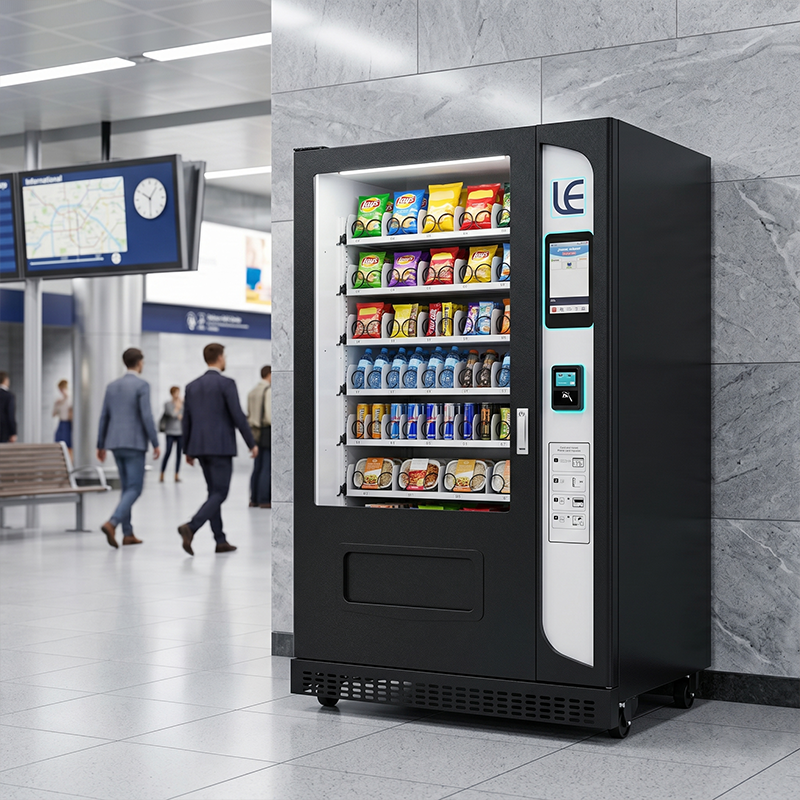
The hardware architecture of smart vending platforms has evolved to prioritize frictionless user experiences. Mechanical keypads have been largely replaced by capacitive touchscreens ranging from 21.5 to 49 inches, offering multi-language support and high-definition product rendering.
Payment gateways are entirely cashless and EMV-compliant, utilizing NFC, RFID, and mobile wallet integrations. These updated payment processors reduce the average transaction time to under 5 seconds, a critical metric for maximizing throughput during peak commuter rushes.
Remote monitoring, dynamic pricing, and inventory visibility
Operational efficiency relies heavily on native cloud connectivity. Telemetry systems, integrated via 4G/5G cellular networks or dedicated station Wi-Fi, provide operators with real-time inventory visibility down to the individual SKU level.
This continuous data stream enables dynamic pricing models, allowing operators to autonomously adjust pricing based on time of day, product expiration dates, or supply levels. System diagnostics track machine health continuously, enabling operators to maintain an uptime standard of 99.8% by preemptively dispatching technicians for impending component failures.
Key machine specs for railway use
Railway environments demand rigorous hardware specifications to withstand continuous public use and potential vandalism. Critical structural requirements include a reinforced steel chassis and 8mm tempered anti-vandalism glass on all transparent display panels.
Energy efficiency is strictly regulated by transit authorities, requiring modern units to utilize high-efficiency hydrocarbon refrigerants and LED lighting, keeping daily power consumption strictly below 3.5 kWh.
| Specification | Legacy Vending Equipment | Smart Transit Vending |
|---|---|---|
| Power Consumption | > 6.0 kWh / day | < 3.5 kWh / day |
| Payment Processing | Coin / Bill (15-20 sec) | NFC / EMV (< 5 sec) |
| Display Protection | 4mm standard acrylic | 8mm tempered glass |
| Telemetry | None / Aftermarket Retrofit | Native Cloud API |
Why Smart Vending Machines Perform Well in Railway Stations
The financial and operational performance of automated retail in transit nodes consistently outpaces legacy formats. When evaluated strictly on capital efficiency and labor overhead, smart machines present a compelling alternative to traditional retail kiosks.
Comparison with staffed kiosks and convenience stores
Traditional staffed kiosks require 2 to 3 full-time equivalent (FTE) employees to maintain extended operating hours, introducing substantial payroll expenses and labor management complexities.
Automated machines eliminate this direct labor overhead entirely, reducing operating expenses by up to 70%. This drastic reduction in fixed costs allows automated units to operate profitably during low-traffic night shifts, capturing revenue that staffed stores inevitably forfeit when they close.
Best product categories for railway stations
Product velocity relies on precise merchandising strategies tailored to the transit demographic. While beverage and snack combinations remain foundational drivers of volume, high-margin categories dictate overall profitability.
Travel adapters, charging cables, and headphones yield gross margins of 40% to 60%. Similarly, over-the-counter pharmaceuticals and personal hygiene products perform exceptionally well. For long-haul commuters, automated fresh food modules dispensing sandwiches and salads maintain a strictly monitored shelf-life of 24 to 72 hours, capturing premium price points.
Comparison criteria for evaluating vending options
Evaluating deployment options requires scrutinizing the footprint-to-capacity ratio and transaction throughput. A premium automated unit occupies less than 2 square meters while holding between 300 and 600 SKUs depending on packaging dimensions.
Operators must benchmark potential hardware against transaction speed and total storage capacity to ensure the machine will not require unprofitable intra-day restocking.
| Metric | Staffed Convenience Kiosk | Smart Vending Array (3 units) |
|---|---|---|
| Footprint Required | 15 – 30 sqm | 4.5 – 6.0 sqm |
| Labor Overhead | $4,000+ / month | $0 (Excluding route driver) |
| Operating Hours | 16 hours / day | 24/7 |
| SKU Capacity | 1,000+ | 900 – 1,800 |
Operational, Compliance, and Logistics Factors for Success
Deploying hardware in high-security, heavily regulated transit infrastructure involves rigorous compliance and logistical planning. Operators must navigate standards established by transit authorities, municipal codes, and international safety organizations to ensure uninterrupted service.
Food safety, payment security, and accessibility
Strict adherence to regulatory frameworks is non-negotiable for public-facing infrastructure. Payment security must comply with PCI-DSS standards to protect consumer financial data during cashless transactions.
Furthermore, physical accessibility mandates, such as the Americans with Disabilities Act (ADA), require all interactive touchpoints and dispensing bins to be positioned within a strict reach range of 15 to 48 inches from the floor. To meet electrical and fire safety standards, any deployed train station vending machine must carry valid CE, UL, or equivalent regional certifications.
Replenishment, cold chain, maintenance, and uptime
Logistics dictate long-term profitability. Route optimization software is essential to determine dynamic replenishment schedules, minimizing driver downtime and vehicle emissions. For perishable goods, strict cold chain integrity must be enforced.
Internal machine temperatures are continuously regulated between 2°C and 4°C. Advanced health-lockout features are mandatory for food safety; if internal temperatures rise above 5°C for more than 15 consecutive minutes, the machine autonomously locks out the affected trays to prevent the sale of compromised goods.
Practical rollout steps for station deployment
Practical rollout requires meticulous site preparation and coordination with station facility managers. Deployments demand dedicated electrical circuits, typically 15A or 20A depending on the region’s 110V/220V standard.
Prior to installation, operators must conduct site surveys to verify cellular signal strength for telemetry systems; in dead zones, such as underground platforms, hardwired Ethernet or specialized high-gain antennas must be installed to guarantee network uptime.
How Operators Should Evaluate Investment Fit
Strategic capital allocation in transit vending requires robust financial modeling. Operators must balance initial capital expenditures against projected transaction volumes and location-specific leasing terms to accurately project profitability.
Traffic, basket size, and location suitability
Investment viability hinges heavily on traffic conversion rates. In a typical rail concourse, a strategically placed machine converts approximately 1.5% to 3.0% of passing foot traffic into paying customers.
Average basket sizes range from $3.50 for standard snacks to over $15.00 for premium electronics and travel accessories. Location suitability is determined by analyzing peak-hour passenger density, proximity to seating areas, and visibility from main thoroughfares or departure gates.
CapEx, leasing, and revenue-share options
The capital expenditure (CapEx) for deploying a commercial-grade train station vending machine typically ranges from $4,500 to $9,000 per unit, heavily dependent on the inclusion of touchscreen interfaces and advanced refrigeration modules.
Transit authorities generally eschew flat-rate leases in favor of revenue-share agreements, capturing 10% to 25% of gross sales as a concession fee. Despite these concession rates, the high volume of automated transactions allows optimized deployments to achieve full return on investment (ROI) within an accelerated timeframe of 8 to 14 months.
Further reading:
Key Takeaways
- The most important conclusions and rationale for train station vending machine
- Specs, compliance, and risk checks worth validating before you commit
- Practical next steps and caveats readers can apply immediately
Frequently Asked Questions
Why are train station vending machines so popular today?
They serve high passenger traffic fast, fit into small spaces, and sell 24/7 when staffed shops are closed.
What products work best in a train station vending machine?
Drinks, snacks, travel essentials, phone accessories, and quick-grab personal care items usually perform best.
How do smart vending machines improve operations in railway stations?
They use remote monitoring, real-time inventory alerts, and fault diagnostics to reduce downtime and refill trips.
What payment methods should a modern station vending machine support?
EMV cards, NFC tap-to-pay, mobile wallets, and contactless transit-friendly payments help speed purchases during rush hours.
Can YL Vending provide machines suitable for railway and airport environments?
Yes, YL Vending offers smart vending solutions with cashless payment, telemetry, and durable designs for high-traffic transit locations.

Post time: Jun-22-2026