

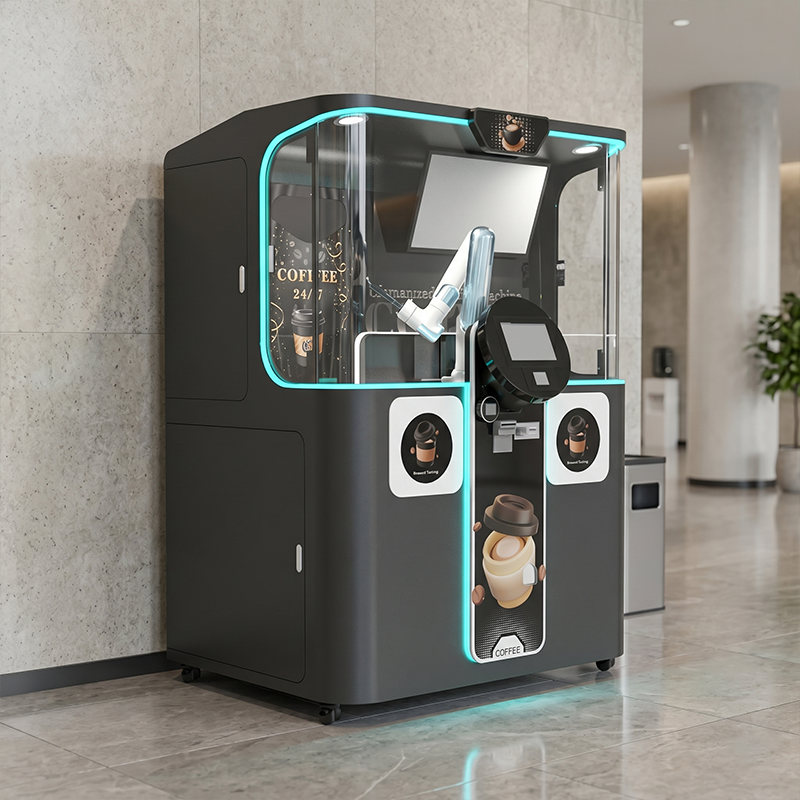
As automated beverage service expands, businesses are looking beyond standard kiosks to systems that fit their space, workflow, and brand. Working with a China-based robot coffee machine manufacturer can make that possible by combining lower production costs with flexible engineering, mature supply chains, and faster scaling. The real advantage is not price alone, but the ability to customize hardware, software, appearance, and performance around specific operating goals. This article explains why China has become a strong source for custom robot coffee solutions, what design options buyers can expect, and how the right manufacturing partner can improve efficiency, consistency, and market appeal.
Why custom robot coffee from China matters
The global transition toward automated food and beverage service has positioned robotic coffee kiosks as highly lucrative assets for retail and hospitality sectors. Sourcing a custom robot coffee machine from China offers buyers a distinct competitive advantage, combining advanced automation technology with highly mature, scalable manufacturing ecosystems. By leveraging established supply chains, businesses can often reduce hardware capital expenditures by 30% to 50% compared to Western alternatives while retaining total control over the kiosk’s aesthetic and functional design.
Choosing to partner with a specialized manufacturer allows operators to bypass rigid, off-the-shelf constraints. Instead, buyers can engineer solutions that align perfectly with their specific spatial requirements, software ecosystems, and target demographics.
Labor savings, service speed, and brand impact
The primary drivers for adopting automated coffee solutions are mitigating labor shortages and accelerating service speed. A standard dual-arm robotic barista can seamlessly produce 50 to 60 cups per hour, operating 24/7 without the overhead associated with shift scheduling, training, or employee turnover. This relentless consistency ensures that every beverage meets exact flavor profiles and temperature specifications.
Beyond operational efficiency, customized robotic kiosks serve as powerful marketing tools. The visual theater of a robotic arm grinding, tamping, and pouring espresso draws significant foot traffic. When a machine is custom-designed with proprietary branding, dynamic LED displays, and unique chassis architectures, it transforms a simple transaction into an engaging brand experience.
Best-fit business cases
Custom robotic coffee machines deliver the highest return on investment in high-footfall, transient environments where speed and convenience are paramount. Airports, university campuses, hospital cafeterias, and corporate lobbies represent ideal deployment scenarios. Because these kiosks typically require a compact footprint of just 2.5 to 4.0 square meters, operators can monetize underutilized real estate without the heavy infrastructure costs of a traditional brick-and-mortar cafe.
Additionally, automated kiosks are highly effective for event-based businesses or pop-up retail strategies. Their modular designs allow for relatively straightforward relocation, meaning operators can shift their assets to capture seasonal demand or service temporary exhibitions.
What to define before choosing a robot coffee machine
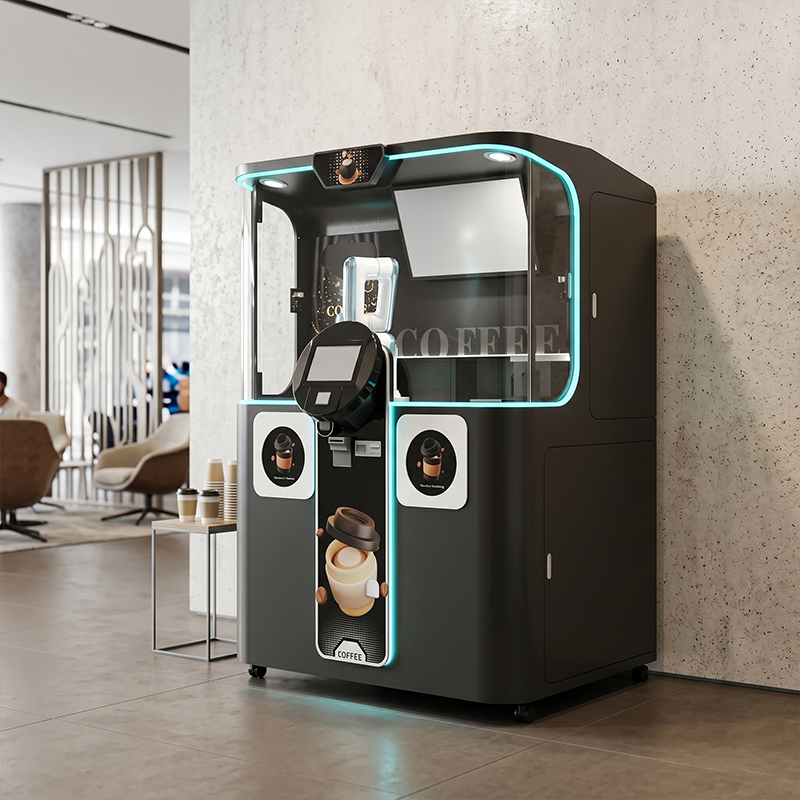
Before engaging a Chinese manufacturer for a custom build, procurement teams must establish a comprehensive set of operational parameters. A loosely defined scope often leads to engineering delays, cost overruns, and hardware that fails to meet user expectations. Precision in the planning phase ensures that the final product will integrate smoothly into the intended business environment.
Product and use-case requirements
The foundation of any custom build is the beverage menu and the anticipated daily volume. Buyers must determine the complexity of the drink offerings: will the machine serve only basic espressos and Americanos, or will it require dual milk systems, syrup dispensers for 10 to 15 flavored lattes, and integrated ice makers for cold beverages?
Use-case requirements also dictate consumable capacities. Operators must specify the sizes of cups accommodated (e.g., standard 8oz, 12oz, and 16oz dimensions) and the required storage capacities for coffee beans, milk, water, and waste. High-volume locations demand larger internal hoppers to prevent the machine from requiring manual restocking more than once per day.
Technical specifications and customization limits
Technical specifications form the core of the manufacturing blueprint. Buyers must define the payload capacity and reach of the robotic arms—typically ranging from 3kg to 5kg payloads to safely handle full cups and portafilters. Furthermore, integration capabilities are critical; the kiosk’s internal computer must feature robust APIs to connect seamlessly with local POS systems, mobile ordering applications, and remote telemetry dashboards.
Customization limits are generally dictated by physical dimensions and safety regulations. While Chinese OEMs can modify chassis shapes and user interface screens, altering the core mechanics of the brewing module or the robotic arm’s primary axes may require extensive re-engineering. Buyers should review available product lines to understand baseline architectures before proposing radical structural changes.
Evaluation criteria and comparison table
To navigate the design phase effectively, buyers should utilize a structured evaluation framework to weigh the benefits of deep customization against standard configurations.
| Feature / Metric | Standard Off-the-Shelf Kiosk | Custom Designed Kiosk |
|---|---|---|
| Development Lead Time | 2 to 4 weeks | 8 to 14 weeks |
| Upfront Engineering Cost | None | $5,000 – $20,000+ (NRE) |
| Brand Integration | Basic vinyl wraps, UI logos | Bespoke chassis, custom lighting, tailored UI |
| Hardware Flexibility | Fixed menu and cup sizes | Scalable hoppers, custom syrup/ice modules |
| Software API Access | Closed or limited | Fully open for custom POS/App integration |
This matrix highlights the trade-offs: while custom designs require higher initial Non-Recurring Engineering (NRE) costs and longer timelines, they offer unparalleled alignment with specific enterprise requirements.
How to evaluate Chinese manufacturers
Vetting a manufacturing partner in China is a critical step that requires moving beyond initial sales pitches to assess actual production capabilities. The ideal partner will demonstrate a balance of mechanical engineering expertise, software integration experience, and a transparent approach to supply chain management.
Cost, supply chain, and prototyping advantages
One of the primary advantages of utilizing a Chinese manufacturer is the rapid prototyping cycle and flexible supply chain. An experienced OEM can often transition from CAD drawings to a fully functional customized prototype in just 45 to 60 days. This speed is driven by localized access to essential components, including servo motors, sensors, and sheet metal fabrication facilities.
Furthermore, Chinese manufacturers frequently offer highly competitive Minimum Order Quantities (MOQs). While Western manufacturers might require commitments of 20 to 50 units for a custom run, many agile Chinese factories will accept MOQs as low as 1 to 5 units, allowing buyers to execute cost-effective pilot programs before scaling up operations.
Quality, IP, and communication risks
Despite the advantages, sourcing custom robotics carries inherent risks regarding quality consistency and intellectual property (IP). Buyers must implement strict Non-Disclosure, Non-Use, and Non-Circumvention (NNN) agreements enforceable under Chinese law before sharing proprietary designs or software algorithms.
Communication barriers can also pose challenges during complex engineering projects. Time zone differences and language nuances require diligent project management. To mitigate these risks, buyers should ensure the manufacturer assigns a dedicated, fluent project manager and utilizes collaborative, cloud-based tracking tools to document every hardware revision and software update.
Supplier comparison matrix
Categorizing potential suppliers helps procurement teams align their project needs with the right factory capabilities. Not all manufacturers are equipped to handle deep software customization or bespoke mechanical engineering.
| Supplier Tier | Production Capacity | Prototyping Speed | Best Suited For |
|---|---|---|---|
| Tier 1: Enterprise Robotics OEMs | 500+ units/month | 60 – 90 days | Large corporate rollouts requiring extensive R&D and global certifications. |
| Tier 2: Specialized Vending Assemblers | 50 – 200 units/month | 40 – 60 days | Mid-sized operators needing moderate customization (chassis, UI, payment integration). |
| Tier 3: Trading Companies | Outsourced | Highly Variable | Buyers seeking standard machines with minimal cosmetic branding; not recommended for deep custom builds. |
Selecting a Tier 2 specialized manufacturer often provides the best balance of dedicated engineering support and cost-efficiency for custom coffee robot projects.
How to assess compliance, quality control, and delivery
A customized robotic coffee machine is only viable if it meets the stringent regulatory standards of the destination country and can be reliably maintained over its lifespan. Quality control cannot be an afterthought; it must be integrated into every phase of the manufacturing and delivery process.
Certifications and food-contact standards
Because these machines process consumables, adherence to international food safety and electrical standards is mandatory. Buyers must ensure the manufacturer can provide or achieve certifications such as CE for Europe, or UL and NSF standards for the North American market.
Food-contact materials require rigorous documentation. All internal tubing, brewing chambers, and nozzles must utilize food-grade materials, such as 304 or 316-grade stainless steel, and BPA-free plastics. Buyers should request independent laboratory test reports verifying that the customized fluid pathways comply with FDA or equivalent local health authority regulations.
Factory audits, FAT, SAT, and spare parts
Before any custom unit leaves the factory, it must undergo a comprehensive Factory Acceptance Test (FAT). This should include a continuous run-time test—often spanning 48 to 72 hours—to ensure the robotic arms and brewing modules achieve a 99.5% uptime under simulated peak-load conditions. Once delivered, a Site Acceptance Test (SAT) verifies that the machine survived transit and integrates properly with local utilities and networks.
Proactive maintenance planning is equally vital. Buyers must negotiate a comprehensive spare parts package alongside the machine purchase. Securing a 2-to-3-year supply of high-wear components, such as custom O-rings, brewing group heads, and specialized sensors, protects the operator from future supply chain disruptions or discontinued parts.
Packaging, shipping, installation, and after-sales support
The logistics of transporting heavy, sensitive robotics require specialized export packaging, typically utilizing ISPM 15 certified wooden crates with internal shock-absorption mounting. Depending on the destination, sea freight shipping times generally range from 25 to 40 days, which must be factored into the project timeline.
Post-delivery, after-sales support dictates the long-term success of the deployment. Buyers should contact their supplier to establish Service Level Agreements (SLAs) that include Over-The-Air (OTA) software updates, remote diagnostic capabilities, and clear protocols for hardware troubleshooting. A manufacturer’s ability to diagnose a sensor fault remotely can save thousands of dollars in unnecessary technician dispatch costs.
How to make the final purchase decision
The final stage of procuring a custom robot coffee machine involves synthesizing technical data, financial projections, and operational readiness into a concrete purchasing strategy. This phase transitions the project from theoretical design to actionable deployment.
RFQ process and pilot testing
A well-structured Request for Quotation (RFQ) is the cornerstone of a successful purchase. The RFQ should detail every custom requirement, from the 5kg payload specs of the robotic arm to the specific API documentation required for the POS system. By demanding itemized pricing for hardware, software licensing, and NRE costs, buyers can accurately compare bids across multiple manufacturers.
Before committing to a multi-unit rollout, executing a pilot test is highly recommended. Purchasing a single, fully customized unit and operating it in a live or controlled environment for 60 to 90 days allows operators to track the Mean Time Between Failures (MTBF). An acceptable commercial standard is an MTBF exceeding 5,000 hours. This pilot phase highlights any necessary adjustments to the user interface, drink recipes, or maintenance schedules before scaling.
Executive decision criteria
For executive stakeholders, the final decision rests on a comprehensive Total Cost of Ownership (TCO) analysis spanning a typical 5-to-7-year asset lifecycle. This calculation must include the landed cost of the hardware, ongoing software licensing fees (which can range from $100 to $300 per month depending on telemetry features), preventative maintenance labor, and consumable costs.
Ultimately, choosing the right Chinese manufacturer for a custom robot coffee machine is a strategic partnership. The selected vendor must not only demonstrate the engineering acumen to build the machine but also possess the financial stability and customer service infrastructure to support the operator’s long-term growth objectives.
Further reading:
Key Takeaways
- The most important conclusions and rationale for custom robot coffee China
- Specs, compliance, and risk checks worth validating before you commit
- Practical next steps and caveats readers can apply immediately
Frequently Asked Questions
Why choose a China manufacturer for a custom robot coffee machine?
China manufacturers often offer 30%–50% lower hardware costs, faster scaling, and flexible OEM design options while maintaining reliable automation quality.
What should I define before requesting a custom robot coffee kiosk?
Set your drink menu, daily cup volume, cup sizes, footprint, payment/POS needs, and required storage for beans, milk, water, and waste.
Which locations are best for deploying a custom robot coffee kiosk?
High-footfall spaces like airports, campuses, hospitals, corporate lobbies, and event venues usually deliver the best ROI and fastest service demand.
Can YL Vending support branding and system integration?
Yes. Through ylvending.com, buyers can explore custom chassis design, branded displays, and API-ready integration for POS, mobile ordering, and remote monitoring.
How long does a custom robot coffee machine project usually take?
Standard units may take 2–4 weeks, while custom designs typically need about 8–14 weeks depending on engineering scope and feature complexity.
Kely
Post time: Jun-15-2026